
Years
1989 in History
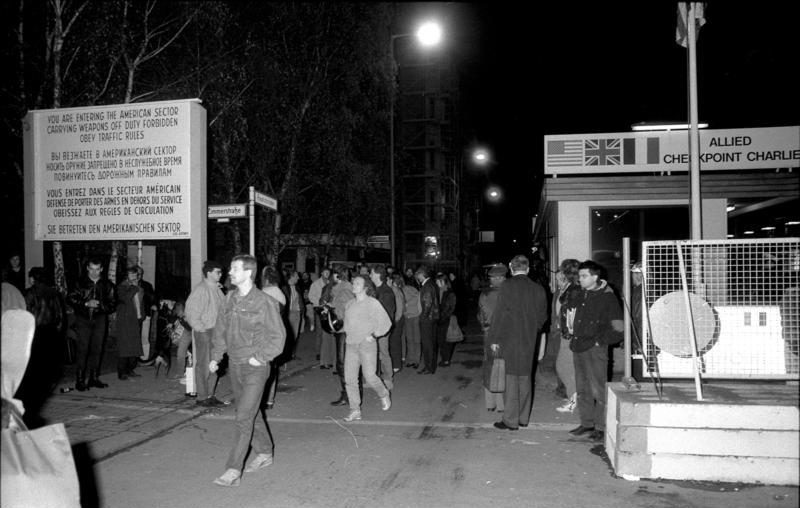
1989 is remembered for the night of 9 November, when an East German official's improvised answer — 'immediately' — opened the Berlin Wall and the Cold War's most famous barrier fell in a single night. Around it, Soviet troops left Afghanistan, Beijing crushed the Tiananmen protests, the Exxon Valdez spilled its oil in Alaska, and Czechoslovakia's Velvet Revolution made a playwright president.
At a Glance
- Defining event
- The Berlin Wall opens, 9 November; the Brandenburg Gate is formally reopened 22 December
- Withdrawals
- The Soviet Union withdraws its last troops from Afghanistan, 15 February
- Disaster
- Exxon Valdez grounds on Bligh Reef, 24 March, spilling an estimated 11 million gallons of crude oil
- Crackdown
- Chinese troops clear the Tiananmen Square protests, night of 3–4 June
- Revolution
- The Velvet Revolution begins in Prague, 17 November; Václav Havel is elected president 29 December
- Culture
- Nintendo launches the Game Boy in North America; The Simpsons airs its first full episode
The defining story: the night the Wall fell
By the autumn of 1989 the German Democratic Republic was haemorrhaging its own people. Hungary had cut its border fence with Austria in the summer, and thousands of East Germans escaped westward through it; thousands more camped in West German embassies in Prague and Warsaw demanding exit. At home, Monday demonstrations in Leipzig grew from thousands to hundreds of thousands, chanting 'Wir sind das Volk' — we are the people. The regime replaced its leader but not its logic, and on 9 November, at a press conference, an official announced new travel rules and, asked when they took effect, improvised the answer that ended the Wall: immediately.
Crowds gathered at the checkpoints, and at Bornholmer Straße the border guards, overwhelmed and without orders, opened the barrier without checking a single document. The Wall did not fall that night in the physical sense — almost nobody demolished anything on 9 November; what fell was its function, because once the crossing opened the border existed only as concrete, and the hammers came days later. Six weeks afterwards, on 22 December, the Brandenburg Gate — sealed inside the Wall's death strip since 1961 — was formally reopened, as Chancellor Helmut Kohl walked through its central arch to meet East German Prime Minister Hans Modrow. The arch he used had been reserved, by protocol, for members of the Prussian royal family alone.
The Wall's fall was the crest of a year that had been dismantling the postwar order for months. On 15 February the Soviet Union withdrew its last troops from Afghanistan, ending the occupation that had begun in 1979. In Beijing the direction was reversed: students raised a Goddess of Democracy statue in Tiananmen Square on 30 May, and on the night of 3–4 June Chinese troops moved into the centre of the capital to clear the protests. Ayatollah Khomeini, who had issued a fatwa against Salman Rushdie in February, died on 3 June. In Prague a student march beaten by riot police on 17 November ignited the Velvet Revolution, and on 29 December the playwright and former dissident Václav Havel was elected president of Czechoslovakia.
The year's other register was disaster and its lessons. Just after midnight on 24 March the supertanker Exxon Valdez, outward bound from Alaska with some 53 million gallons of crude oil, ran aground on Bligh Reef in Prince William Sound; within hours an estimated 11 million gallons had poured into the sea, a spill that prompted the United States Oil Pollution Act of 1990. In Sheffield on 15 April a crush at Hillsborough Stadium killed 97 Liverpool football fans, with police failures later blamed. Between the disasters, ordinary life kept inventing itself: Nintendo launched the Game Boy in North America on 31 July, and on 17 December The Simpsons aired its first full episode.
Timeline of 1989
- 7 January
Emperor Hirohito of Japan dies after a 62-year reign; his son Akihito succeeds him, beginning the Heisei era.
- 14 February
Ayatollah Khomeini issues a fatwa calling for the death of Salman Rushdie, author of The Satanic Verses.
- 15 February
The Soviet Union withdraws its last troops from Afghanistan, ending an occupation that began in 1979.
- 24 March
The Exxon Valdez grounds on Bligh Reef in Prince William Sound, Alaska, spilling an estimated 11 million gallons of crude oil.
- 15 April
A crush at Hillsborough Stadium in Sheffield kills 97 Liverpool football fans.
- 30 May
Protesting students raise the Goddess of Democracy statue in Tiananmen Square, Beijing.
- 3 June
Chinese troops move into central Beijing to clear the Tiananmen Square protests, in a crackdown beginning on the night of 3–4 June.
- 31 July
Nintendo launches the Game Boy in North America, the handheld console that would sell more than 118 million units.
- 17 October
The Loma Prieta earthquake, magnitude 6.9, strikes the San Francisco Bay Area during the World Series, killing 63 people.
- 9 November
The Berlin Wall opens as crowds pour through the checkpoints after an official's improvised 'immediately'.
- 17 November
A student march in Prague is beaten by riot police, igniting the Velvet Revolution in Czechoslovakia.
- 22 December
The Brandenburg Gate in Berlin is formally reopened, 28 years after the Wall sealed it off.
- 29 December
Playwright and former dissident Václav Havel is elected president of Czechoslovakia.
Why 1989 still matters
1989 ended the Cold War's European order without the war everyone had feared. The alliances built in the 1940s, the wall built in 1961 and the doctrine that no satellite could leave Moscow's orbit all dissolved within months, mostly at the pressure of crowds chanting in Leipzig and Prague rather than armies. The contrast with Beijing, where the same season's protests were cleared by troops, fixed the year's double lesson: communist rule in Europe fell when its rulers would no longer shoot, and survived in China because its rulers would. Havel's election — a playwright imprisoned by the state he now led — remains the purest symbol of the peaceful path.
The environmental reckoning was just as durable. The Exxon Valdez spill in Prince William Sound produced the Oil Pollution Act of 1990 and changed how tankers are built and escorted, while Hillsborough began a thirty-year argument about stadium safety and official truth that ended with police failures formally blamed. Even the Soviet withdrawal from Afghanistan, completed in February, set up the vacuum from which much of the next decades' turmoil grew.
And in December the Wall's own gate finished the story the checkpoints had begun: Kohl walking through the Brandenburg Gate's royal arch, with the Quadriga above him that Napoleon had once carted to Paris. German reunification followed within a year. No year since 1945 had rearranged the map so completely, or so hopefully — which is why 1989 is still the standard against which peaceful revolutions are measured. Samuel Beckett, the Irish playwright of Waiting for Godot and a Nobel laureate in literature, died in Paris on 22 December — the very day the Brandenburg Gate reopened, as if the playwright of waiting had left the stage at the moment Europe's long wait ended.
1989 on The History Trail
Berlin dominates this year on The History Trail, from the Wall's opening night to the Gate's reopening.
- November 9 in History — The Berlin Wall opens after an official's improvised answer of 'immediately'.
- December 22 in History — The Brandenburg Gate is formally reopened as Kohl walks through to meet Modrow.
- March 24 in History — The Exxon Valdez oil spill in Prince William Sound, Alaska.
- November 17 in History — A beaten student march in Prague ignites the Velvet Revolution.
- June 3 in History — Troops move into Beijing to clear the Tiananmen Square protests.
- Neptune — A permanent story page on this site connected with this period.
- Nintendo Switch — A permanent story page tracing the company whose Game Boy launched in 1989.
Sources
- Encyclopaedia Britannica — On This Day: February 14
- Encyclopaedia Britannica — On This Day: February 15
- NOAA Office of Response and Restoration — Exxon Valdez Oil Spill
- HISTORY — This Day in History: March 24
- Encyclopaedia Britannica — On This Day: April 15
- Encyclopaedia Britannica — On This Day: June 3
The facts on this page were checked against these sources on 19 November 2026. The History Trail's permanent pages are researched and written for this site; the live profiles elsewhere on The History Trail are assembled automatically from Wikipedia and Wikidata.
About the Author
Researched and written by the The History Trail Editorial Team — the accountable editorial function behind this site's permanent story pages. The team works from the published sources cited on each page; it does not invent historians, reviewers or credentials, and it corrects errors openly.
Fact Check
Every load-bearing fact on this page traces to one of the sources listed above, and significant claims link to their source in the text. Our checking method is described on the methodology page; errors can be reported via the corrections page.
Sources & Citations
Cite this page as: The History Trail Editorial Team, The History Trail — this article's title, publication and update dates are shown beneath its headline. The full source list appears under Sources above; the site's source standards are on the sources page.