
Years
1990 in History
1990 is remembered for two liberations completed and one crisis begun: Nelson Mandela walked out of prison on 11 February after 27 years, Germany was reunified on 3 October as East Germany acceded to the Federal Republic and ceased to exist, and in August Iraq's invasion of Kuwait opened the first great crisis of the post-Cold War world.
At a Glance
- Defining event
- German reunification, 3 October — the German Democratic Republic accedes to the Federal Republic and ceases to exist
- Release
- Nelson Mandela walks free, 11 February, after 27 years in prison for opposing apartheid
- Crisis
- Iraq invades Kuwait, 2 August; U.S. forces deploy to Saudi Arabia in Operation Desert Shield
- Rights
- Americans with Disabilities Act signed, 26 July, covering some 40 million disabled Americans
- Space
- Hubble Space Telescope deployed into orbit, 25 April; Voyager 1 takes the Pale Blue Dot photograph, 14 February
- Closed the year
- The Channel Tunnel's two halves meet beneath the English Channel, 1 December
The defining story: one Germany again
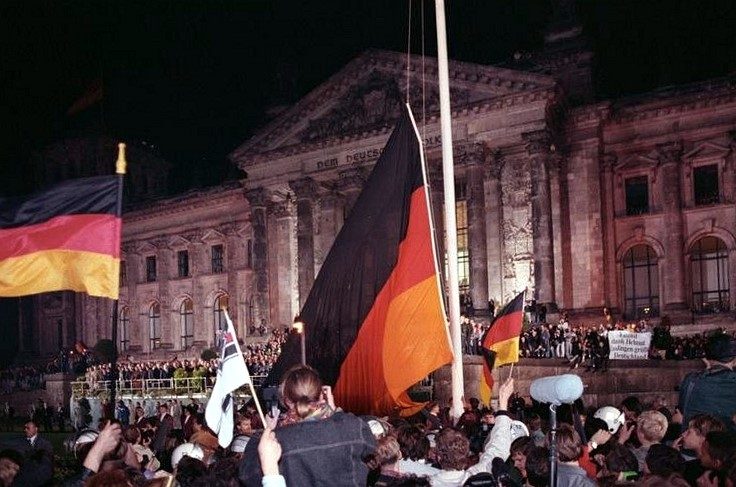
At midnight between 2 and 3 October 1990, the German Democratic Republic simply ceased to exist, and Germany became one country again for the first time since 1945. There was no merger of equals and no new state: under the Unification Treaty the East German state acceded to the Federal Republic of Germany, adopting its constitution, its currency, its laws and its alliances, and its five re-established states became states of the Federal Republic. Crowds celebrated before the Reichstag in Berlin as forty-one years of division ended, less than a year after the Berlin Wall fell. The practical first step had come on 30 June, when East and West Germany merged their economies and adopted a common currency.
The year's other great ending began in South Africa. On 2 February President F. W. de Klerk announced the lifting of the ban on the African National Congress and the coming release of Nelson Mandela. On 11 February Mandela walked through the gates of Victor Verster Prison holding the hand of his wife, Winnie, and raising a clenched fist to the crowds. He was 71, and he had been a prisoner for 27 years — longer than many cheering him had been alive; South African law had banned publishing his image or quoting him, so newspapers had to introduce readers to a face most had never seen. Within four years he was president of a democratic South Africa. On 21 March Namibia became independent from South Africa, with Sam Nujoma sworn in as its first president.
The post-Cold War world's first crisis arrived in the Gulf. Iraq had emerged from its eight-year war with Iran with a huge army, a wrecked economy and enormous debts owed to the Gulf oil monarchies, and through the summer of 1990 Saddam Hussein's government pressed its grievances against Kuwait. In the early hours of 2 August Iraqi armoured divisions rolled into Kuwait, overrunning the country within days; the United Nations Security Council condemned the invasion the same day, Iraq declared Kuwait its 19th province on 8 August, and President George H. W. Bush ordered American forces to Saudi Arabia in Operation Desert Shield on 7 August.
Between those headlines the year quietly rearranged daily life. On 31 January the first McDonald's in the Soviet Union opened in Moscow's Pushkin Square, drawing a queue of some 30,000 people on its first day. On 14 February Voyager 1, some 3.7 billion miles from the Sun, turned its camera homeward and took the Pale Blue Dot photograph of Earth; on 25 April the shuttle Discovery's crew deployed the Hubble Space Telescope into orbit. On 26 July Bush signed the Americans with Disabilities Act, barring discrimination against some 40 million disabled Americans. And on 22 November Margaret Thatcher announced her resignation after eleven years, having failed to win her party's leadership ballot outright.
Timeline of 1990
- 3 January
Manuel Noriega surrenders to United States forces in Panama, days after taking refuge in the Vatican's embassy.
- 31 January
The first McDonald's in the Soviet Union opens in Moscow's Pushkin Square, drawing a queue of some 30,000 people on its first day.
- 11 February
Nelson Mandela is released from prison in South Africa after 27 years.
- 14 February
Voyager 1 turns its camera homeward and takes the Pale Blue Dot photograph of Earth.
- 18 March
Thieves posing as police steal 13 works from the Isabella Stewart Gardner Museum in Boston — still unsolved, America's largest art heist.
- 21 March
Namibia becomes independent from South Africa, with Sam Nujoma sworn in as its first president.
- 25 April
The space shuttle Discovery's crew deploys the Hubble Space Telescope into orbit.
- 30 June
East and West Germany merge their economies, adopting a common currency as the first step to reunification.
- 26 July
President George H. W. Bush signs the Americans with Disabilities Act into law.
- 2 August
Iraq invades Kuwait, overrunning the country within days and triggering the Gulf crisis.
- 15 October
Soviet leader Mikhail Gorbachev is awarded the Nobel Peace Prize for his part in ending the Cold War confrontation.
- 3 October
Germany is reunified as the German Democratic Republic accedes to the Federal Republic and ceases to exist.
- 22 November
Margaret Thatcher announces her resignation as British prime minister after eleven years.
- 1 December
The two halves of the Channel Tunnel meet beneath the English Channel, joining Britain to mainland Europe by land.
Why 1990 still matters
Reunification completed what the crowds of 1989 had begun, and it did so by law rather than by proclamation of a new state — which is why the Federal Republic simply grew while East Germany's flag, anthem, army and legal code vanished overnight. The settlement closed the German question that had caused two world wars, anchored a united Germany inside the Western alliance, and gave Europe the shape it still has. Mandela's release began the negotiated end of apartheid on the same pattern: an old enemy walking free, then talking, then voting — within four years he was president.
The Gulf crisis wrote the post-Cold War rulebook's first page. A vast coalition assembled under United Nations authority to reverse an annexation, American forces deployed to Saudi Arabia within days, and Iraq's declaration of Kuwait as its 19th province was treated as void by the world — a consensus that would be tested, and would fray, in the war that followed in 1991 and again in 2003. Gorbachev's Nobel Peace Prize in October, awarded for ending the Cold War confrontation, marked how completely the superpower contest had already faded.
The year's science left two images that still frame humanity's place: Hubble, deployed in April, would return the deepest views of the universe ever taken, while Voyager's Pale Blue Dot, taken in February from 3.7 billion miles, showed Earth as a mote in a sunbeam. Between a reunified Germany, a free Mandela and a photograph of everyone who ever lived on a pixel, 1990 may be the most hopeful year of the late century — with a war already loading in the Gulf. On 9 December Lech Wałęsa, the Gdańsk shipyard electrician who had led Solidarity, won Poland's presidential election — the first popular vote for a Polish head of state, and another 1989 crowd finding its reward at the ballot box.
1990 on The History Trail
Four featured stories belong to 1990 on The History Trail, from a prison gate in South Africa to a midnight in Berlin.
- February 11 in History — Nelson Mandela is released from prison after 27 years.
- July 26 in History — The Americans with Disabilities Act is signed into law.
- August 2 in History — Iraq invades Kuwait, opening the Gulf crisis.
- October 3 in History — Germany is reunified as East Germany accedes to the Federal Republic.
- December 1 in History — The Channel Tunnel's two halves meet beneath the English Channel.
- January 31 in History — The first McDonald's in the Soviet Union opens in Moscow.
- Microsoft — The software company whose Windows 3.0 won a wide following in 1990.
Sources
- Encyclopaedia Britannica — On This Day: January 31
- Encyclopaedia Britannica — On This Day: February 2
- HISTORY — Nelson Mandela released from prison
- Encyclopaedia Britannica — On This Day: February 14
- Encyclopaedia Britannica — On This Day: March 18
- Encyclopaedia Britannica — On This Day: April 25
The facts on this page were checked against these sources on 19 November 2026. The History Trail's permanent pages are researched and written for this site; the live profiles elsewhere on The History Trail are assembled automatically from Wikipedia and Wikidata.
About the Author
Researched and written by the The History Trail Editorial Team — the accountable editorial function behind this site's permanent story pages. The team works from the published sources cited on each page; it does not invent historians, reviewers or credentials, and it corrects errors openly.
Fact Check
Every load-bearing fact on this page traces to one of the sources listed above, and significant claims link to their source in the text. Our checking method is described on the methodology page; errors can be reported via the corrections page.
Sources & Citations
Cite this page as: The History Trail Editorial Team, The History Trail — this article's title, publication and update dates are shown beneath its headline. The full source list appears under Sources above; the site's source standards are on the sources page.