
On This Day
October 3 in History
On 3 October 1990 Germany became one country again, as the German Democratic Republic acceded to the Federal Republic of Germany and ceased to exist, eleven months after the fall of the Berlin Wall. October 3 is also the day of Alesia's surrender in 52 BC, Britain's first atomic test in 1952 and the acquittal of O. J. Simpson in 1995.
Choose another date: open the On This Day calendar to browse events, births and deaths for any day of the year.
At a Glance
- The date
- 3 October 1990 — now the Day of German Unity, Germany's national day
- What happened
- The German Democratic Republic (East Germany) acceded to the Federal Republic of Germany and ceased to exist
- How it was done
- By the Unification Treaty, under the Federal Republic's existing constitution — an accession, not a merger
- What came before
- The fall of the Berlin Wall on 9 November 1989 and East Germany's first free election in March 1990
- The legal clearance
- The Two Plus Four Treaty with the wartime allies restored full sovereignty to a united Germany
- The capital
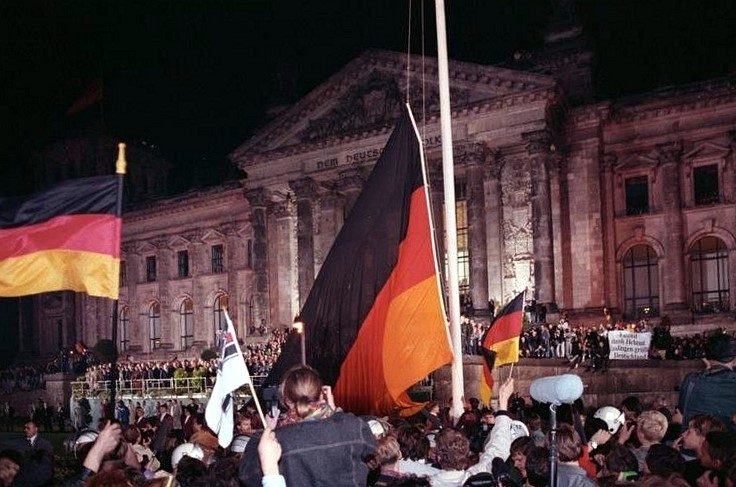
- Berlin, where the flag was raised before the Reichstag at midnight
Events on this day
- 52 BCThe siege of Alesia ends as Vercingetorix surrenders to Julius Caesar, completing Rome's conquest of Gaul.
- 1789George Washington issues the first Thanksgiving proclamation, setting aside 26 November as a day of national thanks.
- 1863Abraham Lincoln proclaims a national Thanksgiving Day, to be held on the last Thursday of November.
- 1929The Kingdom of the Serbs, Croats and Slovenes is renamed the Kingdom of Yugoslavia under King Alexander.
- 1932Iraq becomes independent of Britain, the first League of Nations mandate in the Middle East to gain independence.
- 1935Italy invades Ethiopia, beginning the Second Italo-Ethiopian War and exposing the weakness of the League of Nations.
- 1942A German V-2 rocket makes the first successful flight of a long-range ballistic missile, reaching the edge of space.
- 1952Britain tests its first atomic bomb, Operation Hurricane, detonated aboard HMS Plym off the Montebello Islands, Australia.
- 1960The Andy Griffith Show debuts on American television, beginning its long run in the fictional town of Mayberry.
- 1990East and West Germany are reunified as the German Democratic Republic accedes to the Federal Republic — the featured story above.
- 1995O. J. Simpson is acquitted of the murders of Nicole Brown Simpson and Ronald Goldman after a televised trial that gripped America.
- 2023Kevin McCarthy is voted out as Speaker of the U.S. House of Representatives, the first speaker in American history removed by such a vote.
Born on this day
- 1925Gore Vidal — American novelist and essayist, author of Burr and The City and the Pillar.
- 1938Eddie Cochran — American rock and roll pioneer of Summertime Blues and C'mon Everybody.
- 1941Chubby Checker — American singer whose recording of The Twist launched a worldwide dance craze.
- 1954Stevie Ray Vaughan — American blues guitarist whose playing revived the genre in the 1980s.
- 1962Tommy Lee — American drummer, co-founder of the heavy metal band Mötley Crüe.
- 1969Gwen Stefani — American singer, frontwoman of No Doubt and solo artist.
Died on this day
- 1226Francis of Assisi — Italian friar who founded the Franciscan order and became one of Christianity's most beloved saints.
- 1967Woody Guthrie — American folk singer of This Land Is Your Land, dead after a long illness at 55.
- 2004Janet Leigh — American actress, forever remembered for the shower scene in Hitchcock's Psycho.
- 2005Ronnie Barker — British comedian, one half of The Two Ronnies and Porridge's Fletcher.
The featured story: Germany is reunified, 3 October 1990
At midnight between 2 and 3 October 1990, the German Democratic Republic — East Germany — simply ceased to exist, and Germany became one country again for the first time since 1945. There was no merger of equals and no new state. Under the Unification Treaty, the East German state acceded to the Federal Republic of Germany, adopting its constitution, its currency, its laws and its alliances, and its five re-established states became states of the Federal Republic. In Berlin, before the Reichstag building, the black, red and gold flag was raised over a united capital as fireworks lit the sky, and hundreds of thousands celebrated in the streets.
The speed of it still astonishes. Less than a year earlier, on 9 November 1989, the Berlin Wall had fallen, breached by crowds after a bungled press conference announced that travel rules had changed. Through that winter East Germans voted with their feet and then, in March 1990, at the ballot box, choosing in the East's first free election the parties that promised the fastest route to unity. In July the West German mark replaced the East's currency. In September the wartime allies — the United States, the Soviet Union, Britain and France — signed the Two Plus Four Treaty, formally restoring full sovereignty to a united Germany and clearing the last legal obstacle. Reunification, diplomats had assumed for forty years, was a question for another generation. It took eleven months.
The division it ended had been the central fact of the Cold War in Europe. Defeated in 1945, Germany was split between the Western allies and the Soviet Union, and in 1949 two rival states were founded, each claiming to be the true Germany, each armed and allied against the other. Berlin, deep inside the East, was divided by the Wall from 1961. For twenty-eight years families were separated by concrete and wire, and the city became the likeliest flashpoint for a third world war. That this division ended not with a shot but with a treaty, a flag-raising and a public holiday is one of the great peaceful reversals of modern history.
Unity brought real strains alongside the celebration: East German industry largely collapsed under exposure to the market, millions lost their jobs, and the cost of rebuilding the East ran into the trillions of marks and euros over the following decades, paid for partly by a solidarity tax levied on all Germans. Differences in wealth and outlook between east and west have not entirely disappeared. But the essential fact held. Germany, whole and democratic, took its place in the European Union and NATO, Berlin became the capital again, and 3 October — the Day of German Unity — remains the country's national day, marking the moment the Cold War's front line dissolved into a street party.
Why this date matters
October 3 is a date of endings that became beginnings. Alesia closed Rome's conquest of Gaul; Lincoln's proclamation turned Thanksgiving into a national fixture in the middle of a civil war; Britain joined the nuclear club on it in 1952. But its defining moment came in 1990, when the most dangerous border in the world was abolished by signature rather than by war. A divided country, a divided city and a divided continent were stitched back together in a single midnight, and the date has been Germany's national day ever since — proof that even the most permanent-looking arrangements of history can be renegotiated.
Sources
- Encyclopaedia Britannica — On This Day: October 3
- HISTORY — This Day in History: October 3
- Encyclopaedia Britannica — Kevin McCarthy
- Al Jazeera — Kevin McCarthy Removed as US House Speaker in Unprecedented Vote
The facts on this page were checked against these sources on 19 November 2026. The History Trail's permanent pages are researched and written for this site; the live profiles elsewhere on The History Trail are assembled automatically from Wikipedia and Wikidata.
About the Author
Researched and written by the The History Trail Editorial Team — the accountable editorial function behind this site's permanent story pages. The team works from the published sources cited on each page; it does not invent historians, reviewers or credentials, and it corrects errors openly.
Fact Check
Every load-bearing fact on this page traces to one of the sources listed above, and significant claims link to their source in the text. Our checking method is described on the methodology page; errors can be reported via the corrections page.
Sources & Citations
Cite this page as: The History Trail Editorial Team, The History Trail — this article's title, publication and update dates are shown beneath its headline. The full source list appears under Sources above; the site's source standards are on the sources page.