
On This Day
October 4 in History
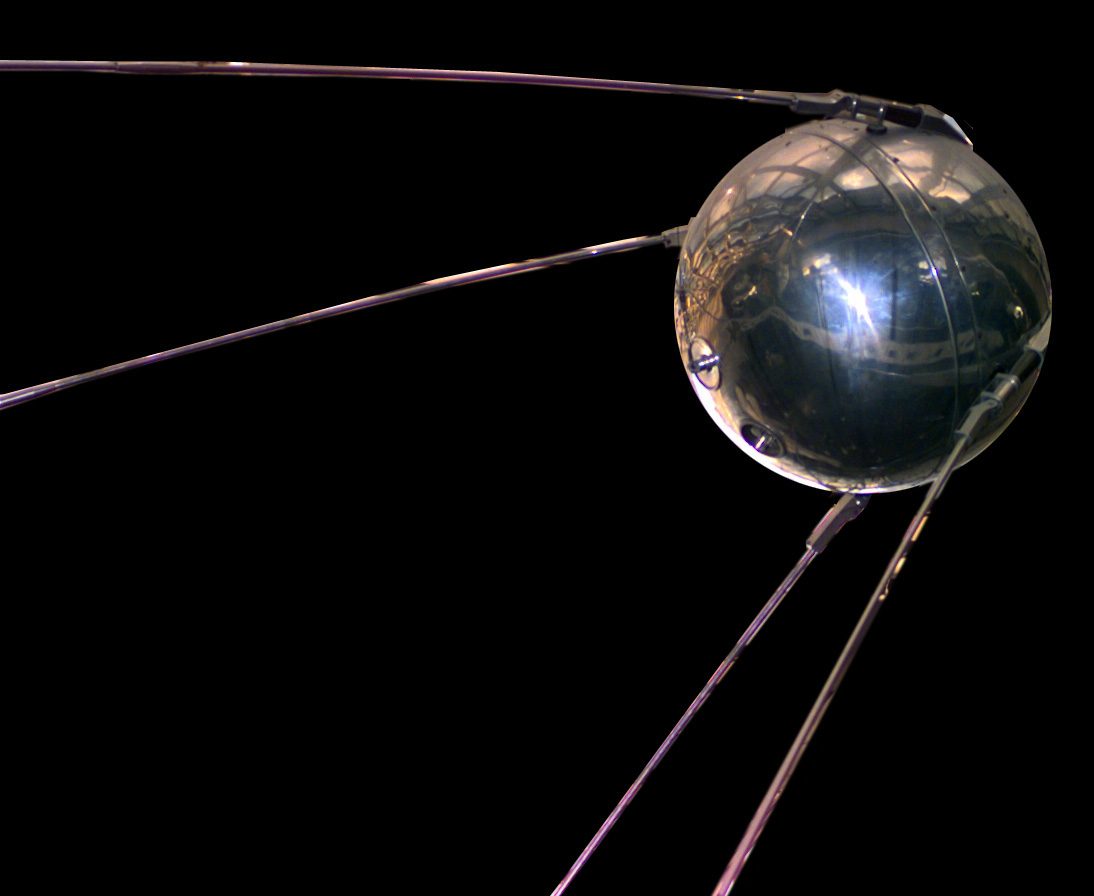
On 4 October 1957 the Soviet Union launched Sputnik 1, a polished sphere just 58 centimetres wide, into orbit — the first artificial satellite, whose radio beeps announced the Space Age and triggered the creation of NASA. October 4 is also the day the Gregorian calendar began in 1582 and Mount Rushmore was started in 1927.
Choose another date: open the On This Day calendar to browse events, births and deaths for any day of the year.
At a Glance
- Launched
- 4 October 1957, from the Baikonur Cosmodrome, by an R-7 rocket
- The satellite
- A sphere 58 centimetres across weighing 83.6 kilograms (184 pounds)
- Its orbit
- One circuit of the Earth roughly every 96 minutes
- Its signal
- A radio beep-beep audible to amateurs worldwide until the batteries failed on 26 October 1957
- Its end
- Burned up on re-entry, 4 January 1958
- The designer
- Sergei Korolev, the Soviet Union's secret 'chief designer'
- The consequence
- The 'Sputnik crisis' in the United States, and the creation of NASA in 1958
Events on this day
- 1582The Gregorian calendar is introduced in Italy, Poland, Portugal and Spain: Thursday 4 October is followed directly by Friday 15 October.
- 1824Mexico adopts a constitution as a federal republic, with Guadalupe Victoria as its first president.
- 1883The Orient Express makes its first run, from Paris towards Constantinople by way of Munich and Vienna.
- 1910Revolution in Lisbon overthrows the Portuguese monarchy; a republic is proclaimed the following day.
- 1927Sculptor Gutzon Borglum begins carving Mount Rushmore in South Dakota, a project that will take fourteen years.
- 1957The Soviet Union launches Sputnik 1, the first artificial satellite — the featured story above.
- 1958BOAC begins the first transatlantic commercial jet service, flying Comet 4 airliners between London and New York.
- 1966Lesotho becomes independent of Britain, one of the last African colonies to gain its freedom in the 1960s.
- 2004SpaceShipOne makes its second flight in a week to win the $10 million Ansari X Prize for private spaceflight.
- 2006WikiLeaks is launched, the website that would become famous for publishing leaked documents.
Born on this day
- 1289Louis X — king of France, whose brief reign saw the last great famine of medieval Europe begin.
- 1472Lucas Cranach the Elder — German Renaissance painter and printmaker, court artist to the electors of Saxony.
- 1822Rutherford B. Hayes — 19th president of the United States, whose disputed election ended Reconstruction.
- 1895Buster Keaton — American comic actor and director, the deadpan genius of The General.
- 1923Charlton Heston — American actor of Ben-Hur and The Ten Commandments, later president of the National Rifle Association.
- 1976Alicia Silverstone — American actress who became a star with Clueless.
Died on this day
- 1582Teresa of Ávila — Spanish mystic and reformer of the Carmelite order, later canonised and made a Doctor of the Church.
- 1669Rembrandt van Rijn — Dutch master painter and etcher, dead in poverty in Amsterdam at 63.
- 1947Max Planck — German physicist who founded quantum theory and won the Nobel Prize in Physics.
- 1951Henrietta Lacks — American woman whose cancer cells, taken without her knowledge, became the immortal HeLa cell line used in research worldwide.
- 1970Janis Joplin — American rock singer, dead of a heroin overdose in Hollywood at 27.
- 2009Mercedes Sosa — Argentine folk singer, the 'voice of Latin America', exiled under the military junta.
The featured story: Sputnik 1, the first artificial satellite, is launched, 4 October 1957
The object that opened the Space Age was almost absurdly simple: a polished metal sphere, 58 centimetres across and weighing 83.6 kilograms, carrying a radio transmitter and little else. On 4 October 1957 a Soviet R-7 rocket lifted it from the Baikonur Cosmodrome in Kazakhstan and set it circling the Earth once every 96 minutes or so, its transmitter chirping a steady beep-beep that any radio amateur on the planet could pick up as it passed overhead. Sputnik 1 — the name means simply 'fellow traveller' — was the first artificial satellite, and its beeping was heard around the world in every sense.
The launch was the work of Sergei Korolev, the Soviet Union's anonymous 'chief designer', whose R-7 had been built as the world's first intercontinental ballistic missile. That dual purpose was precisely what made Sputnik so unsettling in the West. A rocket that could put a satellite over Washington could put a warhead there too, and the satellite's effortless passage over every country on earth, several times a day, made the point without a word of propaganda. In the United States the news landed as a national shock — the 'Sputnik crisis' — feeding fears that America had fallen behind in science, education and missile technology all at once.
The satellite itself was short-lived. Its batteries ran down after about three weeks, and the beeping stopped on 26 October 1957. The sphere stayed in orbit a little longer, finally burning up as it re-entered the atmosphere on 4 January 1958. But its consequences were anything but brief. The United States answered with a crash programme: the Explorer 1 satellite in January 1958, a new emphasis on science and mathematics teaching, and, on 1 October 1958, the creation of NASA, the civilian space agency that would take Americans to the Moon eleven years later. The space race — the defining technological contest of the Cold War — began with that small sphere.
Sputnik also changed the rules of the sky. No nation protested its overflight, establishing in practice the principle that space above the atmosphere is free for all to cross — a precedent every reconnaissance satellite since has relied upon. Korolev, whose name was a state secret in his lifetime, had intended the satellite partly as a scientific contribution to the International Geophysical Year. It became instead a turning point in world politics: proof, broadcast in beeps, that the Soviet Union could reach anywhere on earth, and the starting gun for humanity's expansion beyond it.
Why this date matters
October 4 is a date on which humanity has repeatedly rearranged its frameworks. In 1582 it rearranged time itself, deleting ten days to fix the calendar we still use. In 1824 Mexico rearranged itself into a republic, in 1910 Portugal did the same, and in 1966 Lesotho joined the nations. And in 1957 the date rearranged the heavens: a beeping sphere crossed every border on earth uninvited and unopposed, and the world understood that a new frontier had opened above it. The calendar reform and the satellite belong together — both were announcements that the old measurements no longer described the world people actually lived in.
Sources
- Encyclopaedia Britannica — On This Day: October 4
- HISTORY — This Day in History: October 4
- NASA — 65 Years Ago: Sputnik Ushers in the Space Age
- Smithsonian National Air and Space Museum — What Was Sputnik?
The facts on this page were checked against these sources on 19 November 2026. The History Trail's permanent pages are researched and written for this site; the live profiles elsewhere on The History Trail are assembled automatically from Wikipedia and Wikidata.
About the Author
Researched and written by the The History Trail Editorial Team — the accountable editorial function behind this site's permanent story pages. The team works from the published sources cited on each page; it does not invent historians, reviewers or credentials, and it corrects errors openly.
Fact Check
Every load-bearing fact on this page traces to one of the sources listed above, and significant claims link to their source in the text. Our checking method is described on the methodology page; errors can be reported via the corrections page.
Sources & Citations
Cite this page as: The History Trail Editorial Team, The History Trail — this article's title, publication and update dates are shown beneath its headline. The full source list appears under Sources above; the site's source standards are on the sources page.