
On This Day
July 26 in History
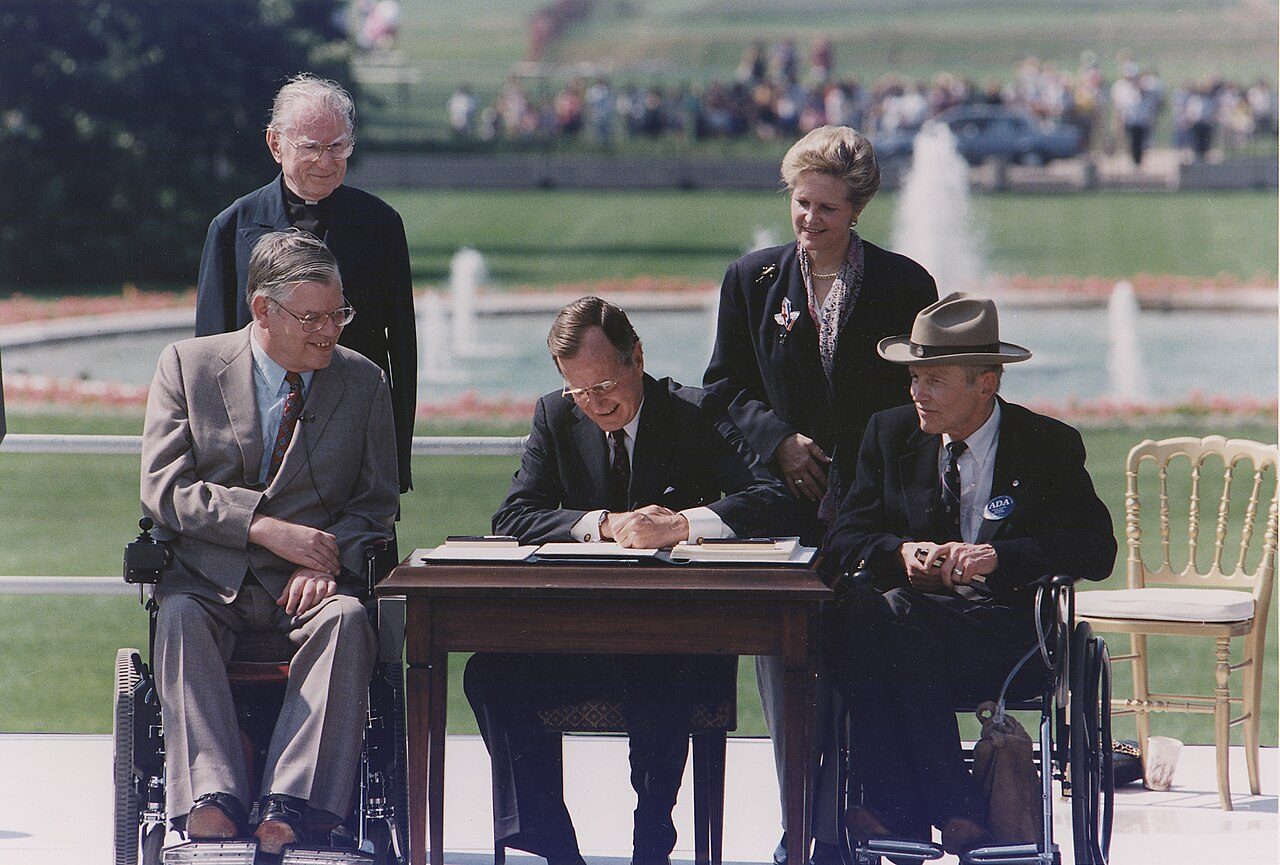
On 26 July 1990 President George H. W. Bush signed the Americans with Disabilities Act on the White House lawn — the most sweeping disability civil rights law yet written, covering jobs, transport, public services and public accommodations for some 40 million Americans. July 26 is also the day Truman desegregated the U.S. military, Nasser seized the Suez Canal, and Castro launched his revolution.
Choose another date: open the On This Day calendar to browse events, births and deaths for any day of the year.
At a Glance
- The signing
- 26 July 1990, South Lawn of the White House — President George H. W. Bush signs Public Law 101-336
- Who it covered
- An estimated 40 million Americans with physical or mental disabilities
- What it barred
- Discrimination in employment, state and local government services, public accommodations, transport and telecommunications
- The road there
- The Capitol Crawl of March 1990, when activists pulled themselves up the Capitol steps; the Senate passed the bill 76–6
- The president's words
- 'Let the shameful wall of exclusion finally come tumbling down'
- The model
- A civil rights act for disabled people, consciously built on the Civil Rights Act of 1964
Events on this day
- 1775The Second Continental Congress establishes a postal system for the united colonies and appoints Benjamin Franklin the first postmaster general — the origin of the U.S. Postal Service.
- 1943Los Angeles suffers its first great smog attack, a 'hellish cloud' that cuts visibility to three blocks and is later traced in part to vehicle exhaust.
- 1947President Truman signs the National Security Act, reorganising the U.S. armed forces and creating the Central Intelligence Agency.
- 1948President Truman signs Executive Order 9981, ordering the desegregation of the United States armed forces.
- 1953Fidel Castro leads an attack on the Moncada Barracks in Santiago de Cuba — a military failure that launches his revolution and gives it its name, the 26th of July Movement.
- 1956Egypt's President Gamal Abdel Nasser nationalises the Suez Canal, seizing the waterway from its British and French owners and triggering the Suez Crisis.
- 1965The Maldives gains independence from Britain, ending a protectorate that had lasted since 1887.
- 1990President George H. W. Bush signs the Americans with Disabilities Act — the featured story above.
- 1999The Kargil War between India and Pakistan over the Kashmir Line of Control officially ends, with India having retaken the heights.
- 2016Hillary Clinton is nominated for president at the Democratic National Convention, the first woman nominated by a major American party.
Born on this day
- 1894Aldous Huxley — English novelist of Brave New World, the defining dystopia of the twentieth century.
- 1939John Howard — Australian Liberal leader who served as prime minister from 1996 to 2007, winning four elections.
- 1943Mick Jagger — English singer and co-founder of the Rolling Stones.
- 1945Helen Mirren — English actress, winner of the Academy Award for The Queen.
- 1956Dorothy Hamill — American figure skater, Olympic champion of 1976 whose haircut set a fashion.
- 1964Sandra Bullock — American actress of Speed, Gravity and an Academy Award for The Blind Side.
- 1980Jacinda Ardern — New Zealand Labour leader who became prime minister at 37 in 2017.
Died on this day
- 1863Sam Houston — soldier and statesman who won Texas its independence and served as president of the Republic of Texas and governor of the state.
- 1952Eva Perón — Argentina's first lady 'Evita', revered by the country's poor, dead of cancer at 33.
- 1971Diane Arbus — American photographer whose portraits of people on society's margins redefined the art, dead by her own hand at 48.
The featured story: the Americans with Disabilities Act is signed, 26 July 1990
On 26 July 1990, on the South Lawn of the White House, before one of the largest signing crowds in the lawn's history, President George H. W. Bush signed the Americans with Disabilities Act. 'Let the shameful wall of exclusion finally come tumbling down,' he said — a Berlin image, eight months after the Wall itself fell, applied to the barriers that kept an estimated 40 million disabled Americans out of jobs, buildings, buses and public life. The White House's own history note records the act's purpose plainly: to ensure that people with disabilities have access to jobs, transportation, public accommodations and communications systems.
The law had been built by activism as much as by legislation. Disability campaigners — organised above all by Patrisha Wright of the Disability Rights Education and Defense Fund, as HISTORY recounts — had pressed through the 1980s for a civil rights act for disabled people on the model of 1964. In March 1990, weeks before the final votes, activists abandoned their wheelchairs at the foot of the Capitol and pulled themselves up its 100 steps in the 'Capitol Crawl', a wordless demonstration of what an inaccessible world means. Congress responded with overwhelming margins: the House passed the bill by unanimous voice vote, the Senate 76 to 6.
The act itself reached into every corner of ordinary life. Its titles barred discrimination in employment, required state and local government services to be accessible, obliged hotels, restaurants, shops and theatres to remove barriers and serve disabled customers, covered transport, and mandated relay services so that deaf people could use the telephone network. It did not hand out benefits; it handed out rights, enforceable in court — which is why its supporters called it, in Bush's phrase at the signing, the world's first comprehensive declaration of equality for people with disabilities.
Its effects compounded over decades. Kerb cuts, ramps, lifts, accessible buses and websites, service animals admitted as of right — the physical texture of American public life, and by example much of the world's, was rebuilt under its pressure, and later laws from Britain's Equality Act to the UN Convention on the Rights of Persons with Disabilities borrowed its architecture. The signing photograph from that July afternoon — the president flanked by campaigners Evan Kemp and Justin Dart, both wheelchair users — remains the movement's defining image: the wall, at least in law, coming down.
Why this date matters
July 26 is disproportionately a day of states rearranging who belongs. A revolutionary congress gives the colonies their own post; a president orders his army to integrate; another creates the CIA; Egypt seizes its canal back; an island nation leaves an empire; and in 1990 the United States writes disabled citizens into its civil rights law in full. Even the day's failed violence fits the pattern — Castro's barracks attack collapses, yet names a movement that takes Cuba within six years. Belonging, and the machinery that grants or denies it, is July 26's recurring subject.
Sources
- Encyclopaedia Britannica — On This Day: July 26
- HISTORY — Americans with Disabilities Act (ADA) signed into law
- The White House (George H. W. Bush Archives) — On this date in White House History, July 26, 1990
- National Archives — Statement by the President on signing the Americans with Disabilities Act, July 26, 1990
- Wikimedia Commons — Bush signs in ADA of 1990.jpg

The facts on this page were checked against these sources on 19 November 2026. The History Trail's permanent pages are researched and written for this site; the live profiles elsewhere on The History Trail are assembled automatically from Wikipedia and Wikidata.
About the Author
Researched and written by the The History Trail Editorial Team — the accountable editorial function behind this site's permanent story pages. The team works from the published sources cited on each page; it does not invent historians, reviewers or credentials, and it corrects errors openly.
Fact Check
Every load-bearing fact on this page traces to one of the sources listed above, and significant claims link to their source in the text. Our checking method is described on the methodology page; errors can be reported via the corrections page.
Sources & Citations
Cite this page as: The History Trail Editorial Team, The History Trail — this article's title, publication and update dates are shown beneath its headline. The full source list appears under Sources above; the site's source standards are on the sources page.