
On This Day
July 27 in History
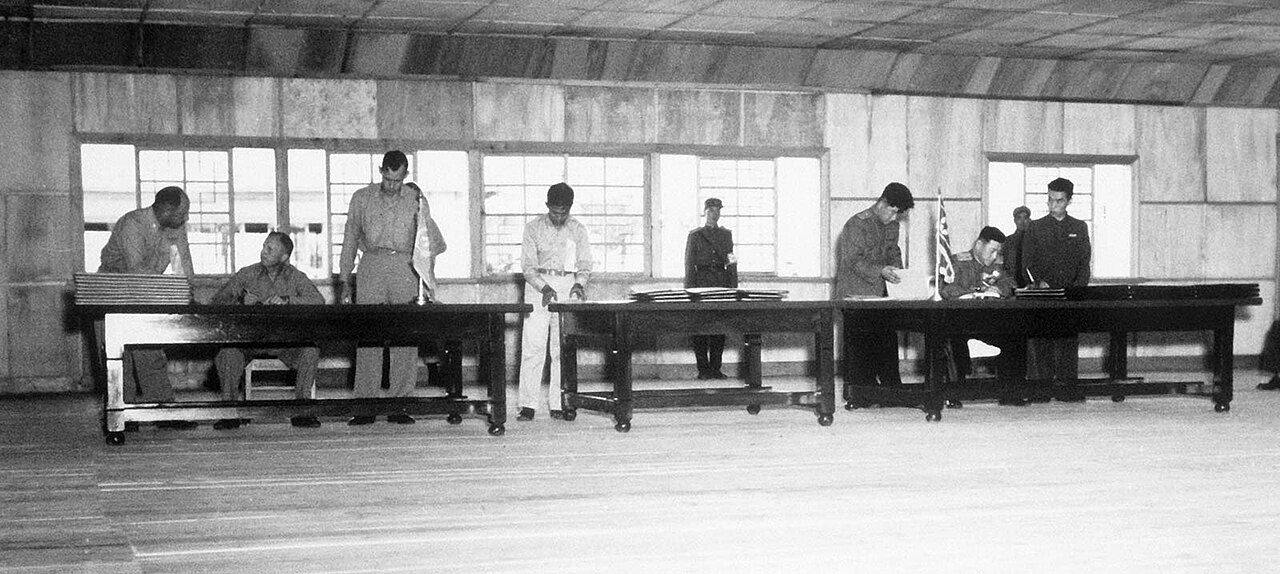
On 27 July 1953, at Panmunjom, generals of the United Nations Command, North Korea and the Chinese volunteers signed the Korean Armistice Agreement — ending three years of fighting, creating the DMZ, and leaving Korea divided to this day. July 27 is also the day the world's first quarantine law was passed in 1377, Robespierre fell in 1794, and Bugs Bunny debuted in 1940.
Choose another date: open the On This Day calendar to browse events, births and deaths for any day of the year.
At a Glance
- The signing
- 10 a.m., 27 July 1953, Panmunjom — Harrison for the UN Command, Nam Il for North Korea and the Chinese People's Volunteers
- The negotiation
- 158 meetings over two years and 17 days — the longest negotiated armistice in history
- The copies
- 18 official copies in Korean, English and Chinese, signed in about ten minutes without a word exchanged
- The line
- A Military Demarcation Line at the last line of contact, with both sides pulling back 2 km to form the DMZ
- The timing
- Signed in the morning, effective at 10 p.m. — the guns fired for twelve more hours
- The catch
- An armistice, not a peace treaty: no nation signed, South Korea refused, and the peninsula remains technically at war
Events on this day
- 1377The Adriatic republic of Ragusa (Dubrovnik) orders arrivals from plague-stricken places to isolate for 30 days — the world's first quarantine law, later extended to the 40 days that give quarantine its name.
- 1794Maximilien Robespierre is arrested in Paris; the coup of 9 Thermidor ends the Reign of Terror, and Robespierre is guillotined the next day.
- 1830The July Revolution begins in Paris as crowds rise against King Charles X's ordinances; within three days he has fled and the 'Citizen King' Louis-Philippe takes the throne.
- 1919The Chicago race riot erupts after a Black teenager, Eugene Williams, is stoned and drowns at a segregated beach; a week of violence leaves 38 dead.
- 1940Bugs Bunny makes his official debut in the Warner Bros. cartoon A Wild Hare, asking Elmer Fudd 'What's up, doc?'
- 1953The Korean War armistice is signed at Panmunjom — the featured story above.
- 1996A pipe bomb explodes in Centennial Olympic Park during the Atlanta Olympics, killing one person directly and injuring 111; the bomber, Eric Rudolph, was caught years later.
Born on this day
- 1768Charlotte Corday — French sympathiser of the Girondins who assassinated Jean-Paul Marat in his bath in 1793 and was guillotined for it.
- 1972Maya Rudolph — American comedian and actress of Saturday Night Live and Bridesmaids.
- 1975Alex Rodriguez — American baseball star, three-time MVP whose career ended under the cloud of a doping suspension.
Died on this day
- 1946Gertrude Stein — American writer and Paris salonnière whose circle shaped modern art and literature, dead at 72.
- 1980Mohammad Reza Pahlavi — the deposed Shah of Iran, dead in exile in Cairo at 60, a year after the revolution that overthrew him.
- 2003Bob Hope — British-born American comedian who entertained audiences, and armies, for most of the twentieth century, dead at 100.
- 2017Sam Shepard — American playwright and actor, Pulitzer winner for Buried Child, dead at 73.
The featured story: the Korean War armistice is signed, 27 July 1953
At ten o'clock on the morning of 27 July 1953, in a pavilion built for the purpose at Panmunjom, two generals sat down at separate tables and signed a war out of existence — or at least into silence. Lieutenant General William K. Harrison Jr. signed for the United Nations Command; General Nam Il signed for the Korean People's Army and the Chinese People's Volunteers. As the National Archives records, they signed 18 official copies of the trilingual agreement 'scarcely acknowledging each other', and it was done in about ten minutes. It was, the Archives notes, the end of the longest negotiated armistice in history: 158 meetings spread over two years and 17 days.
The war they were pausing had begun on 25 June 1950, when North Korea invaded the South. It had drawn in the United States and fifteen other nations under the UN flag, then China in massive numbers that autumn, and it had seesawed the length of the peninsula before settling into two years of static, bloody attrition along roughly the line where it started. The cost was immense — millions of Korean civilians and soldiers dead, some 36,000 Americans, and cities across the North and much of the South reduced to rubble — for a frontier that ended within miles of the 38th parallel where the division had begun.
The armistice was a military document, not a peace. No nation signed it; South Korea's president Syngman Rhee refused to sign at all and had tried to wreck the talks by releasing thousands of prisoners. It fixed a Military Demarcation Line at the last line of contact, pulled both armies back two kilometres to create the four-kilometre-wide Demilitarized Zone, arranged the repatriation of prisoners, and deferred a political settlement to a conference that, when it met at Geneva in 1954, settled nothing. Under the State Department's account of the signing day, the guns kept firing for twelve hours after the signatures — the truce took effect at 10 p.m. — and then, at last, stopped.
They have never formally restarted, and the peace has never formally arrived. The Korean Peninsula remains technically at war, divided at the DMZ, with the armistice machinery — and American troops in the South — still in place more than seventy years on. The document signed in ten silent minutes at Panmunjom is thus one of the most consequential unfinished papers of the modern world: it ended a war, and froze it.
Why this date matters
July 27 is a day for stopping things by decree. Ragusa invents quarantine to stop a plague at its gates; Paris stops a terror by arresting its architect; Atlanta's Olympics are stopped in their tracks by a bomb; and at Panmunjom two generals stop a war with fountain pens, without shaking hands or settling anything. Even the day's lightest entry is a kind of beginning-by-interruption — a cartoon rabbit breaking into a hunter's afternoon with a question. Armistices, quarantines and coups: July 27 is the calendar's day of the enforced pause, and its greatest pause, Korea's, has now lasted more than seventy years.
Sources
- Encyclopaedia Britannica — On This Day: July 27
- HISTORY — What Happened on July 27
- National Archives — Armistice Agreement for the Restoration of the South Korean State (1953)
- U.S. Department of State, Office of the Historian — Foreign Relations of the United States, 1952–1954, Korea: the armistice signing
- Wikimedia Commons — Korean War armistice agreement 1953.jpg

The facts on this page were checked against these sources on 19 November 2026. The History Trail's permanent pages are researched and written for this site; the live profiles elsewhere on The History Trail are assembled automatically from Wikipedia and Wikidata.
About the Author
Researched and written by the The History Trail Editorial Team — the accountable editorial function behind this site's permanent story pages. The team works from the published sources cited on each page; it does not invent historians, reviewers or credentials, and it corrects errors openly.
Fact Check
Every load-bearing fact on this page traces to one of the sources listed above, and significant claims link to their source in the text. Our checking method is described on the methodology page; errors can be reported via the corrections page.
Sources & Citations
Cite this page as: The History Trail Editorial Team, The History Trail — this article's title, publication and update dates are shown beneath its headline. The full source list appears under Sources above; the site's source standards are on the sources page.