
On This Day
July 30 in History
In the first minutes of 30 July 1945 the Japanese submarine I-58 torpedoed USS Indianapolis, which had just delivered the components of the Hiroshima atomic bomb to Tinian. The cruiser sank in twelve minutes; of 1,195 men, only 316 survived four days in shark-infested water. July 30 is also the day Baghdad was founded, Medicare was signed into law, and Jimmy Hoffa disappeared.
Choose another date: open the On This Day calendar to browse events, births and deaths for any day of the year.
At a Glance
- The mission
- A top-secret high-speed run to Tinian delivering the uranium and components of the 'Little Boy' atomic bomb, completed 26 July 1945
- The attack
- Just after midnight, 30 July 1945 — two torpedoes from the Japanese submarine I-58 in the Philippine Sea
- The sinking
- The cruiser capsized and sank in about twelve minutes; some 300 men went down with the ship
- The ordeal
- Roughly 900 men in the water for four days, undiscovered — dying of exposure, thirst and shark attack
- The toll
- 316 survivors of a crew of 1,195 — the greatest single loss of life at sea from one ship in U.S. Navy history
- The wreck
- Found in 2017 by a civilian expedition, resting some 5,500 metres down in the Philippine Sea
Events on this day
- 762The Abbasid caliph al-Mansur founds Baghdad, laying out a perfectly circular city on the Tigris as the capital of his empire.
- 1909French chemist Eugène Schueller founds the company that becomes L'Oréal, two years after developing a safe, successful hair dye.
- 1930Uruguay beats Argentina 4–2 in Montevideo to win the first FIFA World Cup, before a crowd of some 68,000.
- 1945The cruiser USS Indianapolis is torpedoed by a Japanese submarine — the featured story above.
- 1956President Eisenhower signs the law making 'In God We Trust' the official motto of the United States; it begins appearing on paper currency the following year.
- 1965President Lyndon B. Johnson signs the law creating Medicare and Medicaid at the Truman Library in Missouri, enrolling former president Harry Truman as Medicare's first beneficiary.
- 1971Apollo 15 lands on the Moon at the Hadley-Apennine site, the fourth crewed landing and the first to carry a lunar rover.
- 1975Former Teamsters president Jimmy Hoffa vanishes from a restaurant car park in suburban Detroit; he is never seen again and his body is never found.
- 2020NASA launches the Mars 2020 mission, carrying the Perseverance rover and the Ingenuity helicopter toward a February 2021 landing.
Born on this day
- 1818Emily Brontë — English novelist whose single novel, Wuthering Heights, became a cornerstone of English literature.
- 1863Henry Ford — American industrialist whose Model T and moving assembly line put the world on wheels.
- 1898Henry Moore — English sculptor of monumental reclining figures in bronze and stone.
- 1936Buddy Guy — American blues guitarist whose playing shaped Chicago blues and the rock guitarists who followed.
- 1941Paul Anka — Canadian-American singer-songwriter who wrote his first hit, 'Diana', as a teenager.
- 1947Arnold Schwarzenegger — Austrian-American bodybuilder, film star and former governor of California.
Died on this day
- 1898Otto von Bismarck — the 'Iron Chancellor' who unified Germany and dominated European diplomacy for a generation, dead at 83.
- 2007Ingmar Bergman — Swedish director of The Seventh Seal and Persona, dead at 89 on the island of Fårö.
- 2007Michelangelo Antonioni — Italian director of L'Avventura and Blow-Up, dead at 94 in Rome — on the same day as Bergman.
The featured story: the sinking of USS Indianapolis, 30 July 1945
Just after midnight on 30 July 1945, in the Philippine Sea, the American heavy cruiser USS Indianapolis was struck by two torpedoes from the Japanese submarine I-58. She had been sailing unescorted from Guam toward Leyte, on the last leg of the most secret career a ship ever had: days earlier she had raced across the Pacific to deliver the uranium core and components of 'Little Boy', the atomic bomb that would fall on Hiroshima, to the bomber base on Tinian. The cruiser rolled over and sank in about twelve minutes. Of the 1,195 men aboard, some 300 went down with her; roughly 900 found themselves in the open ocean, most without rafts, in kapok life jackets that would stay buoyant for perhaps two days.
What followed is the United States Navy's worst ordeal of survival at sea. No distress signal was received — or none was acted on — and the Navy did not know the ship was missing. For four days the survivors drifted in groups through shark-haunted water, dying of exposure, thirst, salt-water poisoning and shark attack in numbers that have never been exactly counted; the sharks took, by common estimate, scores of men, perhaps more than a hundred. Rescue came by accident on 2 August, when a patrol aircraft spotted the oil slick and the men below. When it ended, 316 of the 1,195 were alive.
The disaster's aftershocks ran for decades. The ship's captain, Charles B. McVay III, was court-martialled for failing to zigzag — the only American captain tried for losing his ship to enemy action in the war — on evidence that included testimony from I-58's commander, Mochitsura Hashimoto, who said a zigzag would have made no difference. Survivors campaigned for fifty years to clear his name; Congress formally exonerated him in 2000, and his record was corrected the following year, three decades after he had taken his own life. In 2017 a civilian expedition found the wreck, eight miles of water down in the Philippine Sea.
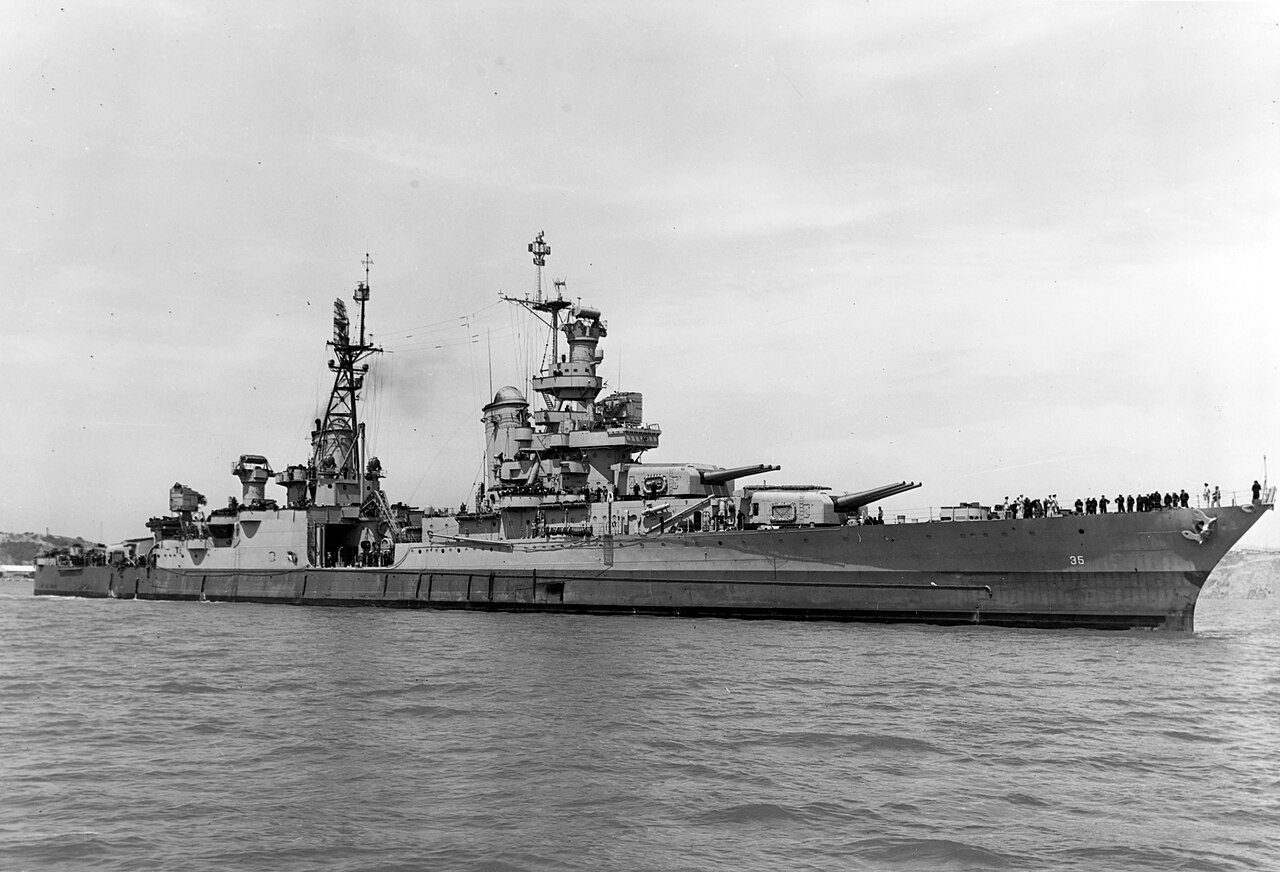
The Indianapolis is remembered because her story compresses the whole war's machinery — the atomic secret, the vast indifferent ocean, the bureaucratic failure, the scapegoat — into four days. The men who died in the water had already, unknowingly, delivered the weapon that ended the war a fortnight later. Their ship's last photograph, taken off Mare Island on 10 July 1945 after her final refit, shows her as she was three weeks before the torpedoes: immaculate, and already sailing into history.
Why this date matters
July 30 is a day of foundings and vanishings. A caliph founds Baghdad; a chemist founds a cosmetics empire; a new World Cup is founded in Montevideo; a health system for the elderly is founded with a signature in Missouri. Against them stand the disappearances: a cruiser and nearly 900 of her crew swallowed by the Pacific and by official silence, a union boss who walks out of a restaurant and out of the world entirely, and two of cinema's greatest directors leaving on the same day in 2007, as if an era had agreed on its exit. Foundings promise permanence; July 30 keeps answering with the sea, the car park and the grave.
Sources
- Encyclopaedia Britannica — On This Day: July 30
- HISTORY — What Happened on July 30
- U.S. Navy — USS Indianapolis (CA 35) at Mare Island, July 1945 (photo gallery)
- Wikimedia Commons — USS Indianapolis (CA-35) off the Mare Island Naval Shipyard, 10 July 1945

The facts on this page were checked against these sources on 19 November 2026. The History Trail's permanent pages are researched and written for this site; the live profiles elsewhere on The History Trail are assembled automatically from Wikipedia and Wikidata.
About the Author
Researched and written by the The History Trail Editorial Team — the accountable editorial function behind this site's permanent story pages. The team works from the published sources cited on each page; it does not invent historians, reviewers or credentials, and it corrects errors openly.
Fact Check
Every load-bearing fact on this page traces to one of the sources listed above, and significant claims link to their source in the text. Our checking method is described on the methodology page; errors can be reported via the corrections page.
Sources & Citations
Cite this page as: The History Trail Editorial Team, The History Trail — this article's title, publication and update dates are shown beneath its headline. The full source list appears under Sources above; the site's source standards are on the sources page.