
On This Day
July 31 in History
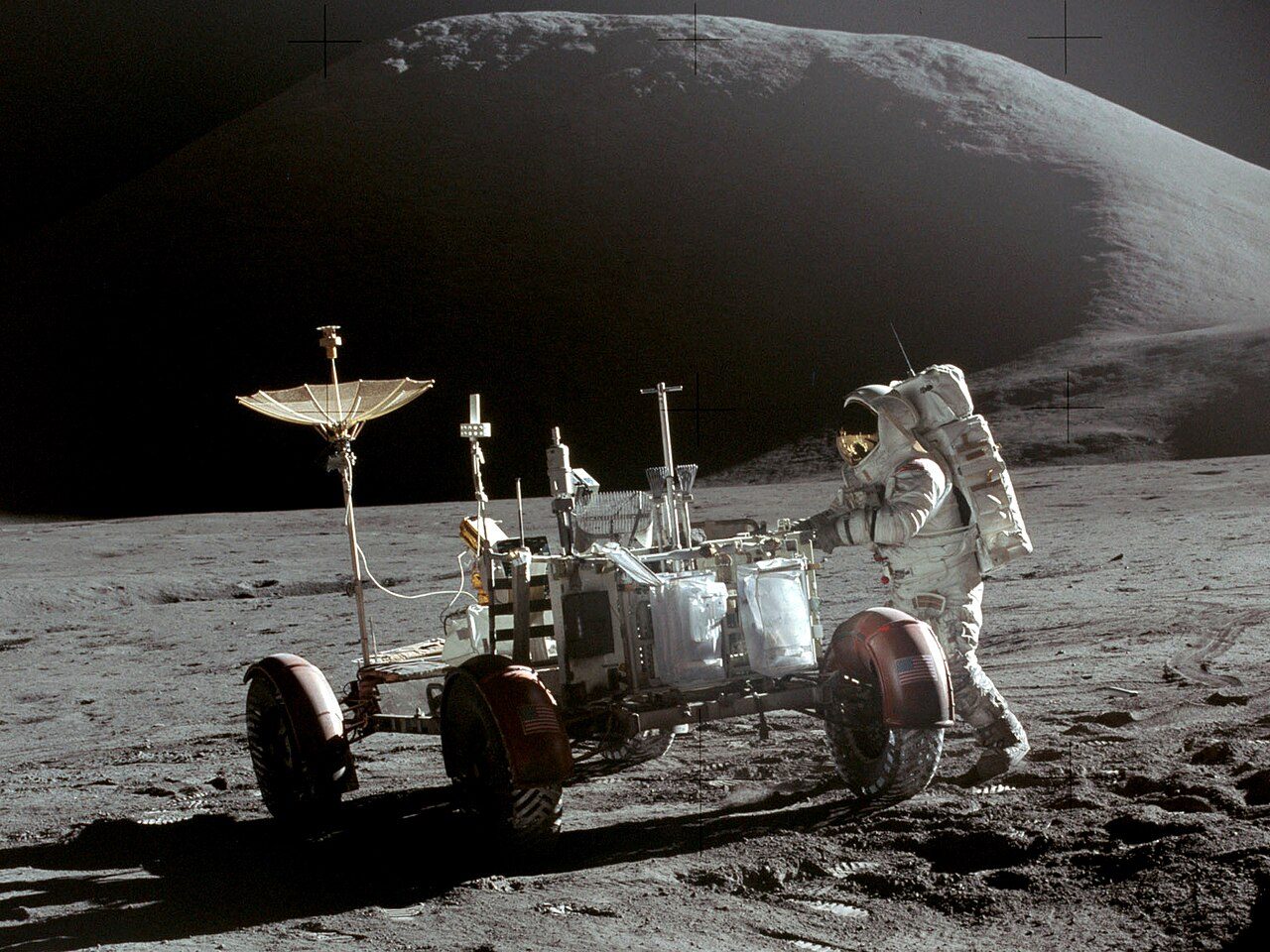
On 31 July 1971 Apollo 15 astronauts David Scott and James Irwin unfolded the Lunar Roving Vehicle on the Moon and drove it for the first time — ranging kilometres from their lander to the rim of Hadley Rille. July 31 is also the day the first U.S. patent was issued, Burns's first book was published, and J. K. Rowling was born.
Choose another date: open the On This Day calendar to browse events, births and deaths for any day of the year.
At a Glance
- The vehicle
- The Lunar Roving Vehicle — a 210 kg battery-electric car, folded flat against the Lunar Module for the journey
- The crew
- Commander David Scott and Lunar Module Pilot James Irwin; Alfred Worden stayed in orbit
- The first drive
- 31 July 1971, during the first Apollo 15 moonwalk at the Hadley-Apennine landing site
- The distance
- About 27.8 km driven across three excursions, in just over three hours of driving
- The prize
- The 'Genesis Rock', a sample of the Moon's original crust more than four billion years old, found at the rille's edge
- The legacy
- Rovers flew on Apollo 15, 16 and 17; all three remain parked on the Moon
Events on this day
- 1667The Treaty of Breda ends the Second Anglo-Dutch War; among the exchanges, the Dutch keep Suriname and England keeps New Netherland — New York.
- 1786Robert Burns's first book, Poems, Chiefly in the Scottish Dialect — the 'Kilmarnock edition' — is published, making his name across Scotland.
- 1790The first United States patent is issued, to Samuel Hopkins of Vermont, for a process of making potash.
- 1964The American probe Ranger 7 transmits the first close-up photographs of the Moon before crashing into it, images a thousand times sharper than any from Earth.
- 1971Apollo 15 astronauts drive the Lunar Roving Vehicle on the Moon for the first time — the featured story above.
- 1989Nintendo launches the Game Boy in North America, the handheld console that would sell more than 118 million units.
- 2012Michael Phelps wins his 19th Olympic medal in London, becoming the most decorated Olympian in history.
Born on this day
- 1912Milton Friedman — American economist, the leading monetarist of the twentieth century and a Nobel laureate.
- 1962Wesley Snipes — American actor of White Men Can't Jump and the Blade films.
- 1965J. K. Rowling — English author of the Harry Potter books, the best-selling series in publishing history.
- 1971Marc Andreessen — American software engineer who co-created the Mosaic and Netscape browsers that opened the web to the public.
Died on this day
- 1556Ignatius of Loyola — Spanish priest who founded the Society of Jesus, the Jesuit order, in 1540.
- 2012Gore Vidal — American novelist, essayist and public intellectual, dead at 86.
- 2019Harold Prince — American theatrical producer and director behind The Phantom of the Opera and Sondheim's great musicals, dead at 91.
The featured story: the first drive on the Moon, 31 July 1971
On 31 July 1971, on a grey plain at the foot of the lunar Apennines, two men unfolded a car. Apollo 15's Lunar Roving Vehicle had ridden to the Moon folded flat against the side of the Lunar Module Falcon, in a package the size of a wardrobe; commander David Scott and lunar module pilot James Irwin pulled the lanyards, unfolded the chassis, locked the wheels and seats into place, and — as NASA's history note for the day puts it — Apollo 15 became the first mission to use the Lunar Roving Vehicle. Humanity's first drive on another world began at walking pace, in silence, in vacuum.
The rover changed what a Moon landing could be. Earlier crews had explored on foot, tethered by their oxygen supply to a radius of a few hundred metres around the lander. The battery-powered LRV — 210 kilograms on Earth, a sixth of that on the Moon, with wire-mesh wheels and a top speed of about 13 kilometres an hour — carried Scott and Irwin kilometres from Falcon: out to the edge of Hadley Rille, a winding canyon, and up the lower slopes of Mount Hadley Delta. Over three excursions they drove some 27.8 kilometres, gathered 77 kilograms of rock, and at the rille's edge found the 'Genesis Rock', a piece of the Moon's original crust more than four billion years old.
The machine was a marvel of constraint. Built by Boeing in just 17 months, it ran on two silver-zinc batteries, steered by a T-handle, navigated by gyroscope and odometer, and phoned home pictures through a dish the crew aimed by hand. It had no steering wheel, no brakes in the ordinary sense, and no possibility of repair beyond tape, clamps and a map pressed into service as a fender — an improvisation that would save Apollo 17's rover the following year. When each mission ended, the rover was left behind, its camera remotely operated from Houston to watch the ascent stage lift off. Four rovers were built under the contract, at a cost of about $38 million; three flew to the Moon, and the fourth ended its days as a source of spare parts.
All three rovers — Apollo 15's, 16's and 17's — are still parked where their crews left them, the only cars ever driven on another world. Apollo 15's first drive, on the last day of July 1971, is the hinge: exploration of the Moon stopped being a walk around a lander and became a journey across a landscape. Scott and Irwin's tracks, undisturbed by wind or rain, remain printed in the dust of the Hadley plain, waiting for the next drivers to arrive.
Why this date matters
July 31 is a day of instruments and departures. A treaty swaps colonies across an ocean; a patent system issues its first grant; a poet's first book leaves a Kilmarnock print shop; a probe photographs the Moon on its way to die there; and seven years later two men drive across that same Moon in an electric car they unfolded by hand. The day's deaths are of founders and explainers — the founder of the Jesuits, the great explainer Gore Vidal, Broadway's defining producer — and its most famous birth is of the woman who would write the best-selling stories of the age. Tools, texts and one small car: the day equips people and sends them out.
Sources
- Encyclopaedia Britannica — On This Day: July 31
- HISTORY — What Happened on July 31
- NASA — This Week in NASA History: First Use of the Lunar Roving Vehicle, July 31, 1971
- NASA — Apollo 15 Spacewalk With Lunar Rover, July 1971
- Wikimedia Commons — Apollo 15 Lunar Rover and Irwin.jpg

The facts on this page were checked against these sources on 19 November 2026. The History Trail's permanent pages are researched and written for this site; the live profiles elsewhere on The History Trail are assembled automatically from Wikipedia and Wikidata.
About the Author
Researched and written by the The History Trail Editorial Team — the accountable editorial function behind this site's permanent story pages. The team works from the published sources cited on each page; it does not invent historians, reviewers or credentials, and it corrects errors openly.
Fact Check
Every load-bearing fact on this page traces to one of the sources listed above, and significant claims link to their source in the text. Our checking method is described on the methodology page; errors can be reported via the corrections page.
Sources & Citations
Cite this page as: The History Trail Editorial Team, The History Trail — this article's title, publication and update dates are shown beneath its headline. The full source list appears under Sources above; the site's source standards are on the sources page.