
On This Day
December 22 in History
On 22 December 1989 the Brandenburg Gate in Berlin, sealed inside the Berlin Wall's death strip since 1961, was formally reopened, as West German Chancellor Helmut Kohl walked through its central arch to be greeted by East German Prime Minister Hans Modrow. Six weeks after the Wall fell, the ceremony turned a breach into a doorway and pointed Germany towards reunification. December 22 is also the day Beethoven's Fifth Symphony was premiered, Alfred Dreyfus was convicted, and the Andes air-crash survivors were rescued.
Choose another date: open the On This Day calendar to browse events, births and deaths for any day of the year.
At a Glance
- Sealed
- From August 1961 the Brandenburg Gate stood inside the Berlin Wall's border strip, inaccessible from both East and West for 28 years
- The night before
- During the night of 21–22 December 1989, workers cut a new crossing through the Wall beside the Gate
- The ceremony
- On 22 December, Chancellor Helmut Kohl walked through the Gate's central arch — once reserved for royalty — to meet Prime Minister Hans Modrow
- The crowd
- The crowd was put at more than 100,000 Berliners from both sides; visa-free travel for West Germans into the East followed on 23 December
- The outcome
- Less than a year later, on 3 October 1990, Germany was formally reunified with Berlin as its capital
Events on this day
- 968A total solar eclipse at the winter solstice prompts Leo the Deacon's account, the earliest description of the Sun's corona that can be tied to a datable eclipse.
- 1216Pope Honorius III formally approves the Dominican Order, the preaching friars founded by St Dominic.
- 1808Beethoven's Fifth and Sixth symphonies are premiered at the Theater an der Wien in Vienna, in a marathon concert conducted by the composer.
- 1864General Sherman telegraphs President Lincoln from captured Savannah: 'I beg to present you as a Christmas gift the City of Savannah.'
- 1894French officer Alfred Dreyfus is convicted of treason by a court-martial on fabricated evidence, opening the Dreyfus Affair that will divide France for a decade.
- 1894The Amateur Golf Association of the United States, soon renamed the United States Golf Association, is founded in New York by five charter clubs.
- 1917Russian and German representatives open peace negotiations at Brest-Litovsk, three weeks after a ceasefire on the Eastern Front.
- 1937The Lincoln Tunnel, under the Hudson River between New Jersey and Manhattan, opens to traffic.
- 1941Winston Churchill arrives in Washington for the Arcadia Conference with President Franklin D. Roosevelt on a joint Anglo-American war strategy.
- 1972Rescue helicopters reach the wreck of Uruguayan Air Force flight 571 in the Andes and evacuate the first survivors; 16 of the 45 aboard had lived through 72 days in the mountains.
- 1989The Brandenburg Gate in Berlin is formally reopened, 28 years after the Berlin Wall sealed it off — the featured story above.
- 2010President Barack Obama signs the repeal of 'Don't Ask, Don't Tell', opening the way for gay Americans to serve openly in the military.
Born on this day
- 1666Guru Gobind Singh — tenth and last human Guru of Sikhism, founder of the Khalsa.
- 1856Frank B. Kellogg — American statesman, co-author of the Kellogg–Briand Pact and Nobel Peace Prize laureate.
- 1858Giacomo Puccini — Italian composer of La Bohème, Tosca and Madama Butterfly.
- 1887Srinivasa Ramanujan — self-taught Indian mathematician whose notebooks still yield new results.
- 1960Jean-Michel Basquiat — American artist who rose from New York street art to redefine contemporary painting.
Died on this day
- 1884John Chisum — Texas and New Mexico cattle baron, a central figure of the Lincoln County War.
- 1988Chico Mendes — Brazilian rubber tapper and environmental campaigner, assassinated for defending the Amazon rainforest and its people.
- 1989Samuel Beckett — Irish playwright of Waiting for Godot and Nobel laureate in literature, dead in Paris on the day Berlin's gate reopened.
The featured story: the Brandenburg Gate reopens, 22 December 1989
The Brandenburg Gate was built between 1788 and 1791 as Berlin's grandest city gate, topped by the Quadriga, the four-horse chariot of victory. It survived Napoleon, who carted the Quadriga off to Paris, and the bombing of the Second World War, which left it one of only two structures standing on Pariser Platz. But in August 1961, when East Germany built the Berlin Wall, the Gate was sealed inside the border strip — visible from both halves of the city, reachable from neither. For 28 years it stood as the Cold War's most eloquent monument: a triumphal arch that led nowhere.
On 9 November 1989, after weeks of mass protest, the East German government announced that its citizens could travel freely, and crowds flooded the Wall's checkpoints and began pulling the barrier down by hand. The Gate, though, still stood behind concrete. Leaders on both sides chose to give it a formal reopening of its own. During the night of 21–22 December, as the German History in Documents and Images project records, the section of Wall beside the Gate was demolished as a Christmas gesture, and West German police and East German border guards shook hands through the first openings.
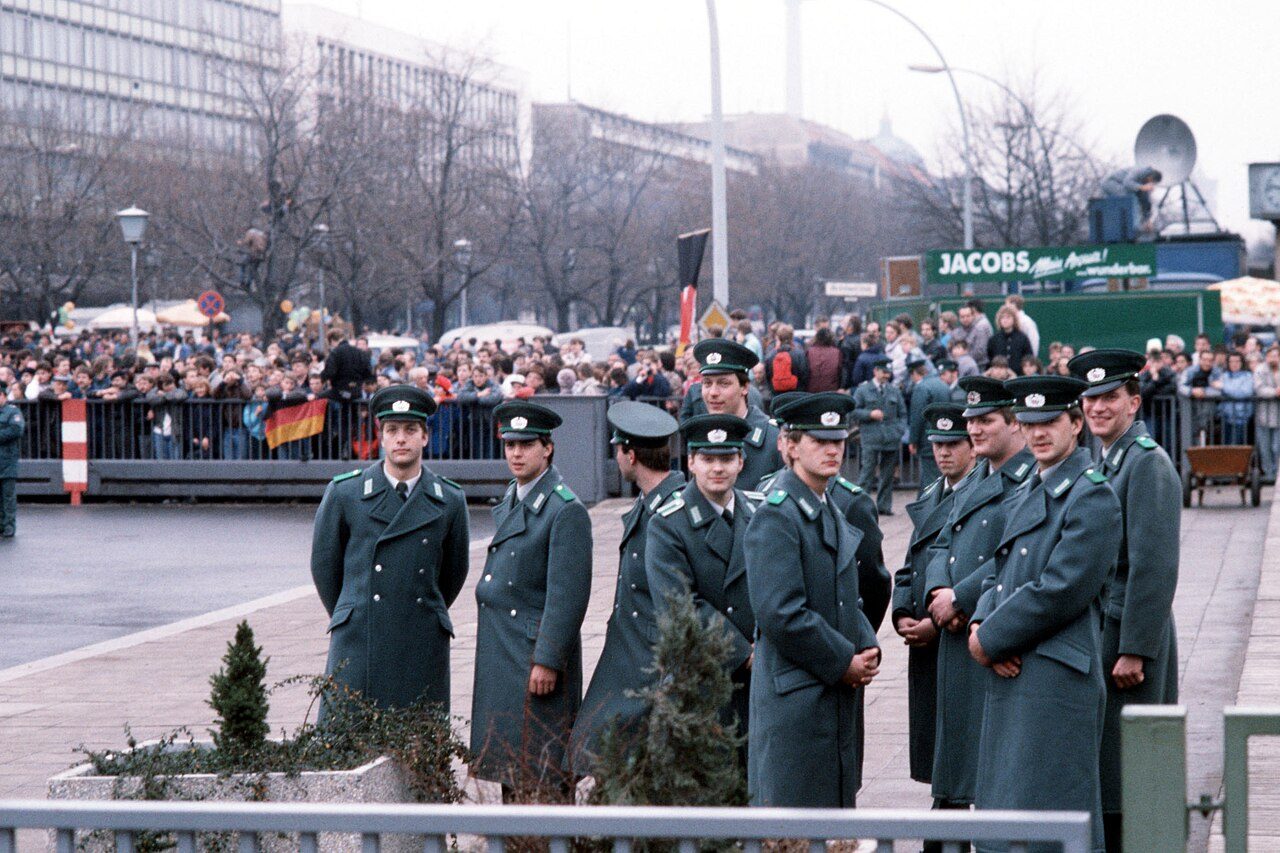
Later on 22 December, in steady rain, Chancellor Helmut Kohl walked through the Gate's central arch — the passage once reserved for the royal family — and was met on the other side by East German Prime Minister Hans Modrow. West Berlin's mayor Walter Momper and his East Berlin counterpart stood alongside. Contemporary reports put the crowd at more than a hundred thousand Berliners, East and West together, applauding in the wet December dark. From the next day, West Germans could enter the East without visas for the first time in decades.
The reopening was ceremony, but it was also a ratchet: crossings, once opened, were never closed again. Free East German elections followed in March 1990, monetary union in July, and on 3 October 1990 Germany reunified, with the Gate restored to its original purpose as a welcome into the heart of a single city. Restored in 2000–2002, it is now the backdrop to the country's New Year celebrations — a gate that finally just stands open.
Why this date matters
December 22 is a day of verdicts and openings. A court-martial in Paris convicts an innocent officer and poisons a republic; in Vienna the most famous four notes in music are heard for the first time; in the Andes, rescuers finally reach men given up for dead; and in Berlin a gate sealed for a generation is ceremonially unsealed, with two heads of government meeting in its archway as if the Cold War were a weather event that had passed. The pattern is release — of music, of survivors, of a city — arriving, appropriately, just as the year turns towards Christmas.
Sources
- Encyclopaedia Britannica — On This Day: December 22
- HISTORY — What Happened on December 22
- Encyclopaedia Britannica — Brandenburg Gate
- German History in Documents and Images — Demolition of the Wall at Brandenburg Gate (December 21, 1989)
The facts on this page were checked against these sources on 19 November 2026. The History Trail's permanent pages are researched and written for this site; the live profiles elsewhere on The History Trail are assembled automatically from Wikipedia and Wikidata.
About the Author
Researched and written by the The History Trail Editorial Team — the accountable editorial function behind this site's permanent story pages. The team works from the published sources cited on each page; it does not invent historians, reviewers or credentials, and it corrects errors openly.
Fact Check
Every load-bearing fact on this page traces to one of the sources listed above, and significant claims link to their source in the text. Our checking method is described on the methodology page; errors can be reported via the corrections page.
Sources & Citations
Cite this page as: The History Trail Editorial Team, The History Trail — this article's title, publication and update dates are shown beneath its headline. The full source list appears under Sources above; the site's source standards are on the sources page.