
On This Day
December 25 in History
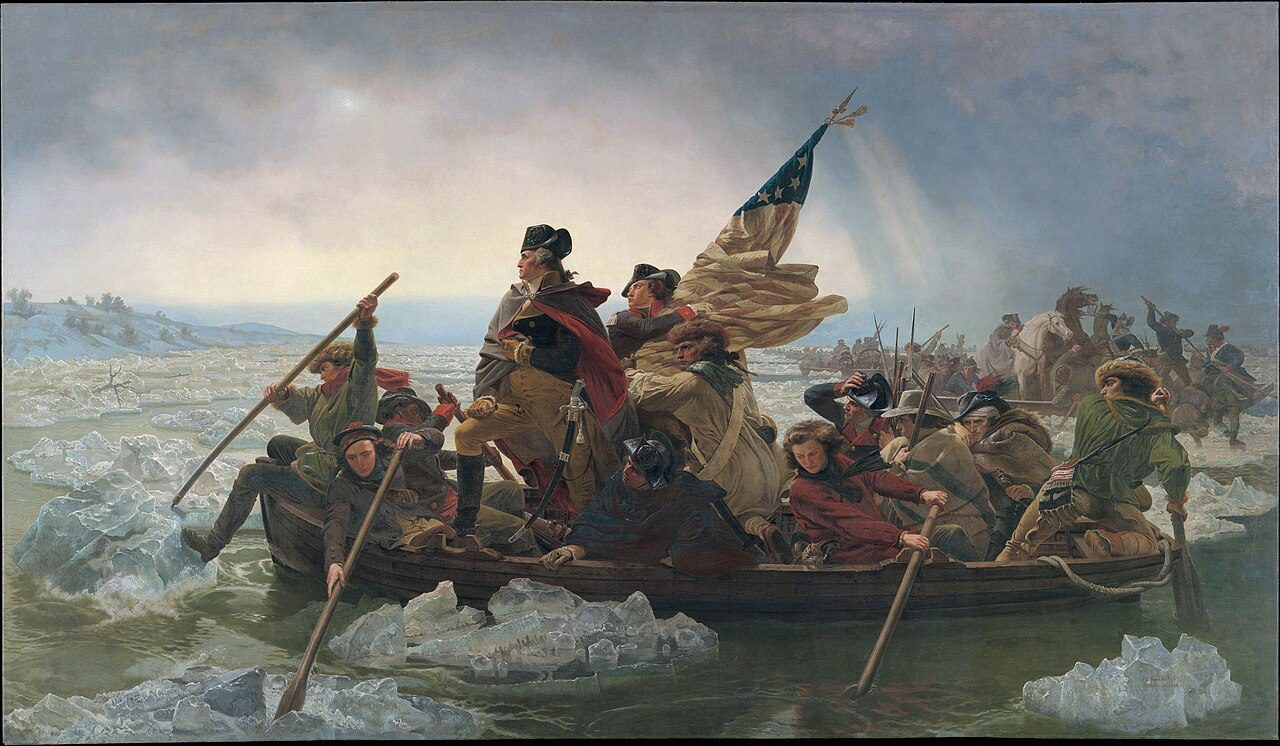
On Christmas night 1776, with the American Revolution close to collapse, George Washington ferried some 2,400 men across the ice-choked Delaware River in a howling storm and marched them through the night on Trenton. It is the most famous of many December 25 turning points, a day that also crowned Charlemagne and William the Conqueror and, in 1991, ended the Soviet Union.
Choose another date: open the On This Day calendar to browse events, births and deaths for any day of the year.
At a Glance
- The crossing
- Night of 25–26 December 1776, from McConkey's Ferry, Pennsylvania, across the Delaware River to New Jersey
- Force that crossed
- About 2,400 Continental soldiers, with 18 cannon and horses (Mount Vernon)
- The boats
- Durham boats — flat-bottomed iron-ore freight craft 40 to 60 feet long — worked by Colonel John Glover's Marblehead mariners
- The weather
- A nor'easter of freezing rain, sleet and snow; one soldier recorded that it 'blew a perfect hurricane'
- The plan
- Three crossings were planned for Christmas night; ice and storm stopped the other two, and only Washington's main force got across
- The result
- A surprise attack on Trenton at about 8 a.m. on 26 December; roughly 900 Hessian soldiers captured and the Revolution revived
Events on this day
- 352Pope Liberius celebrates the first official Christmas mass in Rome, the mass that, Britannica notes, ensured Christmas's place on December 25 in the Roman Catholic calendar.
- 800Pope Leo III crowns Charlemagne, king of the Franks, as emperor in Rome, reviving an imperial title in western Europe.
- 1066William the Conqueror, duke of Normandy, is crowned king of England at Westminster Abbey, completing the Norman Conquest.
- 1492Columbus's flagship, the Santa María, runs aground off Hispaniola and is lost; her timbers are used to build a fort Columbus names La Navidad, 'Christmas'.
- 1776George Washington leads about 2,400 Continental soldiers across the ice-choked Delaware River on Christmas night — the featured story above.
- 1868President Andrew Johnson proclaims, 'unconditionally, and without reservation', a full pardon and amnesty for all who took part in the Confederate rebellion.
- 1914The Christmas Truce begins along parts of the Western Front: German troops sing carols after midnight, and at dawn soldiers from both sides meet in no-man's-land.
- 1946The first Soviet nuclear chain reaction takes place in Moscow, an important step in the U.S.S.R.'s effort to build a nuclear weapon.
- 1991Mikhail Gorbachev resigns as president of the Soviet Union; the union itself is dissolved the following day, ending the Cold War order.
- 2021NASA's James Webb Space Telescope is launched from French Guiana, beginning its journey to observe the earliest galaxies.
Born on this day
- 1642Isaac Newton — English physicist and mathematician, born at Woolsthorpe on 25 December by the Old Style calendar then used in England (4 January 1643 New Style).
- 1821Clara Barton — American nurse who founded the American Red Cross after her relief work in the Civil War.
- 1899Humphrey Bogart — American film star of The Maltese Falcon, Casablanca and The African Queen.
- 1907Cab Calloway — American jazz singer and bandleader, the 'Hi-De-Ho Man' of Harlem's Cotton Club.
- 1918Anwar Sadat — Egyptian president who shared the 1978 Nobel Peace Prize for his peace negotiations with Israel; assassinated in 1981.
- 1924Rod Serling — American screenwriter and producer who created the television series The Twilight Zone.
- 1949Sissy Spacek — Academy Award-winning American actress, star of Carrie and Coal Miner's Daughter.
- 1971Justin Trudeau — Canadian politician, prime minister of Canada from 2015 to 2025, and son of prime minister Pierre Trudeau.
Died on this day
- 1946W. C. Fields — American comedian of vaudeville and film, famous for his misanthropic screen persona, dead at 66.
- 1977Charlie Chaplin — English comic actor and director, the 'Little Tramp', one of the most important figures in film history, dead in Switzerland at 88.
- 1983Joan Miró — Catalan painter and sculptor of dreamlike abstract art, dead at Palma, Mallorca, at 90.
- 1989Nicolae Ceaușescu — Romania's communist dictator, executed with his wife Elena after a summary trial, as his regime collapsed in revolution.
- 1995Dean Martin — American singer and actor, the relaxed crooner of the Rat Pack, dead at 78.
- 2016George Michael — English singer-songwriter of Wham! and a solo career, found dead at home in Oxfordshire at 53.
The featured story: Washington crosses the Delaware, Christmas night 1776
By December 1776 the American Revolution was nearly lost. Washington's army had been beaten out of New York, chased across New Jersey and driven over the Delaware River into Pennsylvania, shrinking all the way, and many of the remaining men's enlistments expired with the year. Across the river the British had settled into winter quarters, with an outpost of about 1,400 Hessian soldiers — German troops hired by the British crown — at Trenton, New Jersey. After several councils of war, Washington fixed on a desperate remedy: cross back over the river on Christmas night and strike Trenton before dawn. As Mount Vernon puts it, he hoped a quick victory would bolster sagging morale and encourage more men to join the ranks of the Continentals come the new year.
The plan called for three crossings. Washington himself, with 2,400 men, would cross at McConkey's and Johnson's ferries, roughly ten miles north of Trenton, then march south on the town. Colonel John Cadwalader was to cross below Trenton near Burlington and strike a Hessian outpost at Bordentown, while General James Ewing crossed at Trenton itself to block the escape route. The infantry went over in Durham boats, big flat-bottomed freight craft built to carry iron ore down the river, poled and rowed by Colonel John Glover's Marblehead mariners, New England fishermen and sailors who knew dangerous water. The guns and horses crossed on flat ferries, under the supervision of the artillery chief, Henry Knox, with some 18 cannon to get over.
Then the weather turned. What began as drizzle became driving rain, and by about eleven o'clock a howling nor'easter was lashing the river with snow and sleet; one soldier recorded that it 'blew a perfect hurricane'. Ice floes choked the current, the crossing fell hours behind schedule, and Washington considered abandoning the attempt. The two southern crossings failed altogether — Ewing could not attempt his, and Cadwalader, finding ice piled on the far bank, brought his men back. Only Washington's force got across, assembling on the Jersey shore in the small hours of 26 December, and it did not begin the march until about four in the morning, far too late for the planned dawn attack.
The army marched some nine to ten miles south through the storm in two columns and reached Trenton at about eight o'clock. The same weather that had nearly wrecked the crossing now covered the approach, and the garrison was taken by surprise. In a short, sharp fight the Hessians were overwhelmed: their commander, Johann Rall, was mortally wounded, and roughly 900 of his men were captured, along with their cannon and stores. Washington then ferried his prisoners back across the Delaware. It was the Continental Army's first clear victory after months of defeat, and it changed the temper of the war: enlistments steadied, recruits came in, and a week later Washington struck again at Princeton. A Christmas-night gamble by an army that was dissolving had kept the Revolution alive.
Why this date matters
December 25 is a feast day that history keeps borrowing for its own purposes. Twice it has crowned the makers of new orders — Charlemagne in Rome in 800, William in Westminster in 1066 — because a Christmas coronation wrapped raw power in sacred legitimacy. Twice in the modern age it has been a day of endings and reconciliations: Johnson's unconditional pardon closing the legal account of the American Civil War in 1868, and Gorbachev's resignation closing the Soviet Union in 1991. In between come its strangest hours: enemies laying down their rifles to sing carols in 1914, and a beaten army crossing a frozen river in a storm in 1776 to win the victory that saved a revolution. No other date so regularly turns a holiday into a hinge.
Sources
- Encyclopaedia Britannica — On This Day: December 25
- HISTORY — What Happened on December 25
- George Washington's Mount Vernon — Crossing of the Delaware
- George Washington's Mount Vernon — 10 Facts About Washington's Crossing of the Delaware River
The facts on this page were checked against these sources on 19 November 2026. The History Trail's permanent pages are researched and written for this site; the live profiles elsewhere on The History Trail are assembled automatically from Wikipedia and Wikidata.
About the Author
Researched and written by the The History Trail Editorial Team — the accountable editorial function behind this site's permanent story pages. The team works from the published sources cited on each page; it does not invent historians, reviewers or credentials, and it corrects errors openly.
Fact Check
Every load-bearing fact on this page traces to one of the sources listed above, and significant claims link to their source in the text. Our checking method is described on the methodology page; errors can be reported via the corrections page.
Sources & Citations
Cite this page as: The History Trail Editorial Team, The History Trail — this article's title, publication and update dates are shown beneath its headline. The full source list appears under Sources above; the site's source standards are on the sources page.