
On This Day
December 24 in History
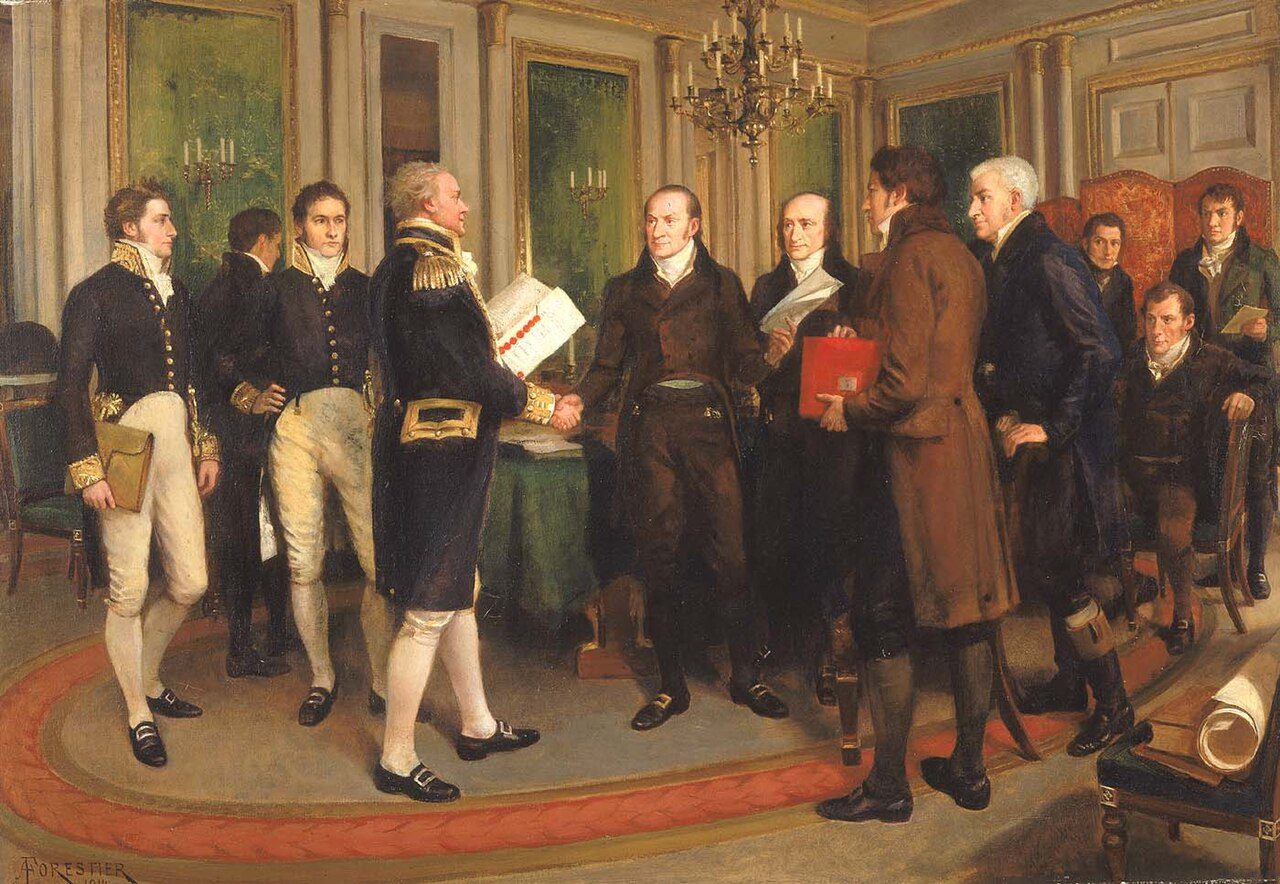
On Christmas Eve 1814, in the Belgian city of Ghent, British and American negotiators signed the Treaty of Ghent, ending the War of 1812 and restoring the borders that had existed before it — a peace that settled almost nothing on paper and yet held for two centuries. December 24 is also the day Edison applied to patent the phonograph, the Apollo 8 astronauts read Genesis from lunar orbit, and Soviet troops entered Afghanistan.
Choose another date: open the On This Day calendar to browse events, births and deaths for any day of the year.
At a Glance
- Signed
- 24 December 1814 at Ghent, in what is now Belgium, after four months of negotiation
- The American team
- Led by John Quincy Adams, with Henry Clay, Albert Gallatin, James Bayard and Jonathan Russell
- The terms
- Status quo ante bellum: all captured territory returned, boundaries restored, commissions appointed to settle disputed borders
- What it ignored
- Impressment and neutral shipping rights — the war's stated causes — went unmentioned; Britain had already abandoned the practices
- The catch
- Peace took effect only on ratification in February 1815 — so the war's bloodiest battle, New Orleans, was fought on 8 January, after the treaty was signed
- The result
- The last war between Britain and the United States; the two countries have never fought since
Events on this day
- 1801British inventor Richard Trevithick gives seven friends a ride through Camborne, Cornwall, in his 'Puffing Devil', the first steam-powered passenger vehicle.
- 1814The Treaty of Ghent is signed in Belgium, ending the War of 1812 between Britain and the United States — the featured story above.
- 1851Fire destroys about two-thirds of the Library of Congress's 55,000 volumes, including most of Thomas Jefferson's personal library, sold to the nation in 1815.
- 1871Verdi's opera Aida receives its premiere at the Khedivial Opera House in Cairo, two years after the theatre opened with the Suez Canal celebrations.
- 1877The U.S. Patent Office receives Thomas Edison's application for the phonograph, weeks after he first demonstrated the talking machine in New York.
- 1923President Calvin Coolidge lights the first National Christmas Tree on the Ellipse in Washington, decorated with 2,500 electric bulbs.
- 1942Admiral François Darlan, head of the French administration in North Africa, is assassinated in Algiers by a young French royalist.
- 1951Libya becomes independent, the first country to gain independence through the United Nations, with Idris I as its king.
- 1968The Apollo 8 astronauts, the first humans in lunar orbit, read the opening of Genesis in a live Christmas Eve broadcast from around the Moon.
- 1979Soviet forces begin their intervention in Afghanistan, airlifting troops into Kabul at the start of a nine-year war.
- 1999Hijackers seize Indian Airlines flight 814 after takeoff from Kathmandu, beginning a week-long hostage crisis that ends at Kandahar on New Year's Eve.
Born on this day
- 1167King John — king of England who sealed Magna Carta in 1215 and lost most of England's French possessions.
- 1822Matthew Arnold — English poet of 'Dover Beach' and the era's most influential critic of culture.
- 1845George I — Danish prince who reigned as king of Greece for fifty years until his assassination in 1913.
- 1905Howard Hughes — American aviator, film producer and industrialist who ended his life a famous recluse.
- 1973Stephenie Meyer — American author of the Twilight novels, a publishing phenomenon among young readers.
Died on this day
- 1524Vasco da Gama — Portuguese navigator who opened the sea route from Europe to India, dead at Cochin on his third voyage as viceroy.
- 1660Mary, Princess Royal — eldest daughter of Charles I and mother of William III, dead of smallpox in London at 29.
- 1942François Darlan — French admiral and Vichy leader in North Africa, assassinated in Algiers on the day of his entry in the events above.
- 1997Toshirō Mifune — Japanese actor, the samurai star of Kurosawa's Rashomon and Seven Samurai.
The featured story: the Treaty of Ghent ends the War of 1812, 24 December 1814
The War of 1812 had begun in American grievance — British warships stopping American vessels and impressing their sailors, British support for Native nations resisting American expansion — and had lurched through two and a half years of invasion attempts, burned capitals on both sides (York, now Toronto, and Washington itself) and naval duels on the Great Lakes. By the summer of 1814 both governments were exhausted and financially strained, and their delegates met at Ghent, in the newly created United Kingdom of the Netherlands, to talk peace.
The negotiations were hard. The British team — Admiral Lord Gambier, Henry Goulburn and William Adams — arrived with demands sharpened by the Duke of Wellington's victories in Europe: an Indigenous buffer state in the Northwest, border revisions, control of the Lakes. The American team, led by John Quincy Adams and including Henry Clay and Albert Gallatin, refused them all. As the autumn wore on and British fortunes stalled — at Plattsburgh and Baltimore — London's demands softened towards the simple restoration of the pre-war map. Wellington himself advised that Britain had no right to demand territory.
On 24 December 1814 the treaty was signed. Its terms, as the National Archives summarises, restored all conquered territory, relinquished British claims to the Northwest Territory and pledged both sides to work towards ending the slave trade; commissions would settle the disputed boundaries later. On the war's great causes — impressment, neutral rights — it said nothing at all, because with Napoleon defeated, Britain had already stopped the practices. Each side could, and did, claim it had not lost.
The peace had one cruel footnote. The treaty bound no one until ratified, and news crossed the Atlantic by sail. On 8 January 1815, outside New Orleans, Andrew Jackson's army destroyed a British assault force in the war's most famous battle — fought a fortnight after the war had legally been agreed over. Ratifications were exchanged in February 1815, and the strangest thing about Ghent then happened: the peace lasted. Britain and the United States, enemies twice in forty years, have never fought each other again.
Why this date matters
Christmas Eve accumulates endings. A war is signed away in a Flemish city; a library burns in Washington; an empire's troops march into Afghanistan to begin the war that will help end the empire; and above the Moon, three astronauts read the oldest words they know — 'In the beginning' — to the largest audience that had ever listened at once. The date sits at the hinge of the festival, and its events share the festival's double character: truces and invasions, gifts and assassinations, the year's accounts being closed in ink, in fire and, once, from lunar orbit.
Sources
- Encyclopaedia Britannica — On This Day: December 24
- HISTORY — What Happened on December 24
- National Archives — Treaty of Ghent (1814)
- National Park Service — The Treaty of Ghent
The facts on this page were checked against these sources on 19 November 2026. The History Trail's permanent pages are researched and written for this site; the live profiles elsewhere on The History Trail are assembled automatically from Wikipedia and Wikidata.
About the Author
Researched and written by the The History Trail Editorial Team — the accountable editorial function behind this site's permanent story pages. The team works from the published sources cited on each page; it does not invent historians, reviewers or credentials, and it corrects errors openly.
Fact Check
Every load-bearing fact on this page traces to one of the sources listed above, and significant claims link to their source in the text. Our checking method is described on the methodology page; errors can be reported via the corrections page.
Sources & Citations
Cite this page as: The History Trail Editorial Team, The History Trail — this article's title, publication and update dates are shown beneath its headline. The full source list appears under Sources above; the site's source standards are on the sources page.