
On This Day
December 26 in History
On the morning of 26 December 2004, a magnitude 9.1 earthquake — among the largest ever recorded — ruptured the seafloor off northern Sumatra and sent a tsunami across the Indian Ocean that killed an estimated 228,000 people in fourteen countries, the deadliest tsunami in recorded history. December 26 is also the day Washington won at Trenton, Jack Johnson became the first Black world heavyweight champion, and the Soviet Union was formally dissolved.
Choose another date: open the On This Day calendar to browse events, births and deaths for any day of the year.
At a Glance
- The earthquake
- Magnitude 9.1 by the U.S. Geological Survey's official estimate (some studies put it at 9.2–9.3), at 7:58 a.m. local time off northern Sumatra
- The rupture
- The fault tore for roughly 1,300 kilometres along the seafloor where the India Plate dives beneath the Burma Plate
- The waves
- Tsunami waves struck Indonesia within minutes and reached Sri Lanka, India and Thailand within about two hours; they were recorded as far away as East Africa
- The toll
- An estimated 228,000 people killed across 14 countries — Indonesia worst hit, then Sri Lanka, India and Thailand
- The missing system
- The Indian Ocean had no tsunami warning system in 2004; one was established in the years that followed
Events on this day
- 1776George Washington's army, having crossed the icy Delaware in the night, surprises and defeats the Hessian garrison at Trenton, New Jersey — the young republic's first great victory.
- 1862Thirty-eight Dakota men are hanged at Mankato, Minnesota, in the largest mass execution in United States history, following the U.S.–Dakota War.
- 1898Pierre and Marie Curie announce their discovery of a new element, radium, to the French Academy of Sciences in Paris.
- 1908Jack Johnson defeats Tommy Burns in Sydney to become the first African American world heavyweight boxing champion.
- 1917With wartime railways in chaos, the U.S. government takes control of the nation's railroad network for the duration of the First World War.
- 1941Winston Churchill becomes the first British prime minister to address a joint meeting of the United States Congress, nineteen days after Pearl Harbor.
- 1943The German battleship Scharnhorst is sunk by British warships, led by HMS Duke of York, in the Battle of the North Cape off Norway.
- 1944Tanks of General Patton's Third Army break through to relieve the besieged American garrison at Bastogne, Belgium.
- 1946Mobster Benjamin 'Bugsy' Siegel opens the Flamingo Hotel in Las Vegas, the resort that points the way to the modern Strip.
- 1966The first Kwanzaa is celebrated, in Los Angeles, by its founder Maulana Karenga, as a festival of African heritage and unity.
- 1991The Supreme Soviet formally dissolves the Union of Soviet Socialist Republics, completing the end of the USSR begun by the republics' declarations.
- 2004A magnitude 9.1 earthquake off Sumatra triggers the Indian Ocean tsunami, killing an estimated 228,000 people in fourteen countries — the featured story above.
Born on this day
- 1791Charles Babbage — English mathematician who designed the first programmable mechanical computers, the Difference and Analytical Engines.
- 1880Elton Mayo — Australian psychologist whose Hawthorne studies reshaped thinking about work and management.
- 1893Mao Zedong — Chinese revolutionary leader, founder of the People's Republic of China and its chairman from 1949.
- 1953Toomas Hendrik Ilves — Estonian statesman, president of Estonia from 2006 to 2016.
- 1982Aksel Lund Svindal — Norwegian alpine skier, Olympic champion and two-time overall World Cup winner.
Died on this day
- 211Publius Septimius Geta — Roman co-emperor, murdered on his brother Caracalla's orders months after their father's death.
- 1909Frederic Remington — American artist whose paintings and sculptures defined the image of the Old West.
- 1968Weegee — Ukrainian-born American photographer, born Arthur Fellig, famed for his stark New York crime scenes.
- 1972Harry S. Truman — 33rd president of the United States, who ended the Second World War and shaped the early Cold War, dead in Missouri at 88.
- 2006Gerald Ford — 38th president of the United States, who pardoned Richard Nixon after Watergate, dead at 93.
The featured story: the Indian Ocean tsunami, 26 December 2004
At 7:58 on the morning after Christmas — Boxing Day in much of the world — the seafloor west of northern Sumatra gave way. Along a fault roughly 1,300 kilometres long, the India Plate, which had been grinding beneath the Burma Plate for centuries, lurched forward in one of the most powerful earthquakes ever measured: magnitude 9.1 by the U.S. Geological Survey's official estimate, a figure some studies place as high as 9.3. The whole column of ocean above the rupture was displaced, and the sea itself began to move outward in every direction at the speed of a jet airliner.
Aceh, at Sumatra's northern tip, was struck within minutes, by waves that in places ran more than 30 metres high. The water erased coastal towns, carried a locomotive two kilometres inland, and killed, on the usual estimates, more than 165,000 people in Indonesia alone. The tsunami reached Sri Lanka and India's Tamil Nadu coast about two hours later, catching beaches, trains and fishing fleets; it hit Thailand's resort coast, full of Christmas tourists, with almost no warning; and it crossed the entire ocean to kill people in Somalia and East Africa, seven hours after the quake. In all, an estimated 228,000 people died in fourteen countries.
The disaster's cruelest feature was its silence. The Pacific Ocean had enjoyed a tsunami warning system for half a century; the Indian Ocean had none — no buoy network, no warning chain, and in most places no public knowledge that a receding sea is nature's own alarm. Where the water drew back, crowds walked out onto the exposed seabed to look. A ten-year-old English schoolgirl, Tilly Smith, recognised the signs from a geography lesson and raised the alarm on a Phuket beach, and everyone there survived — an exception that showed what education alone could have done along a thousand other beaches.
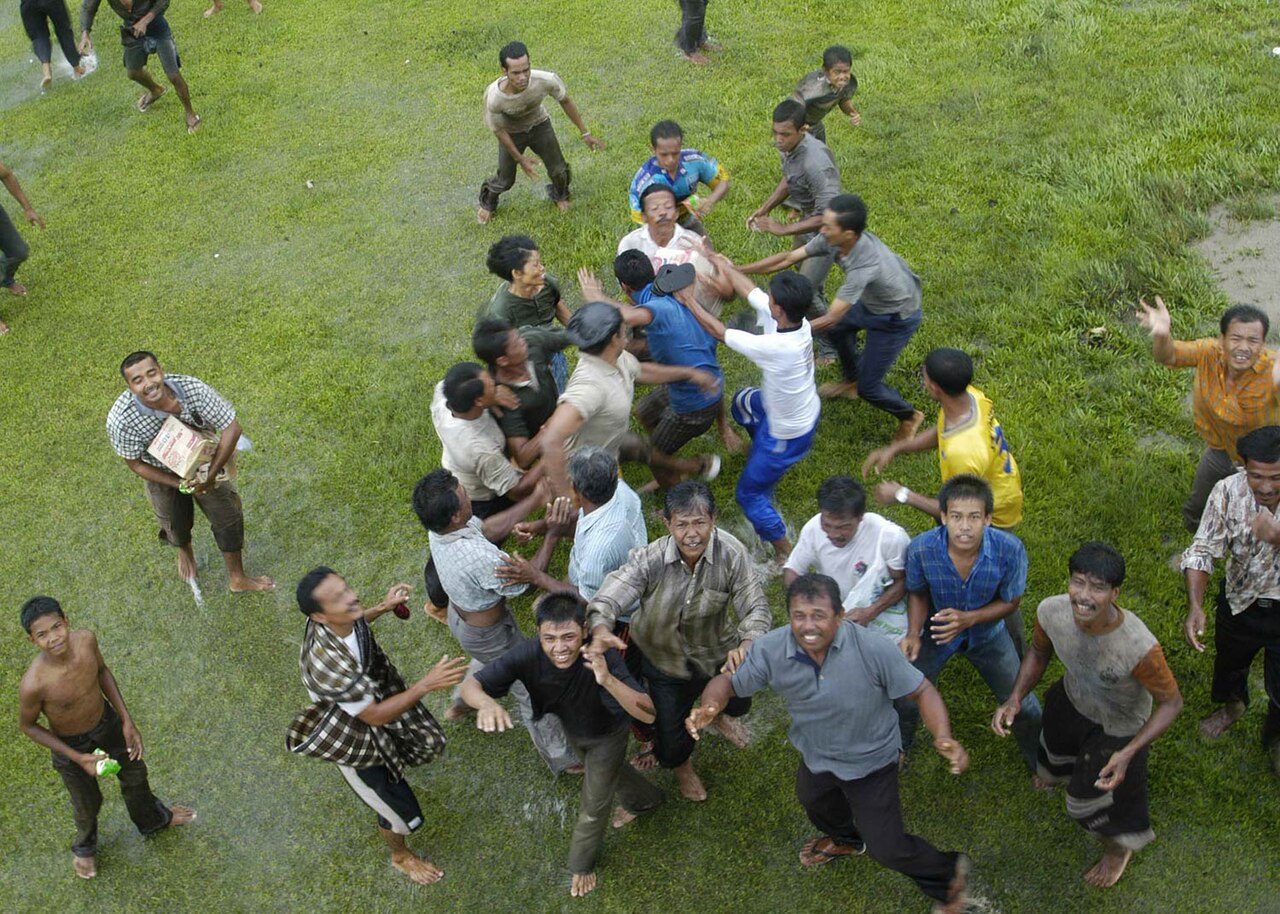
The response was the largest humanitarian operation ever mounted to that date: billions of dollars pledged by governments and ordinary donors, warships and helicopters from two dozen navies, and a reconstruction that rebuilt Aceh's coast over the following decade. The Indian Ocean Tsunami Warning System was established in 2005, with deep-ocean buoys and national warning centres where none had existed. And in Aceh, the disaster broke a thirty-year stalemate: within a year, the Indonesian government and the Free Aceh Movement signed the peace that ended their war.
Why this date matters
December 26 carries Boxing Day's double nature — the feast of St Stephen, the first martyr, and the traditional day of charity boxes and leftovers — and its history is correspondingly split between violence and generosity. Washington attacks at dawn; a frontier war ends on a scaffold; a boxer breaks a colour bar; and in 2004 the sea itself delivers the worst natural disaster of the young century, answered by the largest relief effort the world had yet mounted. It is the calendar's sharpest lesson that catastrophe and the response to it arrive together, and that what a date is remembered for depends on both.
Sources
- Encyclopaedia Britannica — On This Day: December 26
- HISTORY — What Happened on December 26
- U.S. Geological Survey — The Night the Earth Shook
- Encyclopaedia Britannica — Indian Ocean tsunami of 2004
The facts on this page were checked against these sources on 19 November 2026. The History Trail's permanent pages are researched and written for this site; the live profiles elsewhere on The History Trail are assembled automatically from Wikipedia and Wikidata.
About the Author
Researched and written by the The History Trail Editorial Team — the accountable editorial function behind this site's permanent story pages. The team works from the published sources cited on each page; it does not invent historians, reviewers or credentials, and it corrects errors openly.
Fact Check
Every load-bearing fact on this page traces to one of the sources listed above, and significant claims link to their source in the text. Our checking method is described on the methodology page; errors can be reported via the corrections page.
Sources & Citations
Cite this page as: The History Trail Editorial Team, The History Trail — this article's title, publication and update dates are shown beneath its headline. The full source list appears under Sources above; the site's source standards are on the sources page.