
On This Day
November 9 in History
On the evening of 9 November 1989 an East German official's improvised answer — 'immediately' — opened the Berlin Wall, and the Cold War's most famous barrier fell in a single night.
Choose another date: open the On This Day calendar to browse events, births and deaths for any day of the year.
At a Glance
- Date
- 9 November 1989; first crossing opened at Bornholmer Straße late that evening
- Place
- Berlin Wall checkpoints, East and West Berlin
- Key figure
- Günter Schabowski, SED spokesman who announced the new travel rules live on television
- The Wall
- Built from 13 August 1961; it had divided Berlin for 28 years
- Outcome
- Border opened without a shot; German reunification followed on 3 October 1990
Events on this day
- 1799Napoleon Bonaparte seizes power in the Coup of 18 Brumaire, ending the French Directory.
- 1867The Tokugawa shogunate returns power to the Emperor of Japan, beginning the Meiji Restoration.
- 1888Mary Jane Kelly is murdered in London — the last of Jack the Ripper's canonical five victims.
- 1918Kaiser Wilhelm II abdicates and Germany is proclaimed a republic, two days before the Armistice.
- 1923Police and troops crush Hitler's Beer Hall Putsch in Munich; sixteen Nazis and four officers die.
- 1938Kristallnacht: Nazi mobs burn synagogues and Jewish businesses across Germany and Austria.
- 1953Cambodia gains independence from France under King Norodom Sihanouk.
- 1965The Northeast blackout cuts power to 30 million people across the US Northeast and Ontario.
- 1967NASA launches Apollo 4, the first flight of the Saturn V rocket, uncrewed.
- 1985Garry Kasparov, 22, defeats Anatoly Karpov to become the youngest world chess champion.
- 2004Mozilla releases Firefox 1.0, reigniting the browser wars.
Born on this day
- 1683George II — king of Great Britain and Ireland, the last British monarch to lead troops in battle.
- 1801Gail Borden — American inventor of condensed milk and founder of the Borden company.
- 1818Ivan Turgenev — Russian novelist, author of Fathers and Sons.
- 1841Edward VII — king of the United Kingdom, eldest son of Queen Victoria.
- 1877Muhammad Iqbal — philosopher-poet whose vision inspired the Pakistan movement.
- 1880Giles Gilbert Scott — English architect who designed the red telephone box and Battersea Power Station.
- 1914Hedy Lamarr — Austrian-American film star and co-inventor of frequency-hopping radio technology.
- 1934Carl Sagan — American astronomer who brought the cosmos to a mass audience.
Died on this day
- 1778Giovanni Battista Piranesi — Italian artist famed for his etchings of Rome and imaginary prisons.
- 1854Elizabeth Schuyler Hamilton — widow of Alexander Hamilton and co-founder of New York's first orphanage.
- 1918Guillaume Apollinaire — French poet, dead in the influenza pandemic two days before the Armistice.
- 1937Ramsay MacDonald — Britain's first Labour prime minister.
- 1940Neville Chamberlain — British prime minister at the outbreak of the Second World War.
- 1952Chaim Weizmann — Zionist leader and first President of Israel.
- 1953Dylan Thomas — Welsh poet, dead at 39 in New York.
- 1970Charles de Gaulle — leader of Free France and founder of the Fifth Republic.
The featured story: the night the Wall fell
By the autumn of 1989 the German Democratic Republic was haemorrhaging its own people. Hungary had cut its border fence with Austria in the summer, and thousands of East Germans had escaped westward through it; thousands more camped in West German embassies in Prague and Warsaw demanding exit. At home, Monday demonstrations in Leipzig grew from thousands to hundreds of thousands, chanting 'Wir sind das Volk' — we are the people. The regime replaced the ailing Erich Honecker with Egon Krenz in October, but the exodus and the protests only grew. To relieve the pressure, the Politburo drafted new travel rules: East Germans would be allowed to apply for private trips abroad, including, crucially, permanent exit through every border crossing.
The rules were meant to start the next morning, after border guards had been briefed and application offices prepared. Instead they were handed, as a press release, to Politburo spokesman Günter Schabowski just before a live televised press conference on 9 November — a conference he had not been part of drafting them for. Near its end, at about 6:53 p.m., Schabowski read the note aloud. Asked by ANSA correspondent Riccardo Ehrman when the new rules took effect, he shuffled his papers and answered: 'As far as I know, it takes effect immediately, without delay.' Within the hour, West German television — watched widely in the East — was announcing that the Wall was open.
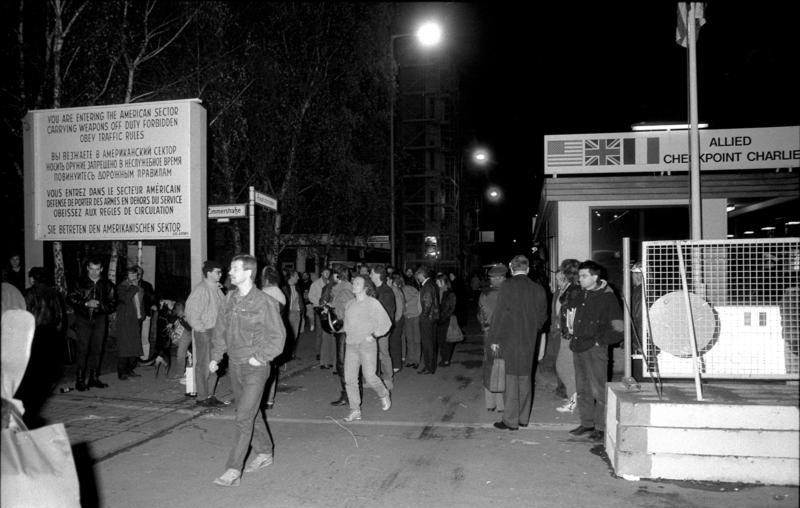
It was not, yet. But thousands of East Berliners, taking the broadcast at its word, gathered at the checkpoints and demanded the passage they had just been promised on television. At Bornholmer Straße, the northern crossing, the crowd grew into the thousands while the officer in charge, Harald Jäger, telephoned superiors who gave him no clear orders and finally abused him for asking. Shortly before 11:30 p.m., fearing a crush and abandoned by his chain of command, Jäger ordered the barriers opened and let everyone through without checks. Other crossings followed within the hour. West Berliners waited on the far side with flowers and champagne; strangers embraced on the Wall itself, and by the weekend more than two million people had crossed to look, shop, visit family — and, mostly, to come back home the same night, free people for the first time.
No shot was fired. The Wall, built in August 1961 and guarded for 28 years by towers, dogs and orders to shoot — more than a hundred people died trying to cross it — had been ended by a misunderstanding amplified by live television and a crowd that refused to go home. In the following days 'wall woodpeckers' chipped at it with hammers; official demolition began in June 1990. Free elections in March 1990, monetary union in July, and on 3 October 1990 Germany was reunified, less than eleven months after Schabowski's press conference. The Cold War's central symbol had fallen first, and the rest of the order it guarded fell with it.
Why this date matters
Germans call 9 November their Schicksalstag — fateful day — and no wonder: on this single date the republic was proclaimed in 1918, Hitler first attempted power in 1923, Kristallnacht disgraced the country in 1938, and the Wall fell in 1989. It is precisely because the date carries both the worst and the best of the German century that reunified Germany chose 3 October, not 9 November, as its national day. The 1989 entry remains the joyful one: proof that a fortified border, an ideology and an empire can be ended by words on television and a crowd that believes them.
Sources
- Encyclopaedia Britannica — Germany: The reunification of Germany
- Encyclopaedia Britannica — The Fall of the Berlin Wall (video transcript)
- People's History Museum — The fall of the Berlin Wall
- Wikipedia — November 9 (events, births and deaths lists)
The facts on this page were checked against these sources on 18 November 2026. The History Trail's permanent pages are researched and written for this site; the live profiles elsewhere on The History Trail are assembled automatically from Wikipedia and Wikidata.
About the Author
Researched and written by the The History Trail Editorial Team — the accountable editorial function behind this site's permanent story pages. The team works from the published sources cited on each page; it does not invent historians, reviewers or credentials, and it corrects errors openly.
Fact Check
Every load-bearing fact on this page traces to one of the sources listed above, and significant claims link to their source in the text. Our checking method is described on the methodology page; errors can be reported via the corrections page.
Sources & Citations
Cite this page as: The History Trail Editorial Team, The History Trail — this article's title, publication and update dates are shown beneath its headline. The full source list appears under Sources above; the site's source standards are on the sources page.