
Things
The Internet: A Network of Networks, Built in the Open
The internet was not invented in a moment but assembled over 30 years — packet switching, an open protocol anyone could adopt, and a web given away free.
At a Glance
- Precursor network
- ARPANET, first nodes connected 1969
- First message
- 29 October 1969, UCLA to SRI — the letters 'lo'
- Core protocols
- TCP/IP, designed by Vint Cerf and Robert Kahn
- TCP/IP adoption
- 1 January 1983, ARPANET 'flag day'
- Research backbone
- NSFNET, launched 1985
- World Wide Web
- Proposed by Tim Berners-Lee at CERN, March 1989
- Web released freely
- 30 April 1993, CERN royalty-free release
A Network With No Single Inventor
The internet has no single inventor and no single birthday, which is precisely why it worked. It grew out of a research question — how can expensive computers be shared by people in different buildings? — and a design decision: instead of building one perfect network, build a way for many imperfect networks to talk to each other. That idea, called open-architecture networking, is what turned a 1969 experiment linking four American research sites into a global system.
Two inventions are often confused in this story. The internet is the underlying network of networks, built between the 1960s and the 1980s. The World Wide Web is a system of linked documents that runs on top of it, proposed at CERN in 1989. The web is what most people mean when they say they are 'going online', but it arrived two decades after the first host-to-host message, and it succeeded because the internet beneath it was left open for uses nobody had planned.
Licklider, Kleinrock and the Galactic Network
The conceptual groundwork was laid in the early 1960s. J.C.R. Licklider, first head of the computer research programme at the US defence agency DARPA, wrote memos in August 1962 imagining a 'Galactic Network' of interconnected computers through which anyone could reach data and programmes from anywhere. At the same time, Leonard Kleinrock published the first paper on packet-switching theory: messages could be chopped into small blocks, sent independently and reassembled, rather than holding a whole circuit open as telephones did.
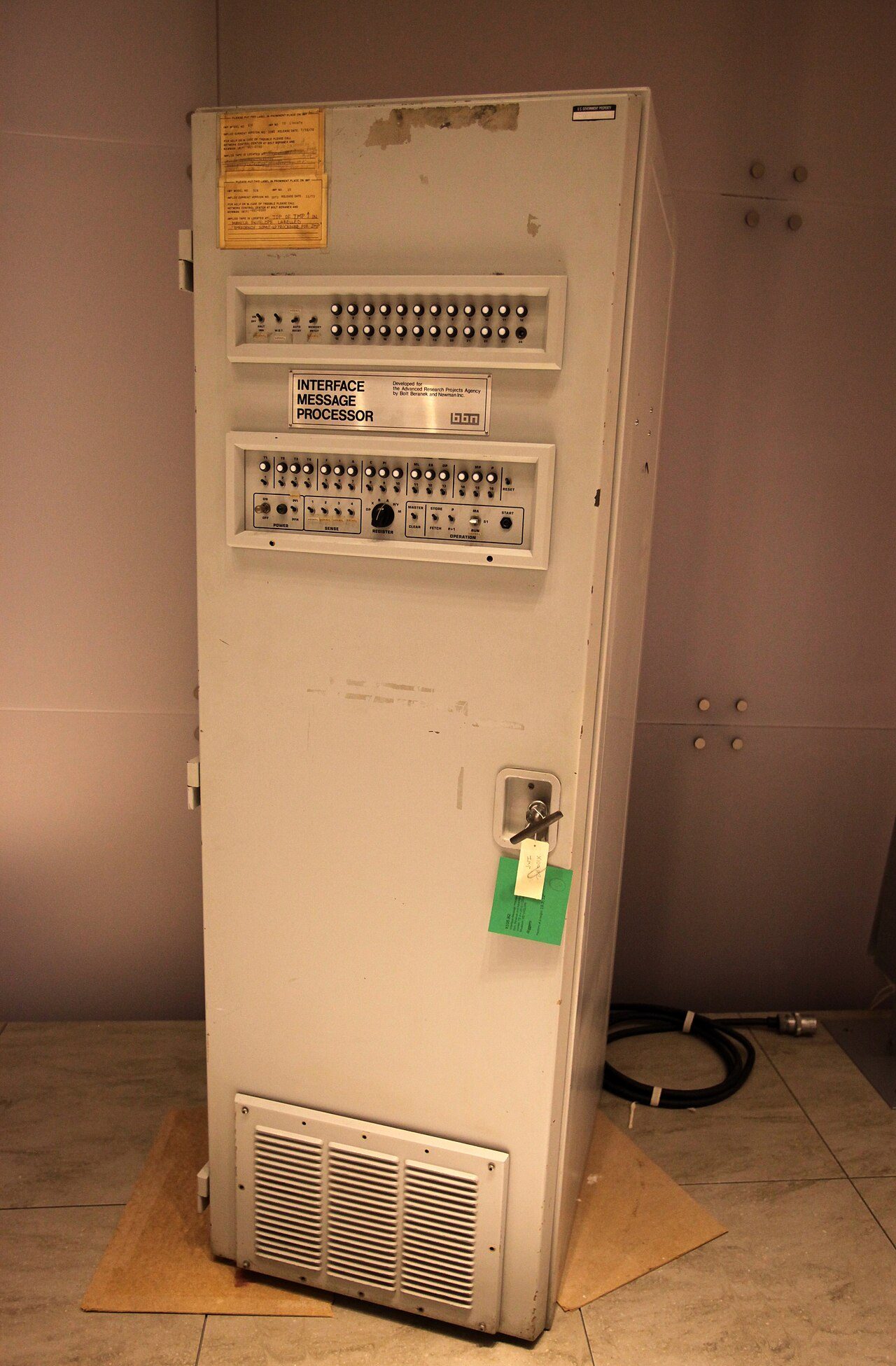
DARPA turned theory into hardware: Roberts joined the agency in late 1966, published his plan for the ARPANET in 1967, and contracted Bolt Beranek and Newman to build the packet switches, called Interface Message Processors. Kleinrock's centre at UCLA was chosen as the first node because of his work on measuring network behaviour. When the first IMP was installed there in September 1969, Stanford Research Institute became the second node and the experiment could begin.
Timeline
- August 1962
J.C.R. Licklider of MIT writes his 'Galactic Network' memos, the first description of social interaction through a global computer network.
- September 1969
BBN installs the first Interface Message Processor at UCLA and the first host computer is connected to the ARPANET.
- 29 October 1969
At 10:30 p.m., UCLA's Charley Kline attempts the first host-to-host login to SRI; the system crashes after two letters, making 'lo' the first message.
- December 1970
The Network Working Group completes NCP, the ARPANET's first host-to-host protocol.
- 1972
ARPANET is demonstrated publicly at the International Computer Communication Conference, and Ray Tomlinson's network email emerges as its first big application.
- 1974
Vint Cerf and Robert Kahn publish the design that becomes TCP/IP, the protocol suite for interconnecting independent networks.
- 1 January 1983
In a planned 'flag day', every ARPANET host switches simultaneously from NCP to TCP/IP — the moment the network of networks becomes recognisably the internet.
- 1985
The US National Science Foundation launches NSFNET for the whole higher-education community, with TCP/IP mandatory from the start.
- March 1989
Tim Berners-Lee at CERN writes the first proposal for the World Wide Web, a hypertext system for sharing information among physicists.
- End of 1990
Berners-Lee has the first web server and browser running at CERN on a NeXT computer labelled, in red ink: 'This machine is a server. DO NOT POWER IT DOWN!!'
- 30 April 1993
CERN makes the World Wide Web source code available royalty-free, turning the web into free software for anyone to build on.
- April 1995
NSF defunds the NSFNET backbone; commercial networks take over, completing the transition from research project to public infrastructure.
TCP/IP and the Low Bar for Joining
The internet's deepest change was architectural humility. TCP/IP asked almost nothing of the networks it joined: each could keep its own technology, packets would be forwarded on a best-effort basis, and lost packets would simply be resent. Because the bar for joining was so low, the system could absorb technologies its designers never imagined — local networks, workstations, and eventually the web, which was possible precisely because the internet was built as general infrastructure rather than for one application. Email, an afterthought for coordinating the builders themselves, became the largest network application for over a decade and previewed the people-to-people traffic that now dominates.
Openness extended to the paperwork. From 1969 the builders circulated their designs as informal Requests for Comments, free for anyone to read, criticise and implement, and folded the protocols into the Unix systems researchers already used. That culture — publish the specification, let a thousand implementations bloom — is why a defence research network could become a civilian utility without being redesigned, and why its governance grew into community bodies such as the Internet Society, founded in the early 1990s, rather than a single owner.
ARPANET Retires, the Web Explodes
By the time ARPANET was decommissioned in 1990, TCP/IP had outlasted or marginalised nearly every rival wide-area protocol, and the web's royalty-free release three years later triggered the public explosion: over 500 web servers by late 1993, and 10,000 servers with 10 million users by the end of 1994. The network designed for sharing a handful of research computers now carries commerce, media and conversation for most of humanity.
Its legacy is also a set of habits: open standards agreed in public, rough consensus tested by running code, and infrastructure treated as a commons rather than a product. The internet's inventors built a system that expected to be built upon — the strongest evidence is that its most famous application was invented by someone else, twenty years later, for a different purpose.
Sources
- Internet Society — A Brief History of the Internet (Leiner, Cerf, Clark, Kahn, Kleinrock et al.)
- CERN — A short history of the Web
- ICANN — The First Message Transmission, by Leonard Kleinrock
The facts on this page were checked against these sources on 18 November 2026. The History Trail's permanent pages are researched and written for this site; the live profiles elsewhere on The History Trail are assembled automatically from Wikipedia and Wikidata.
About the Author
Researched and written by the The History Trail Editorial Team — the accountable editorial function behind this site's permanent story pages. The team works from the published sources cited on each page; it does not invent historians, reviewers or credentials, and it corrects errors openly.
Fact Check
Every load-bearing fact on this page traces to one of the sources listed above, and significant claims link to their source in the text. Our checking method is described on the methodology page; errors can be reported via the corrections page.
Sources & Citations
Cite this page as: The History Trail Editorial Team, The History Trail — this article's title, publication and update dates are shown beneath its headline. The full source list appears under Sources above; the site's source standards are on the sources page.