
On This Day
November 8 in History
On the evening of 8 November 1895, in a darkened laboratory in Würzburg, Wilhelm Röntgen noticed a fluorescent screen glowing metres from a discharge tube sealed in black cardboard — the first observation of X-rays, the radiation that would let medicine see inside the living body. November 8 is also the day Cortés entered Tenochtitlán, Hitler launched the Beer Hall Putsch, Kennedy was elected president and Super Typhoon Haiyan struck the Philippines.
Choose another date: open the On This Day calendar to browse events, births and deaths for any day of the year.
At a Glance
- The observation
- Evening of 8 November 1895, Würzburg: a barium platinocyanide screen fluoresces up to two metres from a light-tight discharge tube
- The investigation
- Seven weeks of near-secret solo work establishes what the rays pass through — and that bone stops them more than flesh
- The name
- X-rays, from the mathematical symbol for an unknown quantity
- The famous image
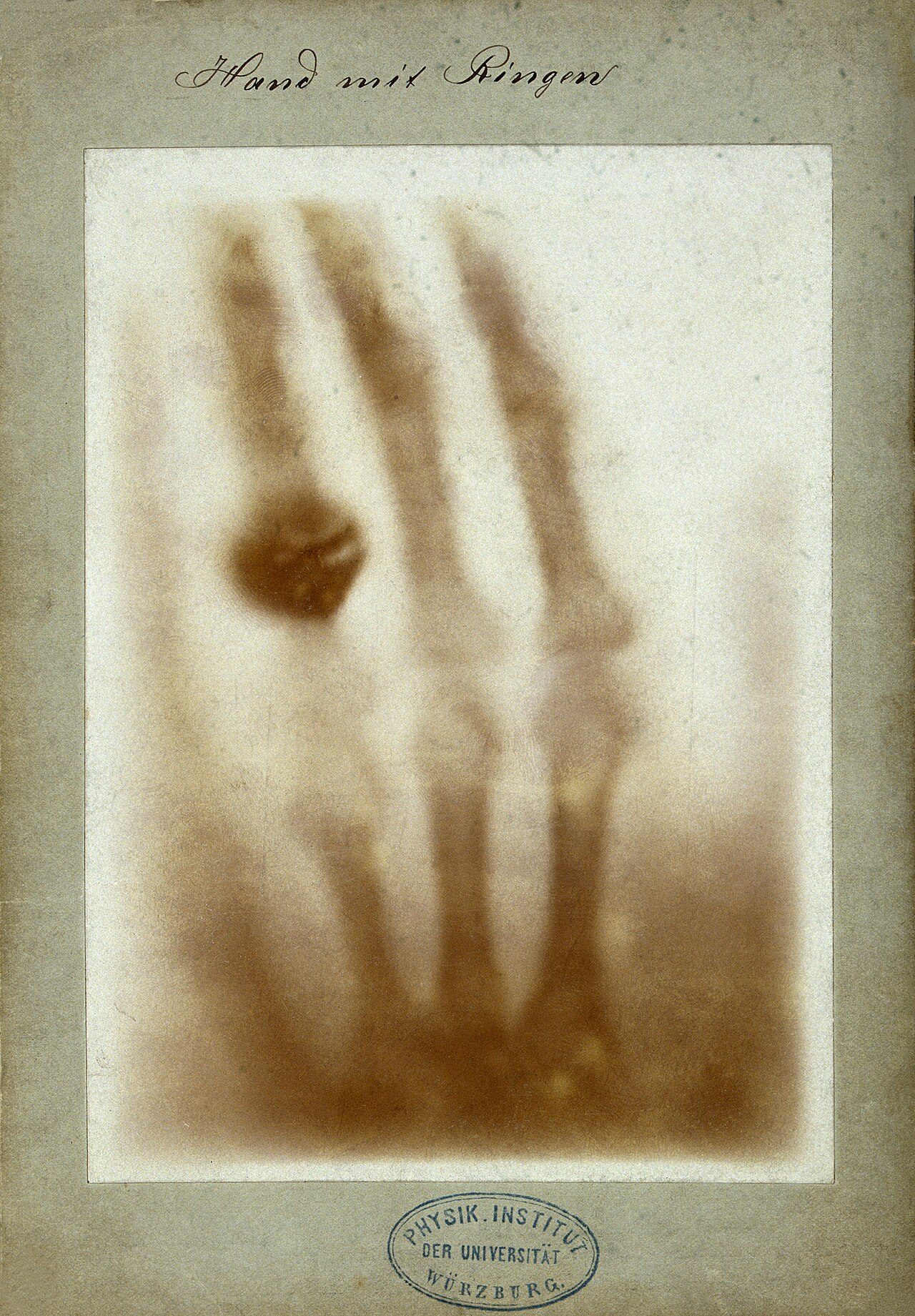
- 22 December 1895 — the hand of his wife Anna Bertha, bones and wedding ring: the first published röntgenogram
- The paper
- 'On a New Kind of Rays', submitted 28 December 1895; hospitals are using X-rays within a year
- The honour
- The first Nobel Prize in Physics, 1901; Röntgen takes no patent and donates the prize money to his university
Events on this day
- 1519Hernán Cortés enters the Aztec capital Tenochtitlán and is received by its ruler, Moctezuma II.
- 1602The Bodleian Library at the University of Oxford opens to readers.
- 1837Mount Holyoke Female Seminary, one of the first American colleges for women, opens in Massachusetts.
- 1864Abraham Lincoln is re-elected president in wartime, carrying all but three states.
- 1895Wilhelm Röntgen discovers X-rays in his Würzburg laboratory — the featured story above.
- 1923Adolf Hitler launches the Beer Hall Putsch in Munich, his failed first attempt to seize power in Germany.
- 1932Franklin D. Roosevelt defeats Herbert Hoover to become president, as the Great Depression deepens.
- 1939A bomb planted by Georg Elser explodes in a Munich beer hall minutes after Hitler has left, killing eight people.
- 1960John F. Kennedy, at 43, defeats Richard Nixon to become the youngest man elected president of the United States.
- 1971Led Zeppelin release their untitled fourth album, containing 'Stairway to Heaven'.
- 1994In the 'Republican Revolution', the Republican Party wins control of both houses of the U.S. Congress for the first time in 40 years.
- 2013Super Typhoon Haiyan strikes the Philippines, one of the strongest landfalling cyclones ever recorded; an estimated 6,300 people die.
- 2016Donald Trump defeats Hillary Clinton to win the presidency of the United States, despite losing the popular vote.
Born on this day
- 1656Edmond Halley — English astronomer who computed the orbit of the comet that bears his name.
- 1847Bram Stoker — Irish novelist whose Dracula created the modern vampire myth.
- 1900Margaret Mitchell — American author of Gone with the Wind.
- 1923Jack Kilby — American engineer whose integrated circuit launched the microelectronics age; Nobel laureate.
- 1935Alain Delon — French actor, an icon of European cinema.
Died on this day
- 1605Robert Catesby — leader of the Gunpowder Plot, shot dead resisting arrest three days after its failure.
- 1674John Milton — English poet of Paradise Lost, dead blind in London.
- 1887Doc Holliday — dentist, gambler and gunfighter of the American West, dead of tuberculosis at 36.
- 1965Dorothy Kilgallen — American journalist and television panellist, a fixture of What's My Line?
The featured story: Röntgen discovers X-rays, 8 November 1895
On the evening of Friday 8 November 1895, Wilhelm Conrad Röntgen, professor of physics at the University of Würzburg, was working alone in his darkened laboratory on a fashionable problem: the behaviour of cathode rays inside evacuated glass tubes. He had covered his tube completely in black cardboard so that no light could escape, and was passing a high-voltage discharge through it — when, across the room, a screen coated with barium platinocyanide began to glow. No known ray should have been able to do that: cathode rays travel only a few centimetres in air, and the cardboard blocked all light. Something entirely new was passing through the room.
Röntgen spent the next seven weeks in his laboratory, eating and sleeping there, testing the unknown radiation systematically and telling almost no one. He found that it passed through wood, books, rubber and most materials, that it was stopped by dense metal such as lead, and — when he held a small piece of lead up in its path — that it cast the shadow of the bones of his own hand on the glowing screen: flesh was nearly transparent to it, bone was not. Because he did not know what the rays were, he named them with the mathematician's symbol for the unknown: X-rays.
On 22 December he made the image that carried the discovery around the world: an X-ray photograph of his wife Anna Bertha's hand, her finger bones dark inside the faint outline of flesh, her wedding ring solid black. 'I have seen my death,' she is reported to have said. A week later, on 28 December 1895, Röntgen submitted his paper 'On a New Kind of Rays' to the Würzburg Physical-Medical Society. Within weeks, laboratories and hospitals everywhere were repeating the experiment; within a year X-rays were being used to find bullets and set bones.
The discovery opened the interior of the living body to sight for the first time, and it also opened modern physics: radioactivity, the electron and quantum theory all followed from the questions the X-ray raised. Röntgen refused to patent it, believing his discovery should benefit everyone, and in 1901 he received the very first Nobel Prize in Physics, donating the prize money to his university. The anniversary of the glow in the dark laboratory, 8 November, is still kept worldwide as the International Day of Radiology.
Why this date matters
November 8 is a day when hidden things become visible. Röntgen's rays reveal the bones inside a living hand; elections in 1864, 1932, 1960 and 2016 reveal a country's mind; a carpenter's bomb in 1939 reveals how close history came to changing in a Munich beer hall; in 1923, in the same city, a failed putsch reveals a movement most Germans still dismissed. The day's science and its politics share one property: after them, nobody could honestly say they had not seen what was coming.
Sources
- Encyclopaedia Britannica — On This Day: November 8
- HISTORY — What Happened on November 8
- Nobel Prize — Wilhelm Conrad Röntgen: Biographical
- Wikimedia — On This Day feed: November 8
The facts on this page were checked against these sources on 19 November 2026. The History Trail's permanent pages are researched and written for this site; the live profiles elsewhere on The History Trail are assembled automatically from Wikipedia and Wikidata.
About the Author
Researched and written by the The History Trail Editorial Team — the accountable editorial function behind this site's permanent story pages. The team works from the published sources cited on each page; it does not invent historians, reviewers or credentials, and it corrects errors openly.
Fact Check
Every load-bearing fact on this page traces to one of the sources listed above, and significant claims link to their source in the text. Our checking method is described on the methodology page; errors can be reported via the corrections page.
Sources & Citations
Cite this page as: The History Trail Editorial Team, The History Trail — this article's title, publication and update dates are shown beneath its headline. The full source list appears under Sources above; the site's source standards are on the sources page.