
On This Day
November 17 in History
On 17 November 1869 the Suez Canal was formally opened in Egypt: a sea-level waterway, dug across the desert isthmus between the Mediterranean and the Red Sea, that let ships pass between Europe and Asia without the long voyage around Africa. Few single engineering works have changed the world's map of trade and power so quickly. November 17 is also the day Elizabeth I came to the throne and the Velvet Revolution began.
Choose another date: open the On This Day calendar to browse events, births and deaths for any day of the year.
At a Glance
- Length
- About 100 miles (roughly 160 km) across the Isthmus of Suez, from Port Said to Suez
- Builder
- The Suez Canal Company of Ferdinand de Lesseps, under a concession from the Ottoman governor of Egypt
- Construction
- Began in 1859 and took ten years; an estimated 1.5 million Egyptians worked on it, many of them conscripted
- Opening
- 17 November 1869 — the French imperial yacht L'Aigle, carrying Empress Eugénie, led the first convoy through
- Dimensions at opening
- Only about 25 feet deep and 72 feet wide at the bottom (HISTORY) — far smaller than today's canal
- Effect
- Cut the London–Bombay voyage by roughly two-fifths, ending the age in which Asia trade rounded the Cape of Good Hope
Events on this day
- 1292John Balliol is chosen as King of Scots by Edward I of England, a decision that leads toward the Wars of Scottish Independence.
- 1558Mary I dies and her half-sister Elizabeth I becomes queen of England, opening the Elizabethan era.
- 1796French forces under Napoleon Bonaparte defeat the Austrians at the Battle of Arcole in Italy.
- 1869The Suez Canal is inaugurated in Egypt, linking the Mediterranean with the Red Sea — the featured story above.
- 1950The 14th Dalai Lama, aged 15, assumes full temporal power as ruler of Tibet.
- 1968NBC cuts away from a tied Raiders–Jets game to show the film Heidi; the Raiders score twice in the final minute, unseen by most viewers.
- 1989A student march in Prague is beaten by riot police, igniting the Velvet Revolution in Czechoslovakia.
- 1989Disney releases The Little Mermaid, the film that begins the Disney Renaissance.
- 1997Islamist gunmen kill 62 people, mostly tourists, at the temple of Hatshepsut in Luxor, Egypt.
- 2013An outbreak of 77 confirmed tornadoes strikes the U.S. Midwest, the largest November outbreak on record in Illinois and Indiana.
Born on this day
- 1906Soichiro Honda — Japanese engineer who founded the Honda Motor Company.
- 1925Rock Hudson — American actor, star of Giant and the Doris Day comedies.
- 1942Martin Scorsese — American director of Taxi Driver, Goodfellas and The Irishman.
- 1944Danny DeVito — American actor of Taxi and It's Always Sunny in Philadelphia.
- 1966Sophie Marceau — French actress who debuted in La Boum and starred in Braveheart.
- 1978Rachel McAdams — Canadian actress of Mean Girls and Spotlight.
Died on this day
- 1796Catherine the Great — empress of Russia for 34 years, dead of a stroke at 67.
- 1917Auguste Rodin — French sculptor, dead a week after his 77th birthday.
- 1929Herman Hollerith — American inventor of the punched-card tabulating machine, a founder of IBM.
- 1959Heitor Villa-Lobos — Brazil's most famous classical composer.
- 1992Audre Lorde — American poet and civil rights activist.
- 2006Ferenc Puskás — Hungarian footballer, captain of the Mighty Magyars and star of Real Madrid.
The featured story: the Suez Canal opens, 17 November 1869
The idea was ancient — pharaohs had dug precursors — but the canal that opened in 1869 was the work of one relentless Frenchman. Ferdinand de Lesseps, a former diplomat who had served in Cairo, obtained a concession in 1854 from Egypt's Ottoman governor, Sa'id Pasha, to build a sea-level canal across the hundred miles of desert between the Mediterranean and the Red Sea. British governments, guarding the route to India that ran around the Cape, opposed the scheme for years and called it physically impossible; de Lesseps raised the money anyway, largely from French small investors, and digging began in 1859. For the first years much of the work was done by Egyptian fellahin labourers conscripted under the corvée system — an estimated 1.5 million Egyptians worked on the canal over the decade, and the number who died, while disputed, was large enough to become an international scandal that forced the corvée's abolition in 1864 and a shift to dredging machinery.
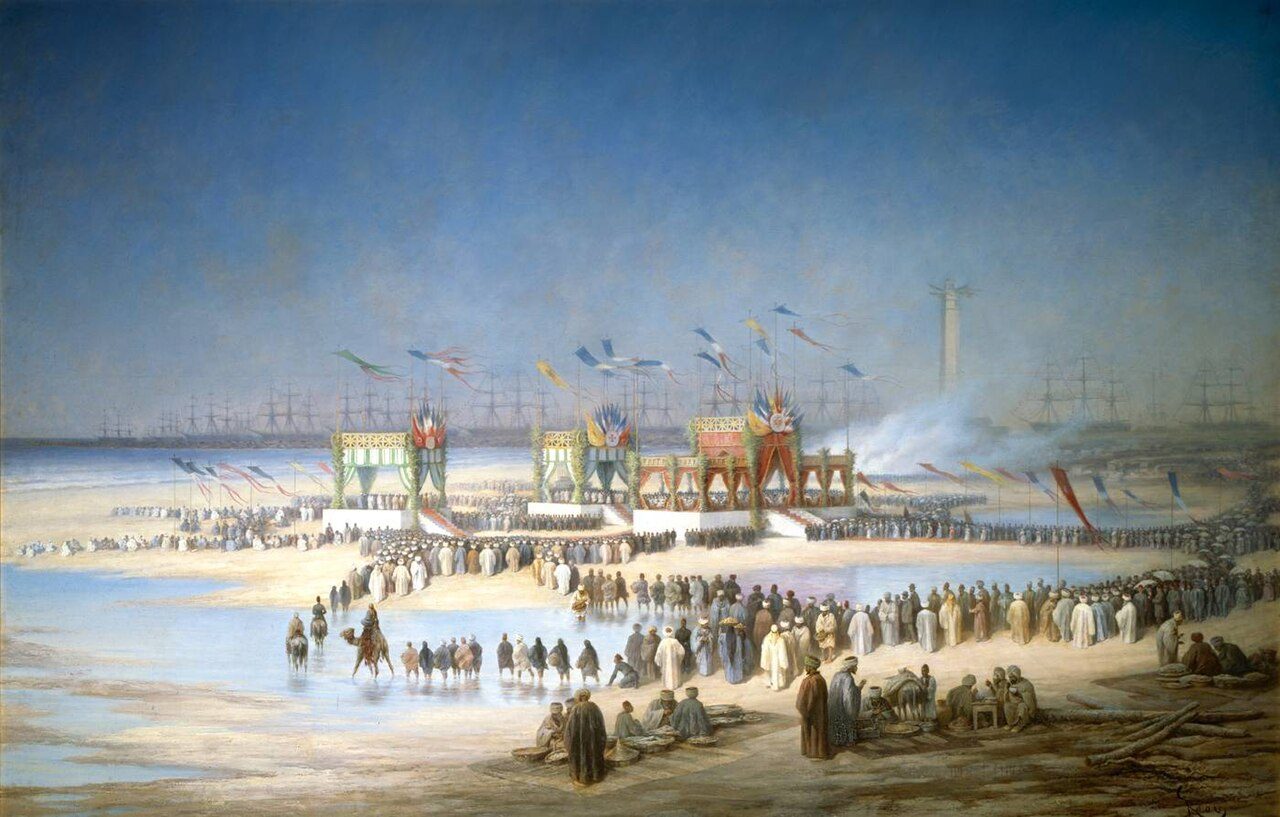
On 17 November 1869 the canal opened with a ceremony staged as imperial theatre. Empress Eugénie of France, in the imperial yacht L'Aigle, led a convoy of dozens of ships into the canal at the brand-new Port Said, amid cannon salutes, fireworks and guests who included much of Europe's royalty; Ismail Pasha, now Khedive of Egypt, had spent so lavishly on the festivities — and on the palaces and opera house built for them — that he helped bankrupt his country. The waterway itself was modest by modern standards: HISTORY records that at opening it was only about 25 feet deep and 72 feet wide at the bottom. But it worked. A ship could now pass from the Mediterranean to the Red Sea in a day, and the London-to-Bombay journey shrank by roughly two-fifths.
The consequences arrived fast and kept arriving. Steamships, which could use the canal as sailing ships mostly could not, displaced sail on the Asia routes; ports on the Cape route withered while Port Said, Aden and Singapore boomed. Britain, having denounced the canal, bought the bankrupt Khedive's shares in 1875 — Disraeli's famous coup — and occupied Egypt itself in 1882, largely to hold the waterway. The canal became the jugular of empire, then of oil: it was nationalised by Nasser in 1956, triggering the Suez Crisis; closed by war from 1967 to 1975; and expanded repeatedly, most recently with a second channel in 2015. When the container ship Ever Given wedged itself across it in 2021, a measurable share of world trade stopped for six days — proof, a century and a half on, of how much of the planet's commerce still passes through de Lesseps' ditch.
The canal's ledger is not clean. It was built substantially by coerced labour, it drew Egypt into debts that ended in foreign occupation, and it served for a century as an instrument of other people's empires. But as a piece of geography it is irreversible: before November 1869, Europe and Asia were joined for shipping purposes only by an ocean detour of thousands of miles; after it, they were neighbours. The day the first convoy steamed into Port Said is as close as the nineteenth century came to moving a continent.
Why this date matters
November 17 is a hinge date, a day of passages opening. A canal joins two seas; a queen succeeds who will give her name to an age; students march in Prague and a regime begins, peacefully, to fall; a fifteen-year-old takes power in Tibet; even its entertainment entry, The Little Mermaid, opens a new era for its studio. The date's pattern is the threshold: doors, channels and reigns beginning — some dug with enormous suffering, some crossed in a single afternoon.
Sources
- Encyclopaedia Britannica — On This Day: November 17
- HISTORY — Suez Canal opens
- HISTORY — What Happened on November 17
- Wikimedia — On This Day feed: November 17
The facts on this page were checked against these sources on 19 November 2026. The History Trail's permanent pages are researched and written for this site; the live profiles elsewhere on The History Trail are assembled automatically from Wikipedia and Wikidata.
About the Author
Researched and written by the The History Trail Editorial Team — the accountable editorial function behind this site's permanent story pages. The team works from the published sources cited on each page; it does not invent historians, reviewers or credentials, and it corrects errors openly.
Fact Check
Every load-bearing fact on this page traces to one of the sources listed above, and significant claims link to their source in the text. Our checking method is described on the methodology page; errors can be reported via the corrections page.
Sources & Citations
Cite this page as: The History Trail Editorial Team, The History Trail — this article's title, publication and update dates are shown beneath its headline. The full source list appears under Sources above; the site's source standards are on the sources page.