
On This Day
November 18 in History
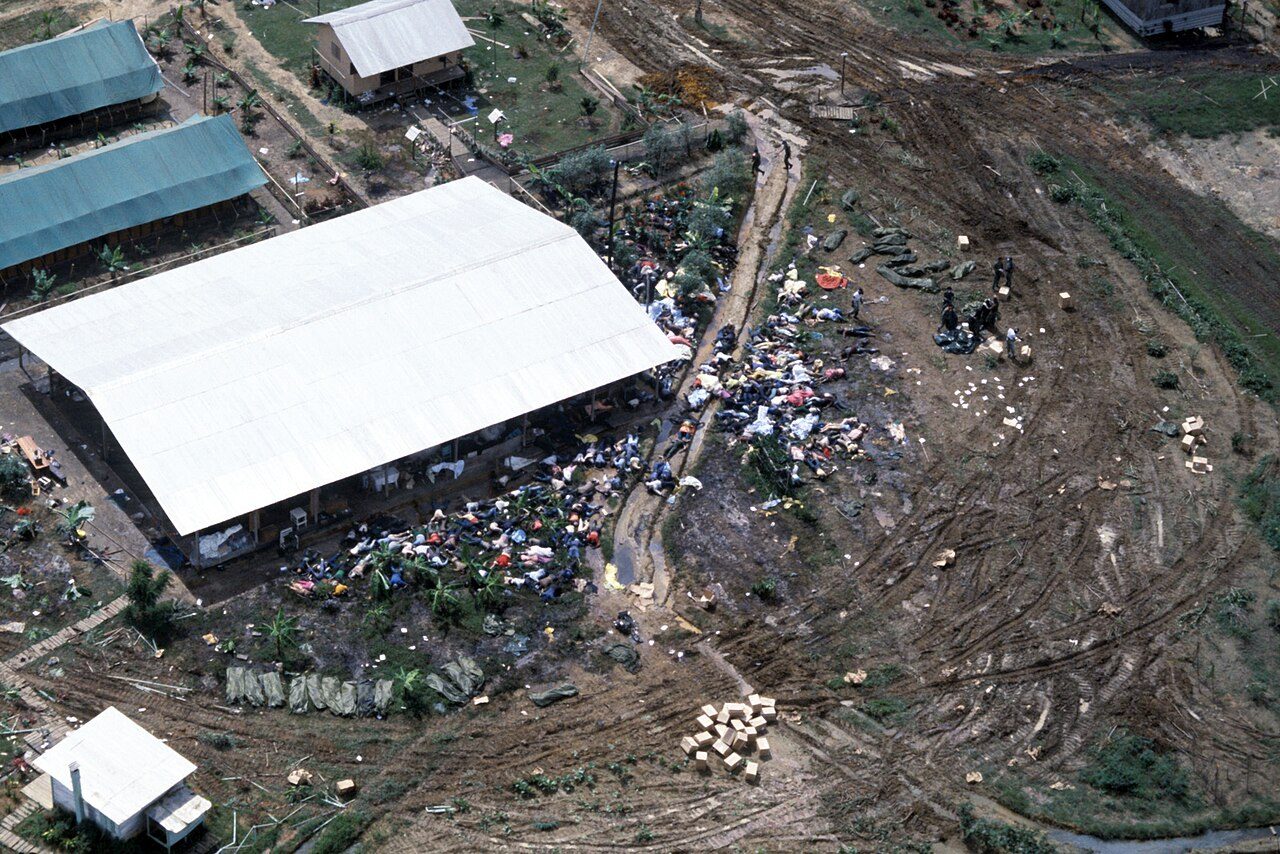
On 18 November 1978, in a jungle clearing in Guyana, more than 900 members of the Peoples Temple — over 300 of them children — died after drinking a fruit drink laced with cyanide, on the orders of their leader, Jim Jones. Hours earlier, Temple gunmen had murdered U.S. Congressman Leo Ryan at a nearby airstrip. It was the greatest single loss of American civilian life in a deliberate act before 9/11. November 18 is also the day the Somme ended and standard time zones began.
Choose another date: open the On This Day calendar to browse events, births and deaths for any day of the year.
At a Glance
- Deaths
- 918 in total in Guyana that day: 909 at Jonestown, five at the Port Kaituma airstrip and four in Georgetown (Jonestown Institute figures)
- Children
- 304 of the Jonestown dead were under 18
- The trigger
- Congressman Leo Ryan's fact-finding visit; his party was attacked at the airstrip as defectors tried to leave with him
- The leader
- Jim Jones, founder of the Peoples Temple, found dead of a gunshot wound beside the pavilion
- The recording
- The FBI recovered a 45-minute tape — the 'death tape' — of Jones urging his followers to die
- The drink
- A fruit drink (Flavor Aid, not Kool-Aid) mixed with cyanide and sedatives
Events on this day
- 1421The St Elizabeth's Day flood breaches the dikes of the Netherlands; up to 10,000 people are said to have died.
- 1865Mark Twain's story 'The Celebrated Jumping Frog of Calaveras County' is published, his first great success.
- 1872Susan B. Anthony is arrested for voting in the U.S. presidential election, an act then illegal for women.
- 1883American and Canadian railroads adopt standard continental time zones, ending the chaos of thousands of local times.
- 1916The Battle of the Somme ends after more than four months, with over a million casualties on all sides.
- 1978More than 900 members of the Peoples Temple die at Jonestown, Guyana, after Congressman Leo Ryan is murdered — the featured story above.
- 1987A fire at King's Cross station in London kills 31 people in the Underground.
- 1991The Yugoslav People's Army captures Vukovar after an 87-day siege, the first great battle of Croatia's war.
- 1999The Aggie Bonfire stack at Texas A&M University collapses during construction, killing 12 people.
- 2003Massachusetts' highest court rules in Goodridge that same-sex couples may marry, a first for a U.S. state.
- 2011Minecraft is officially released, going on to become the best-selling video game in history.
Born on this day
- 1787Louis Daguerre — French artist and inventor of the daguerreotype photographic process.
- 1939Margaret Atwood — Canadian novelist of The Handmaid's Tale.
- 1953Alan Moore — English comics writer of Watchmen and V for Vendetta.
- 1968Owen Wilson — American actor of Midnight in Paris and the Wes Anderson films.
Died on this day
- 1886Chester A. Arthur — 21st president of the United States, who succeeded the assassinated Garfield.
- 1922Marcel Proust — French novelist of In Search of Lost Time, dead at 51.
- 1962Niels Bohr — Danish physicist whose model of the atom won the Nobel Prize.
- 1969Joseph P. Kennedy Sr. — American businessman and diplomat, patriarch of the Kennedy family.
- 1976Man Ray — American Dada and Surrealist artist and photographer.
- 1994Cab Calloway — American jazz singer and bandleader of 'Minnie the Moocher'.
- 2002James Coburn — American actor of The Magnificent Seven, dead at 74.
The featured story: Jonestown, 18 November 1978
The Peoples Temple began, improbably, as one of the most hopeful churches in America: founded by Jim Jones in Indianapolis in the 1950s, it was racially integrated when that was radical, ran soup kitchens and care homes, and preached a gospel of social justice that drew thousands, many of them poor and Black. It was also, from early on, a machine of control — staged healings, public humiliations, confiscated wages and passports. As journalists and defectors began to expose the abuse in California in 1977, Jones moved his flock to a settlement he had carved from the jungle of Guyana, in South America, and named, without irony that survived him, Jonestown. About a thousand people lived there in conditions visitors later described as a prison camp of malnutrition, forced labour and rehearsed mass suicide — the 'White Night' drills in which followers drank what they were told was poison, as a test of loyalty.
Congressman Leo Ryan, whose district included many Temple families, flew to Guyana on 14 November 1978 to investigate, with journalists and relatives in tow — the FBI's account, on which this narrative draws, describes a settlement that at first performed contentment for the cameras. Then, quietly, residents began passing notes asking to leave. On the afternoon of 18 November, Ryan's party, now including fifteen defectors, was ambushed at the Port Kaituma airstrip by Temple gunmen; Ryan, three journalists and a defector were killed. It was the point of no return, and Jones knew it. Back at the pavilion he assembled his followers and told them the time for 'revolutionary suicide' had come.
What followed is documented by the survivors, the Guyanese inquest and the 45-minute tape the FBI recovered from the pavilion. Parents gave the poisoned drink to their children first; armed guards ringed the pavilion; some people resisted, many wept, and Jones, on tape, urged them to die 'with dignity'. In all, 909 people died at Jonestown that day, 304 of them children — figures compiled by the Jonestown Institute at San Diego State University — and with the five murdered at the airstrip and four more Temple members who died in Georgetown, the day's total was 918. Jones himself was found with a gunshot wound to the head. Until the attacks of 11 September 2001, it was the largest single loss of American civilian life in a deliberate act.
Jonestown entered the language — 'drinking the Kool-Aid' is its debased souvenir, doubly wrong, since the drink was Flavor Aid and most of the dead were murdered or coerced rather than willing. The serious legacy is in the record the survivors and scholars built: the Jonestown Institute's archive, the recovered tapes and documents, and the annual memorial at Evergreen Cemetery in Oakland, where many of the unidentified children are buried. The settlement itself was abandoned to the jungle. What 18 November proved, at unbearable cost, was how completely a community built on belonging could be converted into an instrument of death by one man's paranoia — and how many warnings were filed, and not acted on, along the way.
Why this date matters
November 18 is a study in systems — the systems that protect life and the one that destroyed it. Railroads impose standard time and the Somme's guns finally stop; a woman is arrested for voting and a court in Massachusetts extends marriage; a bonfire stack and a station escalator show what happens when safety systems fail. And at the centre stands Jonestown, where every safeguard — family, church, press, Congress — arrived too late. It is the calendar's darkest demonstration that institutions matter precisely on the days they are absent.
Sources
- Encyclopaedia Britannica — On This Day: November 18
- HISTORY — What Happened on November 18
- FBI — Jonestown
- Wikimedia — On This Day feed: November 18
The facts on this page were checked against these sources on 19 November 2026. The History Trail's permanent pages are researched and written for this site; the live profiles elsewhere on The History Trail are assembled automatically from Wikipedia and Wikidata.
About the Author
Researched and written by the The History Trail Editorial Team — the accountable editorial function behind this site's permanent story pages. The team works from the published sources cited on each page; it does not invent historians, reviewers or credentials, and it corrects errors openly.
Fact Check
Every load-bearing fact on this page traces to one of the sources listed above, and significant claims link to their source in the text. Our checking method is described on the methodology page; errors can be reported via the corrections page.
Sources & Citations
Cite this page as: The History Trail Editorial Team, The History Trail — this article's title, publication and update dates are shown beneath its headline. The full source list appears under Sources above; the site's source standards are on the sources page.