
On This Day
June 3 in History
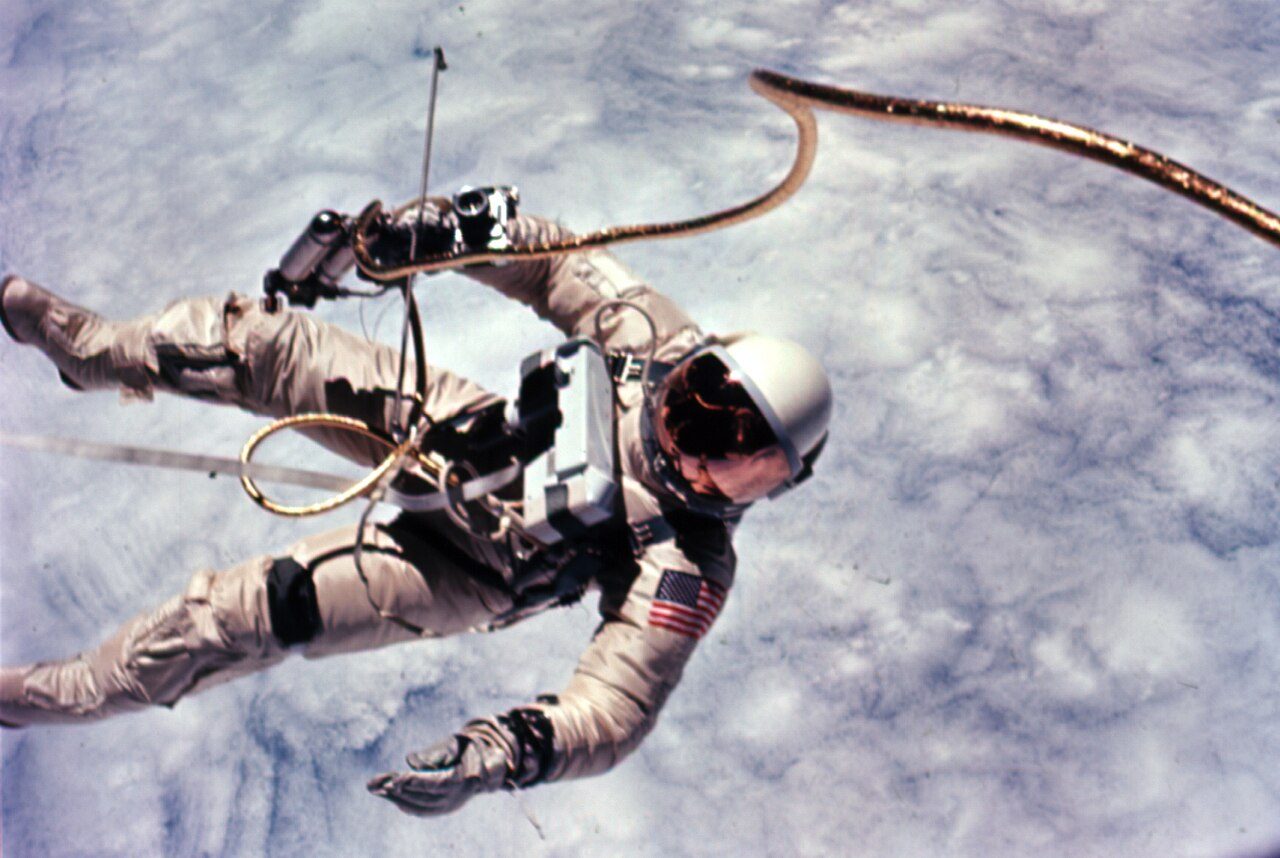
On 3 June 1965 Edward White stepped out of the Gemini 4 capsule and floated free above the Earth for 23 minutes, the first American to walk in space. June 3 is also the day the Dutch West India Company was chartered, the Duke of Windsor married Wallis Simpson, and the crackdown in Tiananmen Square began.
Choose another date: open the On This Day calendar to browse events, births and deaths for any day of the year.
At a Glance
- Date
- 3 June 1965, during the third orbit of Gemini 4
- Duration
- 23 minutes outside the spacecraft
- First
- The first American spacewalk; the second by any human, after Alexei Leonov's on 18 March 1965
- Equipment
- A hand-held self-manoeuvring unit firing oxygen jets; a 25-foot umbilical and a 23-foot tether wrapped in gold-coloured tape
- Crew
- Edward White outside; command pilot James McDivitt inside, photographing him
- Mission
- Gemini 4 flew for four days, the first long-duration American spaceflight
Events on this day
- 1621The Dutch West India Company is chartered, given a trade monopoly in the Americas and West Africa and the power to found colonies such as New Netherland.
- 1754George Washington's Virginia troops begin building Fort Necessity in Pennsylvania, weeks before fighting there opens the French and Indian War.
- 1800President John Adams arrives in the new federal capital of Washington, D.C., months before the government completes its move from Philadelphia.
- 1839The Chinese commissioner Lin Zexu begins destroying more than a thousand tons of confiscated British opium at Humen, the act that led to the First Opium War.
- 1844The last two great auks are killed on Eldey Island, Iceland, and the species is extinct; some sources date the killing to 3 July instead.
- 1864At the Battle of Cold Harbor, Virginia, a frontal Union assault on entrenched Confederate positions is repulsed with thousands of casualties in under an hour.
- 1916President Woodrow Wilson signs the National Defense Act, greatly expanding the United States Army and National Guard.
- 1937The former King Edward VIII, now Duke of Windsor, marries Wallis Simpson in France, six months after abdicating the British throne to be free to wed her.
- 1940German aircraft bomb Paris in the Luftwaffe's first major raid on the French capital, killing, by the day's reports, more than 250 people.
- 1943The Zoot Suit Riots begin in Los Angeles, as American servicemen attack Mexican American youths in disturbances that spread over several days.
- 1965Edward White floats outside Gemini 4 for 23 minutes, the first American spacewalk — the featured story above.
- 1989Chinese troops move into central Beijing to clear the Tiananmen Square protests, in a crackdown that begins on the night of 3–4 June.
- 2006Montenegro formally declares independence from its state union with Serbia, restoring its sovereignty after 88 years.
Born on this day
- 1808Jefferson Davis — president of the Confederate States during the American Civil War.
- 1904Charles Drew — American surgeon and researcher who pioneered large-scale blood banks.
- 1906Josephine Baker — American-born French entertainer, Resistance worker and civil rights activist.
- 1926Allen Ginsberg — American poet of Howl, a central voice of the Beat Generation.
- 1936Larry McMurtry — American novelist of Lonesome Dove and The Last Picture Show.
Died on this day
- 1989Ayatollah Ruhollah Khomeini — Iranian religious leader who led the 1979 revolution and ruled the Islamic Republic for a decade.
- 1990Robert Noyce — American physicist and co-inventor of the integrated circuit, co-founder of Intel.
- 2016Muhammad Ali — American heavyweight boxing champion and global sporting icon, dead at 74.
The featured story: Edward White makes the first American spacewalk, 3 June 1965
The space race demanded spectacles, and in the spring of 1965 the Soviet Union had just produced the greatest one yet: on 18 March Alexei Leonov had floated outside Voskhod 2 to become the first human being to walk in space. NASA's answer came less than three months later. Gemini 4, crewed by command pilot James McDivitt and pilot Edward White, was to make the first long-duration American flight — four days — and, once in orbit, White would open his hatch and go outside.
On 3 June 1965, during the capsule's third orbit, White pulled himself out over the Pacific. He was connected to Gemini 4 by a 25-foot umbilical that carried his oxygen, with a 23-foot tether wound together with it and wrapped in gold-coloured tape. In his right hand he held a hand-held self-manoeuvring unit — a 'zip gun' firing jets of oxygen — with which he could push himself around the capsule. His helmet's outer visor was gold-plated against the unfiltered sun. For 23 minutes he floated and turned above the Earth, passing over Hawaii and the Gulf of Mexico, while McDivitt photographed him from inside, producing some of the most famous images of the space age.
White was enjoying himself so much that bringing him back became a negotiation. When mission control ordered the spacewalk ended as Gemini 4 approached darkness, White pleaded for more time before finally, reluctantly, pulling himself back to the hatch. He later called the moment he had to re-enter the saddest moment of his life. The flight itself went on for four days, testing whether astronauts could endure the long missions a Moon voyage would require, and splashed down on 7 June.
The walk proved that a suited astronaut could work outside a spacecraft — the skill on which moonwalks, satellite repairs and space-station assembly would all depend. White never flew in space again. On 27 January 1967 he died, with Gus Grissom and Roger Chaffee, in the fire that engulfed Apollo 1 during a launch-pad test. The 23 minutes over the Pacific and the Gulf remain the purest expression of the early space age: one man, a golden cord, and the whole Earth turning beneath him.
Why this date matters
June 3 keeps returning to thresholds crossed in public: a trading company chartered to project Dutch power across an ocean, opium destroyed on a Chinese shore, a king who gave up a throne for marriage, and an astronaut who quite literally stepped outside. The date's signature is the moment of exposure — stepping out of the fort, the palace or the capsule into an element that cannot be controlled. White's 23 minutes define it best, because they were both a technical test and a piece of theatre, and because the man who performed them was so plainly reluctant to come back in.
Sources
- Encyclopaedia Britannica — On This Day: June 3
- HISTORY — What Happened on June 3
- NASA — Gemini June 3, 1965
- Wikipedia — June 3
The facts on this page were checked against these sources on 19 November 2026. The History Trail's permanent pages are researched and written for this site; the live profiles elsewhere on The History Trail are assembled automatically from Wikipedia and Wikidata.
About the Author
Researched and written by the The History Trail Editorial Team — the accountable editorial function behind this site's permanent story pages. The team works from the published sources cited on each page; it does not invent historians, reviewers or credentials, and it corrects errors openly.
Fact Check
Every load-bearing fact on this page traces to one of the sources listed above, and significant claims link to their source in the text. Our checking method is described on the methodology page; errors can be reported via the corrections page.
Sources & Citations
Cite this page as: The History Trail Editorial Team, The History Trail — this article's title, publication and update dates are shown beneath its headline. The full source list appears under Sources above; the site's source standards are on the sources page.