
On This Day
June 6 in History
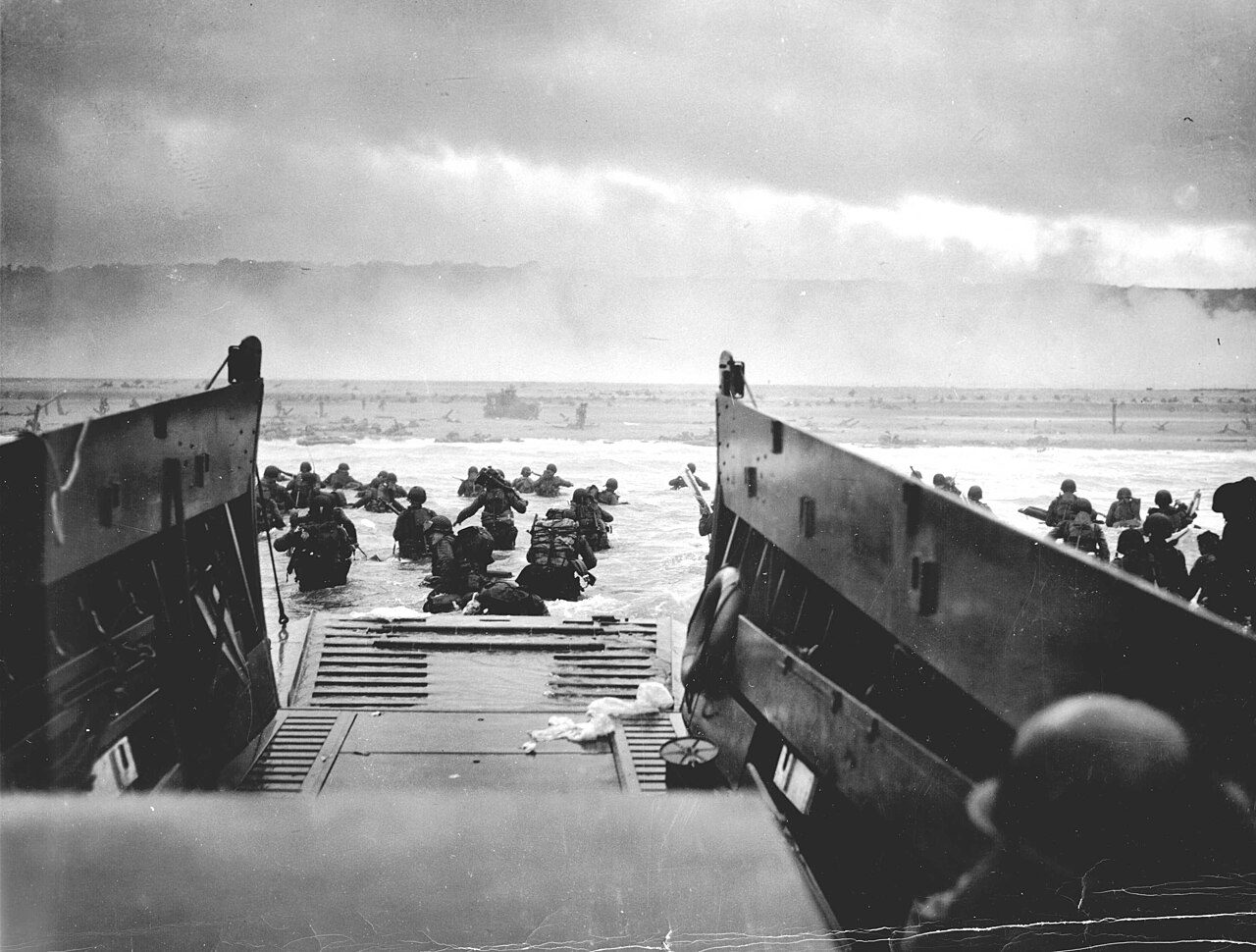
On 6 June 1944 Allied forces landed in Normandy in the largest seaborne invasion in history: some 156,000 troops crossed the Channel on the first day of Operation Overlord. June 6 is also the day the YMCA was founded in London, the first drive-in cinema opened in New Jersey, and Robert F. Kennedy died of his wounds.
Choose another date: open the On This Day calendar to browse events, births and deaths for any day of the year.
At a Glance
- Date
- 6 June 1944; the landing operation was codenamed Neptune, within Operation Overlord
- Scale
- Some 156,000 Allied troops landed on the first day, carried by more than 5,000 ships and landing craft and supported by over 11,000 aircraft
- The beaches
- Five landing beaches: Utah and Omaha (American), Gold and Sword (British), Juno (Canadian)
- The delay
- The landings were postponed 24 hours from 5 June because of bad weather, on a narrow forecast window
- The cost
- Allied casualties on the day are estimated at about 10,000, including 4,414 confirmed killed
- The commander
- General Dwight D. Eisenhower, Supreme Allied Commander
Events on this day
- 1833Andrew Jackson rides a Baltimore and Ohio train, becoming the first American president to travel by rail.
- 1844George Williams founds the Young Men's Christian Association (YMCA) in London, a movement that spreads worldwide.
- 1892Chicago's first elevated railway, the 'L', begins carrying passengers, the start of the city's famous loop system.
- 1933The first drive-in cinema opens, in Camden, New Jersey, the creation of Richard Hollingshead, who had tested the idea in his driveway.
- 1944Allied forces land in Normandy on D-Day — the featured story above.
- 1968Robert F. Kennedy dies in Los Angeles of the wounds inflicted by an assassin the previous night, aged 42.
- 1984Alexey Pajitnov completes Tetris in Moscow; the falling-block game becomes one of the best-selling video games of all time.
- 1998Sex and the City premieres on HBO, beginning a six-season run that reshapes American television comedy.
- 2004Phylicia Rashad wins the Tony Award for best actress for A Raisin in the Sun, the first African American to win in that category.
- 2015American Pharoah wins the Belmont Stakes to complete the first American Triple Crown in 37 years.
Born on this day
- 1599Diego Velázquez — Spanish painter of Las Meninas, baptised in Seville on this day.
- 1756John Trumbull — American artist who painted the great scenes of the American Revolution.
- 1919Peter Carington — British foreign secretary and secretary general of NATO.
- 1943James Turrell — American artist who works with light and perception.
- 1956Björn Borg — Swedish tennis champion, winner of eleven Grand Slam singles titles.
- 1980Mmusi Maimane — South African politician, former leader of the Democratic Alliance.
Died on this day
- 1832Jeremy Bentham — English philosopher and jurist who founded modern utilitarianism; his preserved auto-icon is displayed at University College London.
- 1961Carl Jung — Swiss psychiatrist who founded analytical psychology, dead at Küsnacht, aged 85.
- 1968Robert F. Kennedy — American senator and presidential candidate, dead in Los Angeles a day after being shot, aged 42.
The featured story: D-Day — the Normandy landings, 6 June 1944
D-Day was the most heavily prepared gamble of the Second World War. By the spring of 1944 the Allies had assembled in southern England an invasion force of some 156,000 men for the first day alone, supported by more than 5,000 ships and landing craft and over 11,000 aircraft. An elaborate deception, Operation Fortitude, worked to convince the Germans that the blow would fall at the Pas-de-Calais, the shortest crossing. The supreme commander, General Dwight D. Eisenhower, had fixed the landings for 5 June — and then, with a storm battering the Channel, postponed them by a day on the forecast of his meteorologist, Group Captain James Stagg, who promised a brief window of tolerable weather on the 6th.
The invasion began in darkness. Shortly after midnight, more than 18,000 British and American paratroopers and glider troops dropped behind the beaches to seize bridges and causeways. At dawn the greatest naval bombardment of the war opened on the German Atlantic Wall, and from 6:30 a.m. the infantry went ashore on five beaches: Utah and Omaha for the Americans, Gold and Sword for the British, Juno for the Canadians. At Omaha, where a German infantry division waited on the bluffs, the first waves were cut down in the surf and among the obstacles, and for hours the landing hung in the balance.
By nightfall all five beachheads were held and some 156,000 troops were ashore — but the cost was severe, and the day's ambitions were only partly met: the city of Caen, a first-day objective, would not fall for weeks. Allied casualties for 6 June are estimated at about 10,000 men, of whom 4,414 are confirmed killed. The German defenders, surprised — many senior officers were away from their posts, and armoured reserves were released too late — could not throw the invaders back into the sea, the one outcome that might have changed the war's course.
Within eleven months Germany had surrendered, and the armies that landed on D-Day had liberated Paris, crossed the Rhine and met the Red Army in the heart of Germany. Normandy remained the hinge: the moment the Western Allies returned to France in strength and Nazi Germany's defeat became a matter of time. The cemeteries above the beaches, and the dwindling ranks of veterans who return to them each June, have made 6 June the most commemorated date of the war in the West. The invasion also fixed the vocabulary of the century: 'D-Day', a plain military term for the day an operation begins, now belongs to this one morning above all others.
Why this date matters
June 6 will always belong to Normandy, and the rest of the date arranges itself around that fact: a president's first train ride, a youth movement founded in a London draper's shop, a cinema you watched from your car, a video game assembled in Moscow. They are all, in their way, departures — new ways of moving, gathering and seeing arriving on a single date. But it is the departure from the landing craft that defines the day: the largest fleet ever assembled, launched on a weather forecast, carrying the liberation of a continent in its holds. That the same date in 1968 took Robert Kennedy, who had hoped to lead that liberated world a generation later, gives the day its sombre counterweight.
Sources
- Encyclopaedia Britannica — On This Day: June 6
- HISTORY — What Happened on June 6
- Imperial War Museums — 10 Things You Need to Know About D-Day
- Smithsonian Magazine — The Day That Changed the World
The facts on this page were checked against these sources on 19 November 2026. The History Trail's permanent pages are researched and written for this site; the live profiles elsewhere on The History Trail are assembled automatically from Wikipedia and Wikidata.
About the Author
Researched and written by the The History Trail Editorial Team — the accountable editorial function behind this site's permanent story pages. The team works from the published sources cited on each page; it does not invent historians, reviewers or credentials, and it corrects errors openly.
Fact Check
Every load-bearing fact on this page traces to one of the sources listed above, and significant claims link to their source in the text. Our checking method is described on the methodology page; errors can be reported via the corrections page.
Sources & Citations
Cite this page as: The History Trail Editorial Team, The History Trail — this article's title, publication and update dates are shown beneath its headline. The full source list appears under Sources above; the site's source standards are on the sources page.