
On This Day
June 5 in History
On 5 June 1968 Senator Robert F. Kennedy was shot in Los Angeles minutes after winning California's Democratic presidential primary; he died the following day. June 5 is also the day George Marshall proposed the Marshall Plan at Harvard, the Six-Day War began, and the first report of the illness later named AIDS was published.
Choose another date: open the On This Day calendar to browse events, births and deaths for any day of the year.
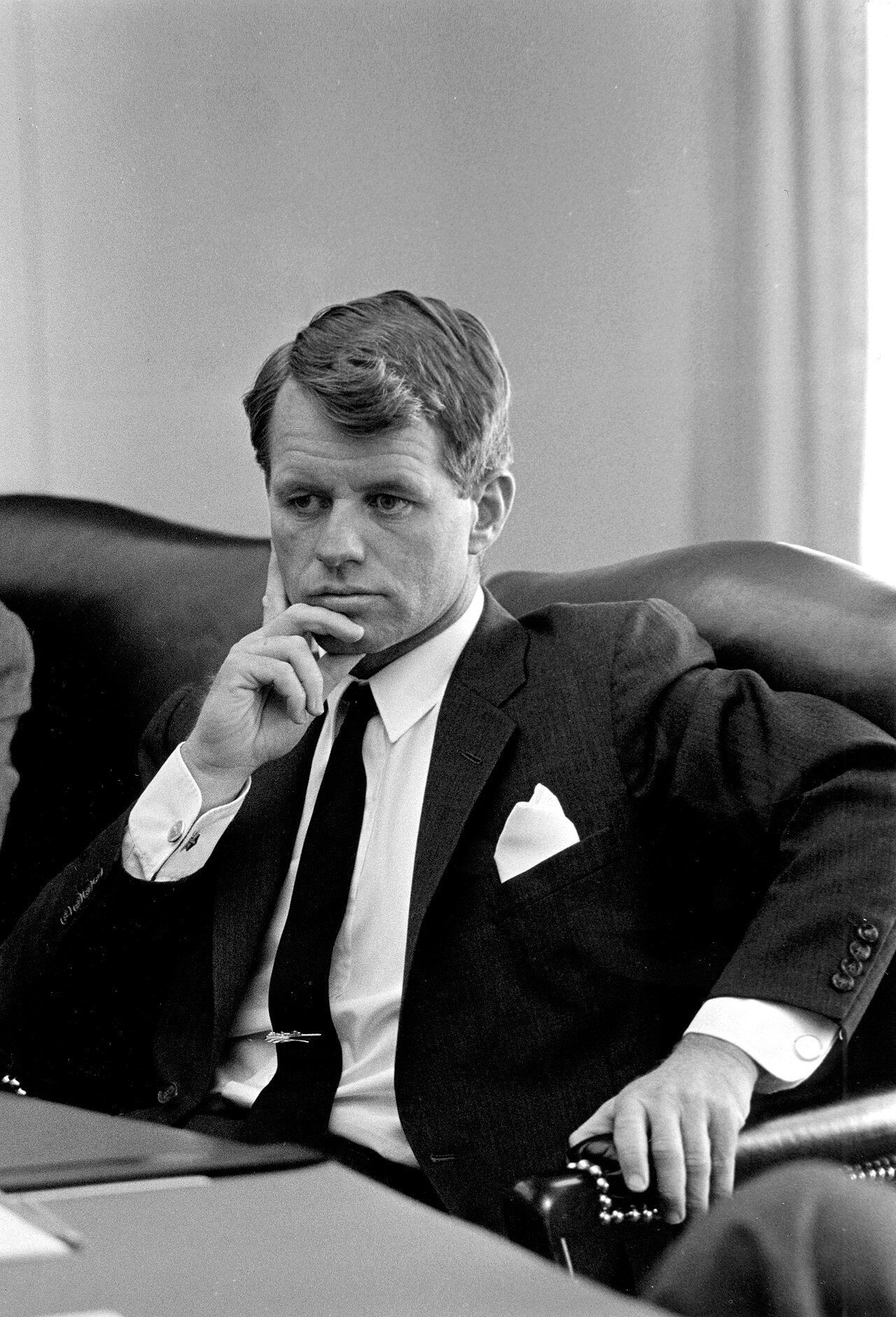
At a Glance
- Shot
- Just after midnight on 5 June 1968, in the pantry of the Ambassador Hotel, Los Angeles
- The occasion
- Kennedy had just won the California Democratic presidential primary with 46 percent of the vote
- The gunman
- Sirhan Sirhan, who fired eight shots from a .22 revolver; five other people were wounded and survived
- Death
- Kennedy died at 1:44 a.m. on 6 June 1968, aged 42
- Who he was
- Former US attorney general, senator from New York, and brother of President John F. Kennedy
- Aftermath
- Sirhan was convicted of murder in 1969; his death sentence was commuted to life imprisonment in 1972
Events on this day
- 1849Denmark adopts a new constitution, abolishing absolute monarchy and establishing a constitutional monarchy with an elected parliament.
- 1942The United States declares war on Bulgaria, Hungary and Romania, completing its entry into the European war against the Axis.
- 1944On the eve of D-Day, some 1,000 British bombers pound German coastal defences in Normandy, the heaviest raid of the invasion preparation.
- 1947Secretary of State George C. Marshall, speaking at Harvard, proposes American aid to rebuild war-shattered Europe — the speech that launched the Marshall Plan.
- 1956Elvis Presley performs 'Hound Dog' on The Milton Berle Show, gyrating in a style that scandalises television audiences.
- 1967The Six-Day War begins as Israel launches Operation Focus, a surprise strike that destroys most of Egypt's air force on the ground.
- 1968Senator Robert F. Kennedy is shot at the Ambassador Hotel in Los Angeles — the featured story above.
- 1975The Suez Canal reopens to shipping for the first time since the Six-Day War closed it eight years earlier.
- 1981The US Centers for Disease Control publishes the first report of a rare pneumonia in five Los Angeles patients — the first recognised report of the epidemic later named AIDS.
- 2017Montenegro becomes the 29th member of NATO, joining the alliance despite Russian objections.
Born on this day
- 1723Adam Smith — Scottish economist and author of The Wealth of Nations; baptised in Kirkcaldy on this day, his exact birth date unrecorded.
- 1883John Maynard Keynes — English economist whose ideas reshaped governments' management of economies.
- 1898Federico García Lorca — Spanish poet and playwright, murdered at the start of the Spanish Civil War.
- 1939Joe Clark — Canadian politician who became, at 39, his country's youngest prime minister.
Died on this day
- 1910O. Henry — American short-story writer, pen name of William Sydney Porter, master of the twist ending, dead at 47.
- 2004Ronald Reagan — 40th president of the United States, dead at 93 after a decade with Alzheimer's disease.
- 2012Ray Bradbury — American author of Fahrenheit 451 and The Martian Chronicles, dead at 91.
The featured story: Robert F. Kennedy is shot in Los Angeles, 5 June 1968
Robert Kennedy entered the 1968 presidential race late and ran it like an insurgency. The Tet Offensive had shattered confidence in the Vietnam War, and President Lyndon Johnson, humiliated in the New Hampshire primary, withdrew on 31 March. Kennedy, the former attorney general and now senator from New York, had declared his candidacy two weeks earlier, and through the spring he campaigned in poor neighbourhoods, on reservations and in farm towns, building a coalition of Black, Latino and working-class white voters. Everything depended on California, the biggest primary prize, on 4 June.
He won it, with 46 percent of the vote. Shortly after midnight on 5 June, in the Embassy Ballroom of the Ambassador Hotel in Los Angeles, Kennedy thanked his supporters, promised to heal the country's divisions and finished: 'So my thanks to all of you, and on to Chicago, and let's win there.' Leaving the stage, he was steered through a serving pantry — by most accounts a last-minute shortcut — shaking hands with kitchen staff. There, Sirhan Sirhan, a 24-year-old Palestinian-born man who had been waiting in the pantry, stepped forward with a .22 revolver and fired eight shots. Kennedy was hit three times; five other people were wounded, all of whom survived.
Surgeons at the Hospital of the Good Samaritan operated for nearly four hours, but the bullet that entered behind his right ear had done irreparable damage. Robert Kennedy died at 1:44 a.m. on 6 June, aged 42 — five years after his brother the president, and two months after Martin Luther King Jr. His body was flown to New York, where thousands filed past the coffin at St Patrick's Cathedral, then carried by train to Washington while crowds lined the tracks the whole way. He was buried at Arlington, near his brother, on the evening of 8 June.
Sirhan Sirhan was convicted of murder in 1969; prosecutors pointed to his notebooks and his anger at Kennedy's support for Israel, and he was sentenced to death, a sentence commuted to life imprisonment in 1972. The killing, following so closely on King's, deepened the trauma of 1968, fed demands for gun control, and led directly to the extension of Secret Service protection to major presidential candidates. Kennedy's campaign — the last of the Kennedy brothers — has been remembered ever since as one of American politics' great might-have-beens. The Democratic Party went on to a chaotic convention in Chicago that August and defeat by Richard Nixon in November, and historians have argued ever since about whether Kennedy, uniquely able to hold together the party's warring constituencies, might have changed that ending.
Why this date matters
June 5 is a date of launches and one terrible interruption: a canal reopened, a recovery plan proposed, a war begun in a morning, an epidemic first noticed in a medical bulletin. Its centre of gravity is the Ambassador Hotel pantry, where the politics of a decade turned in eight shots. Read whole, the day has a hinge quality — constitutions adopted, wars declared, candidacies ended — as if history preferred this date for crossing from one arrangement of the world into another, for better and for worse. Even its quietest entry, a baptism in Kirkcaldy in 1723, produced The Wealth of Nations and the modern economy.
Sources
- Encyclopaedia Britannica — On This Day: June 5
- HISTORY — What Happened on June 5
- California State Archives — Robert F. Kennedy Assassination
- Wikipedia — June 5
The facts on this page were checked against these sources on 19 November 2026. The History Trail's permanent pages are researched and written for this site; the live profiles elsewhere on The History Trail are assembled automatically from Wikipedia and Wikidata.
About the Author
Researched and written by the The History Trail Editorial Team — the accountable editorial function behind this site's permanent story pages. The team works from the published sources cited on each page; it does not invent historians, reviewers or credentials, and it corrects errors openly.
Fact Check
Every load-bearing fact on this page traces to one of the sources listed above, and significant claims link to their source in the text. Our checking method is described on the methodology page; errors can be reported via the corrections page.
Sources & Citations
Cite this page as: The History Trail Editorial Team, The History Trail — this article's title, publication and update dates are shown beneath its headline. The full source list appears under Sources above; the site's source standards are on the sources page.