
On This Day
June 8 in History
On 8 June 632, by the traditional dating, the Prophet Muhammad died at Medina, in the house of his wife Aisha, weeks after delivering his Farewell Sermon — though historians note the exact day rests on tradition and cannot be verified with certainty. June 8 is also the day Vikings first raided Lindisfarne, Orwell's Nineteen Eighty-Four was published, and the first Porsche was completed.
Choose another date: open the On This Day calendar to browse events, births and deaths for any day of the year.
At a Glance
- Died
- 8 June 632 — traditionally 12 Rabi' al-Awwal, year 11 of the Islamic calendar — at Medina
- Age
- About 62
- Place
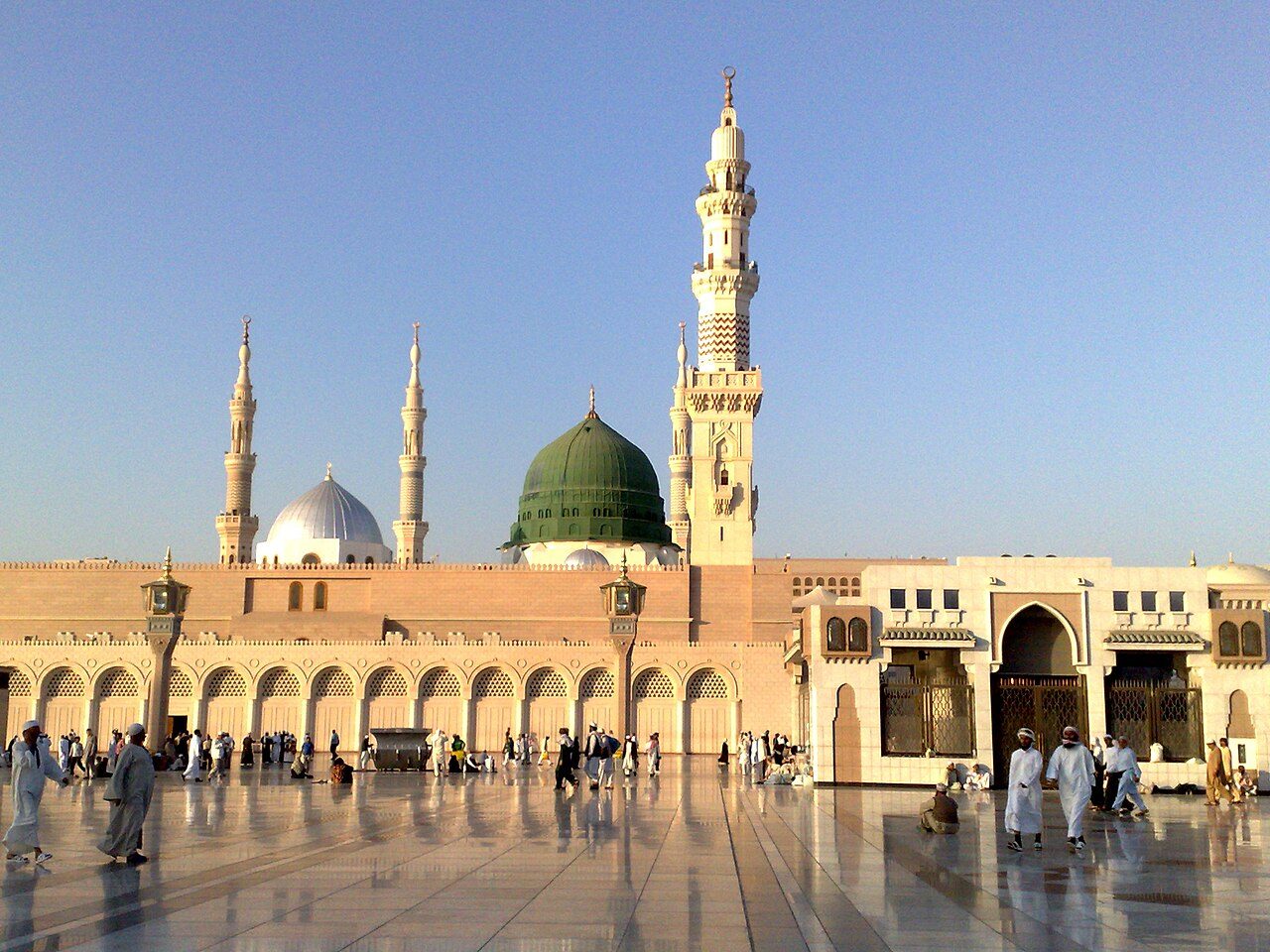
- The house of his wife Aisha, adjoining the mosque at Medina; he was buried in its floor
- Final journey
- The Farewell Pilgrimage to Mecca and its sermon, completed weeks earlier in March 632
- Succession
- No successor had been universally designated; Abu Bakr was chosen as the first caliph
- The site today
- His burial chamber is enclosed within the Prophet's Mosque in Medina
Events on this day
- 632Muhammad dies at Medina, weeks after his Farewell Pilgrimage — the featured story above.
- 793Viking raiders attack the monastery of Lindisfarne off the Northumbrian coast, the raid traditionally taken as the start of the Viking Age.
- 1191Richard I of England arrives at Acre during the Third Crusade and joins the siege of the city.
- 1783The Laki fissure eruption begins in Iceland; its ash, famine and disease kill, by common estimate, more than 9,000 Icelanders and disrupt weather worldwide.
- 1789James Madison introduces proposed amendments to the US Constitution in Congress — the proposals that become the Bill of Rights.
- 1861Tennessee votes to secede from the Union, the last state to join the Confederacy.
- 1867Franz Joseph is crowned King of Hungary in Budapest, sealing the Compromise that creates the Dual Monarchy of Austria-Hungary.
- 1948The first Porsche, the 'No. 1' prototype roadster, is completed in Gmünd, Austria.
- 1949George Orwell's dystopian novel Nineteen Eighty-Four is published in London.
- 1959The US Navy submarine Barbero fires a Regulus missile carrying 3,000 letters to a Florida naval station — the only 'missile mail' delivery.
- 1967Israeli forces attack the US Navy ship USS Liberty during the Six-Day War, killing 34 American servicemen; Israel apologised, calling it mistaken identity.
- 1968James Earl Ray, the assassin of Martin Luther King Jr., is captured at London's Heathrow Airport.
Born on this day
- 1810Robert Schumann — German Romantic composer of piano music, songs and symphonies.
- 1867Frank Lloyd Wright — American architect of Fallingwater and the Guggenheim Museum.
- 1916Francis Crick — English biologist who, with James Watson, determined the structure of DNA.
- 1933Joan Rivers — American comedian and television host, a pioneer for women in stand-up.
- 1955Tim Berners-Lee — English computer scientist who invented the World Wide Web.
Died on this day
- 1845Andrew Jackson — seventh president of the United States, dead at his home, the Hermitage in Tennessee, aged 78.
- 1874Cochise — Chiricahua Apache leader who fought the United States in Arizona before making peace in 1872.
- 1924George Mallory and Andrew Irvine — British climbers last seen alive high on Mount Everest; they are presumed to have died that day, and Mallory's body was found in 1999.
- 2018Anthony Bourdain — American chef, writer and television traveller, dead at 61.
The featured story: the death of Muhammad at Medina, 8 June 632
In March 632, weeks before his death, Muhammad made the journey from Medina to Mecca for the pilgrimage known to tradition as the Farewell Pilgrimage. The sermon he delivered there, as the traditional accounts preserve it, set out the sanctity of life and property, the rights of women and the equality of believers. He returned to Medina, the city that had received him a decade earlier when he fled Mecca, and it was there, in the early summer, that his final illness began — described in the sources as fever and severe headache.
He died, according to the traditional dating, on 8 June 632 — the 12th of Rabi' al-Awwal in the year 11 of the Islamic calendar — in the room of his wife Aisha, adjoining the mosque at Medina. The news at first met disbelief: the companion Umar is said to have denied that the Prophet could be dead, until Abu Bakr addressed the community with the words tradition has preserved: whoever worshipped Muhammad should know that Muhammad is dead; whoever worshipped God, God is living and does not die. Muhammad was buried where he died, in the floor of Aisha's chamber — the spot now enclosed within the Prophet's Mosque.
His death opened an immediate crisis, for he had named no universally accepted successor. While his closest family prepared the burial, leading companions met at the Saqifa, the hall of the Banu Sa'ida clan, and chose Abu Bakr as caliph — 'successor' — a decision that secured the community's unity in the short term but planted the question of rightful leadership that would, in time, divide Islam into its Sunni and Shia branches. Under Abu Bakr and his successors the tribes of Arabia were reunited in the Ridda wars, and within a generation Arab armies carried Islam far beyond the peninsula.
A note of scholarly caution belongs with the date itself: 8 June 632 is the conventional conversion of the traditional Hijri date, and reference works such as HISTORY observe that the exact day cannot now be verified with certainty. What is not in doubt is the scale of what ended at Medina. In twenty-three years Muhammad had transformed Arabia's religion and politics; the community he left behind became, within a century, the nucleus of a civilisation stretching from Spain to Central Asia.
Why this date matters
June 8 holds an unusual double character: endings that became beginnings. A prophet's death in a small room in Medina set in motion a civilisation; a raid on a Northumbrian island opened an age of seaborne upheaval; a novel published in 1949 gave the future a warning it still quotes. Even the day's lighter entries — a car prototype in Austria, letters delivered by missile — are first versions of things that grew. It is a date about seeds: small, sometimes violent moments whose consequences nobody present could have measured.
Sources
- Encyclopaedia Britannica — On This Day: June 8
- HISTORY — What Happened on June 8
- Wikipedia — June 8
- Encyclopaedia Britannica — Muhammad
The facts on this page were checked against these sources on 19 November 2026. The History Trail's permanent pages are researched and written for this site; the live profiles elsewhere on The History Trail are assembled automatically from Wikipedia and Wikidata.
About the Author
Researched and written by the The History Trail Editorial Team — the accountable editorial function behind this site's permanent story pages. The team works from the published sources cited on each page; it does not invent historians, reviewers or credentials, and it corrects errors openly.
Fact Check
Every load-bearing fact on this page traces to one of the sources listed above, and significant claims link to their source in the text. Our checking method is described on the methodology page; errors can be reported via the corrections page.
Sources & Citations
Cite this page as: The History Trail Editorial Team, The History Trail — this article's title, publication and update dates are shown beneath its headline. The full source list appears under Sources above; the site's source standards are on the sources page.