
On This Day
June 7 in History
On 7 June 1929 the Lateran Treaty came into force, creating Vatican City as an independent state and ending nearly sixty years of estrangement between Italy and the papacy. June 7 is also the day Spain and Portugal divided the non-European world at Tordesillas, climbers first stood on the summit of Denali, and Alan Turing died.
Choose another date: open the On This Day calendar to browse events, births and deaths for any day of the year.
At a Glance
- Signed
- 11 February 1929, at the Lateran Palace in Rome
- Signatories
- Cardinal Pietro Gasparri for Pope Pius XI; Benito Mussolini for King Victor Emmanuel III of Italy
- In force
- 7 June 1929, on the exchange of ratifications
- What it settled
- The 'Roman Question', open since Italian troops seized Rome in 1870
- The new state
- Vatican City — about 44 hectares (109 acres), the smallest independent state in the world
- Also agreed
- A concordat on church-state relations and a financial settlement compensating the Holy See for the lost Papal States
Events on this day
- 1494Spain and Portugal sign the Treaty of Tordesillas, dividing the lands beyond Europe between them along a line in the Atlantic.
- 1520Henry VIII of England and Francis I of France meet at the Field of the Cloth of Gold, a summit of spectacular pageantry near Calais.
- 1576Martin Frobisher sails from England in search of the Northwest Passage to Asia, reaching the bay in Canada that now bears his name.
- 1832The Great Reform Act receives royal assent, redrawing Britain's parliamentary map and widening the franchise.
- 1913Hudson Stuck's expedition makes the first successful ascent of Denali (Mount McKinley), the highest peak in North America.
- 1919The Sette Giugno riots erupt in Malta against British rule and high food prices; four Maltese men are killed, and the day is now a national holiday.
- 1929The Lateran Treaty comes into force and Vatican City becomes an independent state — the featured story above.
- 1965In Griswold v. Connecticut, the US Supreme Court strikes down a ban on contraceptives, recognising a constitutional right to privacy.
- 1982Elvis Presley's Memphis home, Graceland, opens to the public, five years after his death.
- 2006Abu Musab al-Zarqawi, leader of al-Qaeda in Iraq, is killed in a US airstrike near Baqubah.
Born on this day
- 1848Paul Gauguin — French Post-Impressionist painter of Tahitian scenes.
- 1917Gwendolyn Brooks — American poet, the first African American to win a Pulitzer Prize for poetry.
- 1940Tom Jones — Welsh singer of 'It's Not Unusual' and 'Delilah'.
- 1958Prince — American musician and songwriter, born Prince Rogers Nelson in Minneapolis.
Died on this day
- 1329Robert the Bruce — king of Scots who won Scotland's independence from England, dead at Cardross.
- 1937Jean Harlow — American film star, the original 'blonde bombshell', dead at 26.
- 1954Alan Turing — English mathematician who laid the foundations of computer science and helped break Germany's codes, dead at 41.
- 1970E. M. Forster — English novelist of A Passage to India and Howards End, dead at 91.
- 1980Henry Miller — American writer of Tropic of Cancer, dead at 88.
The featured story: the Lateran Treaty creates Vatican City, 7 June 1929
For nearly sixty years the popes had called themselves prisoners. When Italian troops seized Rome in 1870, completing the unification of Italy, Pope Pius IX withdrew into the Vatican palaces and refused to recognise the Italian state that had swallowed the Papal States — the broad band of central Italy the popes had ruled for a thousand years. Successive popes never left the Vatican, the 'Roman Question' festered, and Italian Catholics were long discouraged from taking part in the politics of a state their church did not accept.
Benito Mussolini, in power since 1922, wanted the question settled: a treaty with the Church would lend his Fascist regime legitimacy at home and abroad. Negotiations opened in 1926 and concluded at the Lateran Palace on 11 February 1929, where Cardinal Pietro Gasparri, secretary of state to Pope Pius XI, and Mussolini, representing King Victor Emmanuel III, signed three documents: a treaty, a concordat regulating church-state relations, and a financial convention compensating the Holy See for its lost territories.
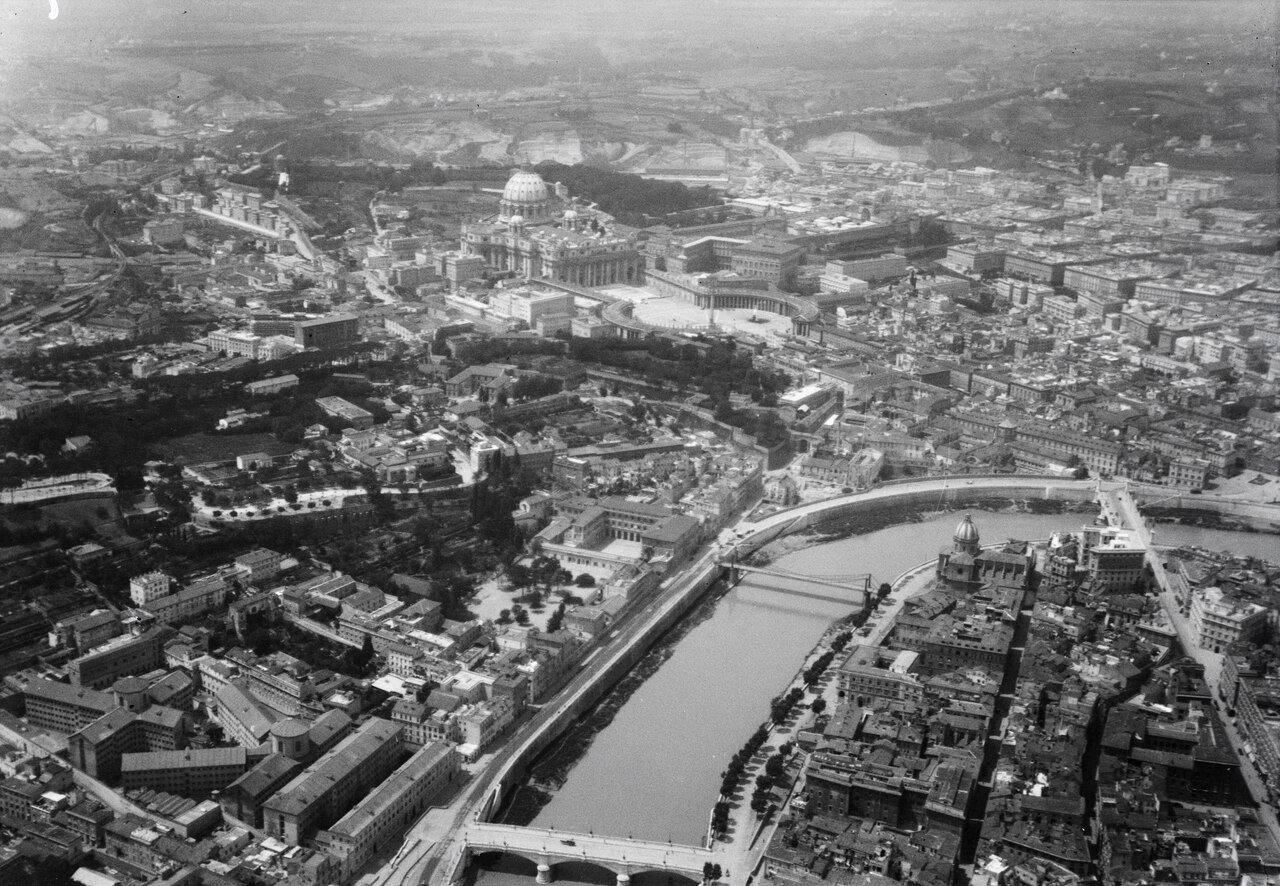
The instruments of ratification were exchanged on 7 June 1929, and the Lateran Treaty came into force. Italy recognised the sovereignty of the Holy See over a new state, Vatican City — some 44 hectares around St Peter's Basilica, the smallest state in the world — together with extraterritorial rights over basilicas and palaces across Rome and the papal summer residence at Castel Gandolfo. The pope was no longer a prisoner: Pius XI could, and soon did, travel beyond the Vatican walls, and the Holy See took its place among the subjects of international law. The new state quickly acquired the furniture of statehood — its own flag, stamps, coinage, courts and a tiny administration — all in the service of a single purpose: guaranteeing that the Church's government would never again depend on another power's permission.
The settlement proved one of the most durable of the interwar years. The Lateran Pacts were written into the Italian constitution of 1948, surviving the fall of Fascism and of the monarchy that had signed them; the concordat was revised in 1984, ending Catholicism's status as Italy's state religion. Vatican City still functions as the territorial guarantee of the Holy See's independence — a state smaller than many farms, created so that a global church could answer to no earthly government.
Why this date matters
June 7 is a day of lines drawn and summits reached: an imaginary line down the Atlantic dividing two empires' claims, a treaty line around 44 hectares in Rome, a legal line around private life in Connecticut, and four climbers standing where no one had stood before, on the roof of North America. Its character is settlement — of maps, of disputes, of questions thought unanswerable. The Lateran Treaty is its emblem because it settled the most stubborn dispute of all, between a modern state and a medieval inheritance, with a state so small it proved the point: sovereignty is an idea before it is a territory. Even the day's deaths — a Scottish king, a computing pioneer — belong to people whose settlements with history long outlived them.
Sources
- Encyclopaedia Britannica — On This Day: June 7
- HISTORY — What Happened on June 7
- Encyclopaedia Britannica — Lateran Treaty
- Wikipedia — June 7
The facts on this page were checked against these sources on 19 November 2026. The History Trail's permanent pages are researched and written for this site; the live profiles elsewhere on The History Trail are assembled automatically from Wikipedia and Wikidata.
About the Author
Researched and written by the The History Trail Editorial Team — the accountable editorial function behind this site's permanent story pages. The team works from the published sources cited on each page; it does not invent historians, reviewers or credentials, and it corrects errors openly.
Fact Check
Every load-bearing fact on this page traces to one of the sources listed above, and significant claims link to their source in the text. Our checking method is described on the methodology page; errors can be reported via the corrections page.
Sources & Citations
Cite this page as: The History Trail Editorial Team, The History Trail — this article's title, publication and update dates are shown beneath its headline. The full source list appears under Sources above; the site's source standards are on the sources page.