
On This Day
June 10 in History
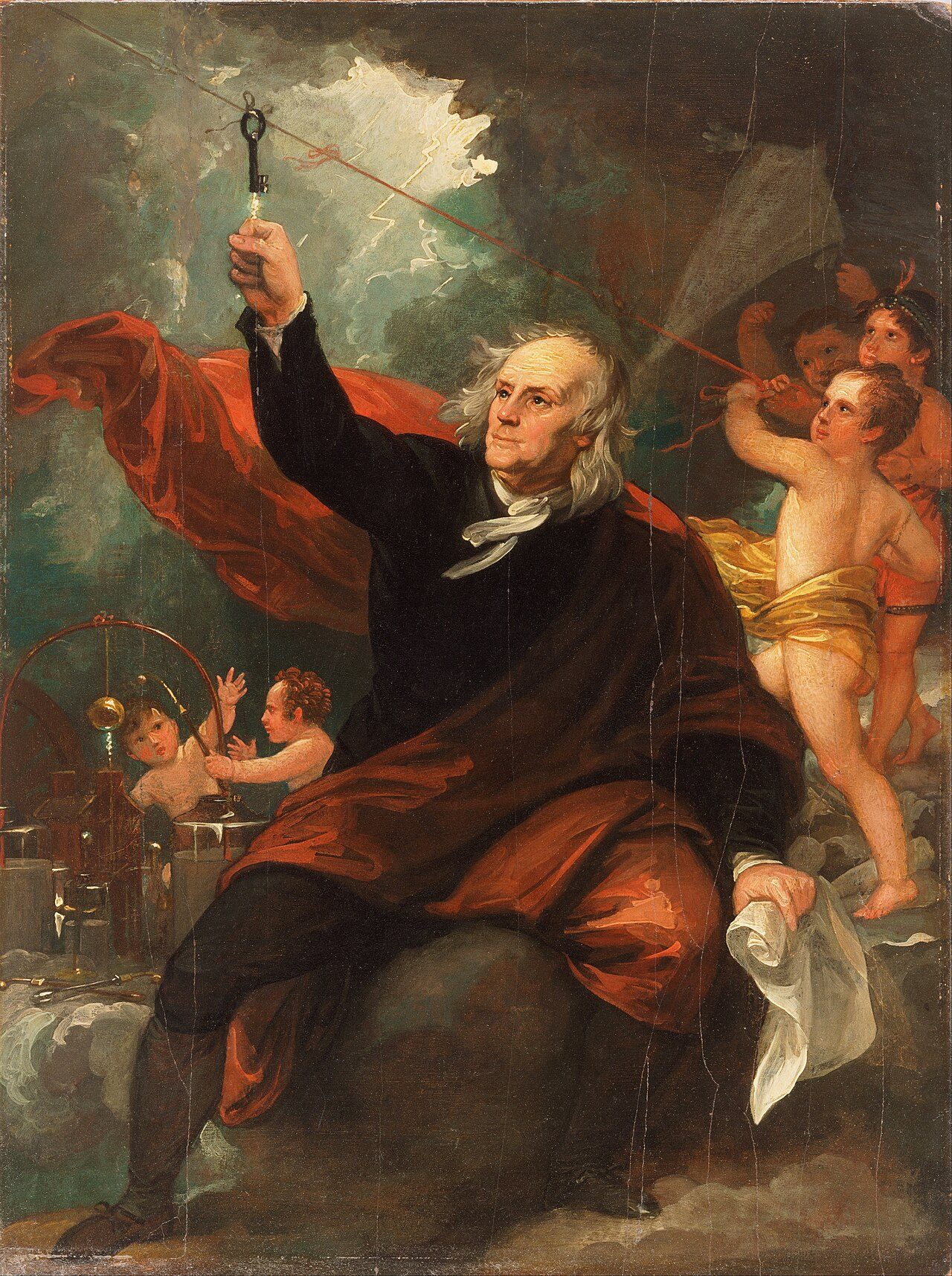
On 10 June 1752, by the traditional account, Benjamin Franklin flew a kite in a Philadelphia thunderstorm and drew an electric spark from its key, showing that lightning is a form of electricity. June 10 is also the day Bridget Bishop was hanged at Salem, Italy entered the Second World War, and the Six-Day War ended.
Choose another date: open the On This Day calendar to browse events, births and deaths for any day of the year.
At a Glance
- Traditional date
- 10 June 1752, Philadelphia
- The apparatus
- A silk kite with a pointed wire, a hemp string, a dry silk ribbon as insulation, and a brass key
- The result
- A spark drawn from the key; a Leyden jar charged from the string behaved exactly as with machine-made electricity
- The crucial point
- The kite was never struck by lightning — Franklin drew off the cloud's charge, which is why he survived
- The evidence
- Franklin's brief report in the Pennsylvania Gazette (October 1752); the fuller account in Joseph Priestley's 1767 history of electricity
- The legacy
- The lightning rod, and electrical terms Franklin coined or fixed: battery, conductor, electrician
Events on this day
- 1692Bridget Bishop is hanged at Salem, Massachusetts, the first person executed in the Salem witch trials.
- 1752Benjamin Franklin flies a kite in a thunderstorm and draws electricity from a key — the featured story above.
- 1772Rhode Island colonists burn the British customs vessel Gaspee in Narragansett Bay, one of the first acts of armed resistance to British rule.
- 1829The first Boat Race between Oxford and Cambridge universities is rowed on the Thames at Henley.
- 1918An Italian motor torpedo boat sinks the Austro-Hungarian battleship Szent István off Croatia, in an attack captured on film.
- 1935Alcoholics Anonymous is founded in Akron, Ohio, by Bill Wilson and Dr Bob Smith — the start of the twelve-step movement.
- 1940Italy declares war on France and Britain; Mussolini announces the decision from the balcony of the Palazzo Venezia in Rome.
- 1942Nazi forces destroy the Czech village of Lidice in reprisal for the assassination of Reinhard Heydrich, killing its men and deporting its women and children.
- 1967The Six-Day War ends as Israel and Syria accept a United Nations ceasefire.
- 2007The final episode of The Sopranos airs on HBO, ending with a cut to black that viewers argue about for years.
Born on this day
- 1819Gustave Courbet — French painter who led the Realist movement.
- 1922Judy Garland — American singer and actress, Dorothy in The Wizard of Oz.
- 1928Maurice Sendak — American author and illustrator of Where the Wild Things Are.
- 1929E. O. Wilson — American biologist who transformed the study of ants and biodiversity.
Died on this day
- 1190Frederick I Barbarossa — Holy Roman emperor, drowned in a river in Anatolia while leading the Third Crusade.
- 1926Antoni Gaudí — Catalan architect of the Sagrada Família, dead in Barcelona three days after being struck by a tram.
- 1967Spencer Tracy — American actor, the first to win two consecutive Academy Awards for best actor.
- 2004Ray Charles — American singer and pianist who fused gospel, blues and country into soul music.
- 2016Gordie Howe — Canadian ice hockey great known as 'Mr. Hockey', dead at 88.
The featured story: Benjamin Franklin's kite experiment, 10 June 1752
Benjamin Franklin came to electricity as a gentleman amateur and remade it as a science. In the 1740s the Philadelphia printer-turned-philosopher built electrical machines, corresponded with experimenters in London, and in 1751 published Experiments and Observations on Electricity, arguing that lightning was simply a giant electric spark and that a pointed iron rod could draw its charge safely away. In May 1752, unknown to him, the French experimenter Thomas-François Dalibard used just such a rod at Marly to draw sparks from a thundercloud — Franklin's theory, proved in France before Franklin himself could test it.
Franklin's own test, by the traditional account, came on 10 June 1752. Rather than wait on a church spire that Philadelphia had not yet built, he used a kite: a silk handkerchief stretched on a cedar frame, a pointed wire at the top, a hemp string that would conduct when wet, and then — the crucial insulation — a dry silk ribbon between the string and his hand, with a brass key tied where the two met. Flying it with his son William as a storm approached, Franklin saw the loose fibres of the hemp string stand on end, then drew a spark from the key with his knuckle and charged a Leyden jar from it. The jar behaved exactly as it did with machine-made electricity. Lightning was electricity.
The experiment was not what the famous paintings show. The kite was never struck by lightning — a direct strike on the wet string would very likely have killed Franklin, as a similar rod experiment killed the physicist Georg Wilhelm Richmann in St Petersburg the following year. Franklin's design worked precisely because it drew off the cloud's ambient charge before any strike. Nor is the story documented as tightly as its fame suggests: Franklin's own report, printed in his Pennsylvania Gazette that October, was brief and written in the third person, and the fuller narrative, kite and key included, comes from Joseph Priestley's history of electricity fifteen years later. The date of 10 June itself rests on tradition rather than a dated record.
The practical consequence was immediate: the lightning rod, which Franklin promoted tirelessly and never patented, spread across America and Europe and still protects buildings today. The conceptual consequence was larger — electricity was one force, in the jar and in the sky, open to experiment and measurement. Franklin's electrical vocabulary survives in the words he coined or fixed: battery, conductor, electrician. The elderly experimenter with the kite became, for Europe as much as America, the face of the Enlightenment: the colonial printer who had snatched lightning from the heavens.
Why this date matters
June 10 pairs curiosity with consequence: a philosopher coaxing sparks from a storm cloud, students racing boats at Henley, a support fellowship founded in Ohio — and, on the same square of the calendar, a woman hanged for witchcraft, a dictator taking his country into a world war, and a village erased in reprisal. The date's lesson is that it holds both kinds of history without comment. Franklin's kite is its emblem because it was an act of pure inquiry whose result — the lightning rod — quietly saved more lives than most battles on this page ever took.
Sources
- Encyclopaedia Britannica — On This Day: June 10
- HISTORY — What Happened on June 10
- Wikipedia — June 10
- HistorIQly — June 10: This Day in History
The facts on this page were checked against these sources on 19 November 2026. The History Trail's permanent pages are researched and written for this site; the live profiles elsewhere on The History Trail are assembled automatically from Wikipedia and Wikidata.
About the Author
Researched and written by the The History Trail Editorial Team — the accountable editorial function behind this site's permanent story pages. The team works from the published sources cited on each page; it does not invent historians, reviewers or credentials, and it corrects errors openly.
Fact Check
Every load-bearing fact on this page traces to one of the sources listed above, and significant claims link to their source in the text. Our checking method is described on the methodology page; errors can be reported via the corrections page.
Sources & Citations
Cite this page as: The History Trail Editorial Team, The History Trail — this article's title, publication and update dates are shown beneath its headline. The full source list appears under Sources above; the site's source standards are on the sources page.