
On This Day
July 20 in History
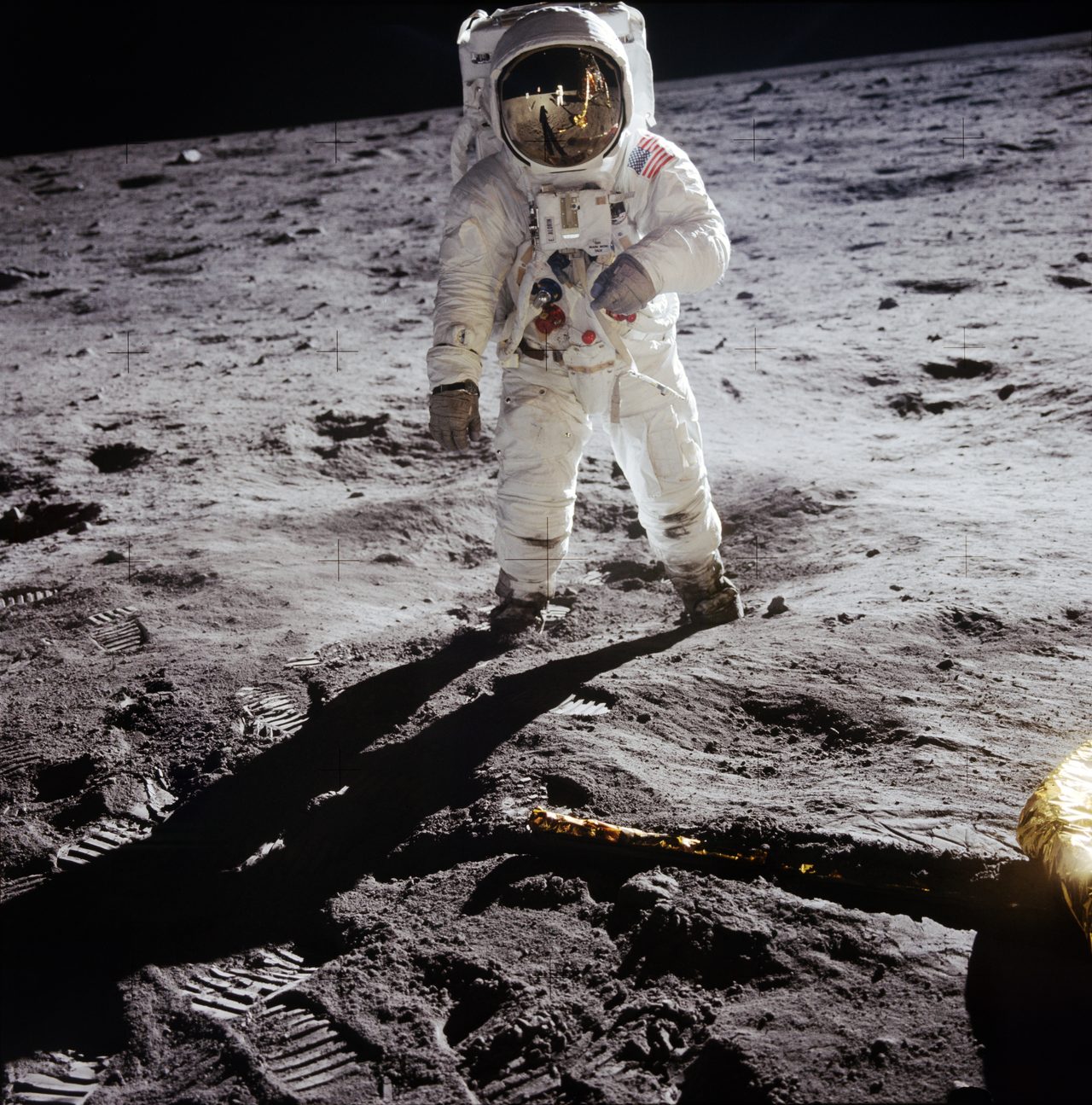
On 20 July 1969 the lunar module Eagle touched down in the Sea of Tranquility, and Neil Armstrong and Buzz Aldrin became the first people to walk on the Moon.
Choose another date: open the On This Day calendar to browse events, births and deaths for any day of the year.
At a Glance
- Landing
- 20 July 1969, 20:17 UTC (4:17 pm EDT), Sea of Tranquility
- Crew
- Neil Armstrong, Buzz Aldrin, and Michael Collins in orbit
- Spacecraft
- Lunar module Eagle; command module Columbia; Saturn V rocket
- First step
- 21 July 1969, 02:56 UTC — Armstrong, about six and a half hours after landing
- Time on surface
- 21 hours 36 minutes; moonwalk of just over two hours
Events on this day
- 70Roman forces under Titus storm the Fortress of Antonia in Jerusalem during the siege of the city.
- 1807Nicéphore Niépce patents the Pyréolophore, the world's first internal combustion engine, in France.
- 1810Citizens of Bogotá, New Granada, declare independence from Spain — now Colombia's Independence Day.
- 1848The first Women's Rights Convention concludes at Seneca Falls, New York.
- 1871British Columbia joins the Canadian Confederation as a province.
- 1903The Ford Motor Company ships its first automobile, a Model A.
- 1944Adolf Hitler survives the 20 July assassination attempt led by Colonel Claus von Stauffenberg.
- 1960The Polaris missile is launched from a submerged submarine, USS George Washington, for the first time.
- 1968The first International Special Olympics Summer Games open at Soldier Field, Chicago.
- 1976NASA's Viking 1 becomes the first spacecraft to land successfully on Mars.
- 2005The Civil Marriage Act legalises same-sex marriage across Canada.
- 2021Jeff Bezos flies to the edge of space aboard Blue Origin's New Shepard on its first crewed flight.
Born on this day
- 1304Petrarch — Italian poet and scholar, a founding figure of Renaissance humanism.
- 1822Gregor Mendel — Augustinian friar whose pea experiments founded the science of genetics.
- 1873Alberto Santos-Dumont — Brazilian aviation pioneer who flew the first powered aeroplane in Europe.
- 1919Edmund Hillary — New Zealand mountaineer, first to summit Everest, with Tenzing Norgay, in 1953.
- 1933Cormac McCarthy — American novelist of Blood Meridian and No Country for Old Men.
- 1938Diana Rigg — English actress, from The Avengers to Game of Thrones.
- 1947Carlos Santana — Mexican-American guitarist who fused rock with Latin and African rhythms.
- 1964Chris Cornell — American singer, frontman of Soundgarden and Audioslave.
Died on this day
- 1866Bernhard Riemann — German mathematician whose geometry later underpinned general relativity.
- 1903Leo XIII — pope of the Catholic Church for 25 years, author of Rerum Novarum.
- 1923Pancho Villa — Mexican revolutionary general of the Division of the North.
- 1937Guglielmo Marconi — Italian pioneer of radio telegraphy and Nobel laureate.
- 1945Paul Valéry — French poet and essayist, buried at Sète as he had wished.
- 1951Abdullah I of Jordan — the kingdom's first king, assassinated in Jerusalem on this day.
- 1973Bruce Lee — Hong Kong-American martial artist and film star, dead at 32.
- 2017Chester Bennington — American singer, frontman of Linkin Park.
The featured story: the Eagle has landed
Apollo 11 was the answer to a deadline set in anger and hope. In May 1961, weeks after the Soviet Union put the first human in space, President John F. Kennedy asked the United States to land a man on the Moon and return him safely before the decade ended. Eight years, one fatal fire and a string of test missions later, a Saturn V lifted off from Florida on 16 July 1969 carrying commander Neil Armstrong, lunar module pilot Buzz Aldrin and command module pilot Michael Collins. On 20 July, after three days of travel, Armstrong and Aldrin crawled into the lunar module Eagle and cast off from Collins, alone in Columbia, to begin the descent no crew had ever attempted.
The descent nearly unravelled in its final minutes. Five times the guidance computer flashed program alarms — 1202 and 1201, codes meaning it was being fed more data than it could process. In Mission Control, guidance officer Steve Bales recognised the alarms from simulations and called 'go' each time, and flight director Gene Kranz backed him. Then, about 150 metres up, Armstrong saw the computer was flying them into a boulder-strewn crater. He took manual control, pitched Eagle more upright and flew on, hunting for clear ground while the fuel gauge fell through sixty seconds, then thirty. Aldrin called out 'Contact light' at 20:17 UTC — a probe beneath a footpad had touched the surface. Armstrong's reply became the mission's signature: 'Houston, Tranquility Base here. The Eagle has landed.' The landing itself belongs to 20 July in both UTC and United States time; the first footstep came after midnight UTC, which is why both dates appear in accounts of the mission.
The plan called for rest first; the crew asked to go out early instead. At 02:56 UTC on 21 July — still the evening of 20 July in the United States — Armstrong descended the ladder, tested the jump back to the first rung, and stepped onto the powdery surface: 'That's one small step for a man, one giant leap for mankind.' Aldrin followed about twenty minutes later, calling the view 'magnificent desolation.' For just over two hours the two men photographed the landscape, collected about 21.5 kilograms of rock and soil, deployed a seismometer, a laser reflector and a solar-wind experiment, planted a flag and took a phone call from President Richard Nixon — watched live by hundreds of millions of people, the largest audience in history to that point.
After 21 hours and 36 minutes on the surface, Eagle's ascent stage lifted off and docked with Columbia, and the crew splashed down in the Pacific on 24 July, followed by three weeks of quarantine in case of lunar germs. Kennedy's challenge was met with five months to spare. Twelve astronauts would walk on the Moon by 1972, but Apollo 11 remains the benchmark: the first time human beings stood on another world, achieved not by a lone hero but by some 400,000 people whose work converged on one July afternoon.
Why this date matters
July 20 bookends the age of exploration. On this date in 1919 Edmund Hillary was born — the man who, with Tenzing Norgay, first stood on Earth's highest point; exactly fifty years later Armstrong and Aldrin stood on the Moon, and in 1976, on the landing's seventh anniversary, Viking 1 touched down on Mars. The through-line is not national rivalry, though the Space Race supplied the money and the deadline. It is that each generation's 'impossible' journey becomes the next generation's starting point — which is why 20 July is now kept informally around the world as Moon Day.
Sources
- NASA History — 50 Years Ago: One Small Step, One Giant Leap
- NASA JPL — Celebrate the 50th Anniversary of NASA's Apollo Moon Landing
- Encyclopaedia Britannica — Apollo 11
- Wikipedia — July 20 (events, births and deaths lists)
The facts on this page were checked against these sources on 18 November 2026. The History Trail's permanent pages are researched and written for this site; the live profiles elsewhere on The History Trail are assembled automatically from Wikipedia and Wikidata.
About the Author
Researched and written by the The History Trail Editorial Team — the accountable editorial function behind this site's permanent story pages. The team works from the published sources cited on each page; it does not invent historians, reviewers or credentials, and it corrects errors openly.
Fact Check
Every load-bearing fact on this page traces to one of the sources listed above, and significant claims link to their source in the text. Our checking method is described on the methodology page; errors can be reported via the corrections page.
Sources & Citations
Cite this page as: The History Trail Editorial Team, The History Trail — this article's title, publication and update dates are shown beneath its headline. The full source list appears under Sources above; the site's source standards are on the sources page.