
Comparisons
Wright Flyer vs Spitfire
One flew for 59 seconds at the speed of a bicycle; the other defended a nation at over 360 mph. Together they bookend aviation's fastest transformation.
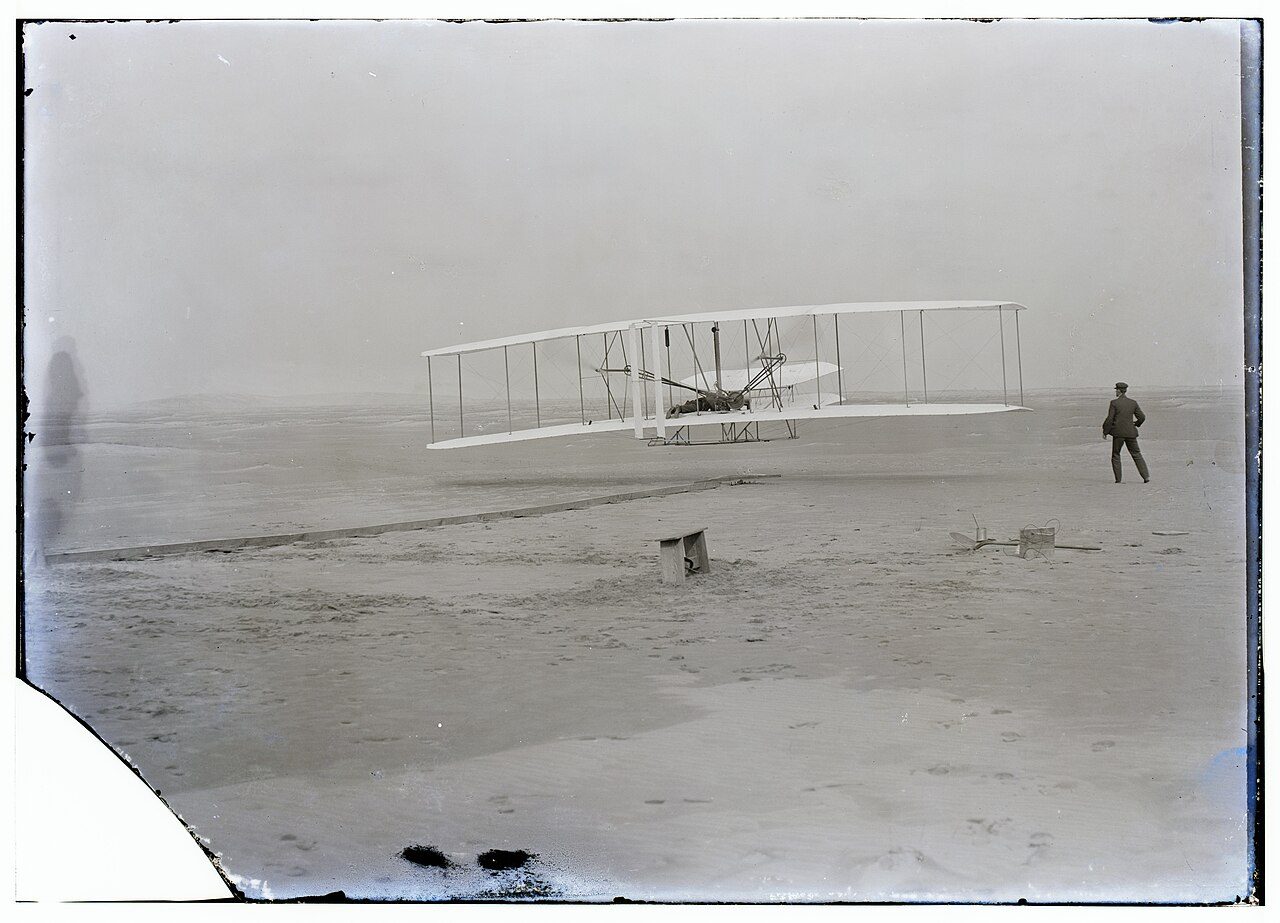
Wright Flyer
The 12-horsepower machine that opened the aerial age
- First flight
- 17 December 1903, Kitty Hawk, North Carolina
- Designers
- Wilbur and Orville Wright
- Engine
- Wright four-cylinder, about 12 hp
- Flights made
- Four, all on one day
- Longest flight
- 852 feet (255.6 m) in 59 seconds
- Now kept at
- Smithsonian National Air and Space Museum, Washington DC
Spitfire
The Merlin-powered fighter that became a nation's symbol
- First flight
- 5 March 1936 (prototype K5054), Eastleigh
- Designer
- R. J. Mitchell, Supermarine
- Engine
- Rolls-Royce Merlin V12, 1,030 hp in the Mk I
- Top speed (Mk I)
- About 362 mph
- Total built
- More than 20,000, 1938–1948
- Defining moment
- The Battle of Britain, 1940
Both subjects of this comparison are introduced above, side by side, before either story begins.
Introduction
Thirty-three years separate these two aircraft, yet they belong to a single story: what happens once human beings decide that the sky is a place to work, fight and travel, rather than merely to visit. The Wright Flyer was a question made of spruce, fabric and bicycle-chain engineering — could a powered machine lift a pilot, stay under control, and land intact? The Spitfire was an answer refined for a darker purpose: an interceptor built to climb fast, turn hard and defend a country under attack.
The contrast is almost unfair, and that is the point. Between them sits the fastest transformation of any technology in history. The Flyer flew for less than a minute, at walking pace, in front of a handful of witnesses. The Spitfire's early marks flew at more than 360 mph and were produced by the tens of thousands. Yet every Spitfire pilot owed something to Kitty Hawk: the three-axis control the Wrights worked out — the unglamorous insight that made all later flight possible. The flight figures need care: the Flyer's first flight on 17 December 1903 lasted just 12 seconds; the 59-second flight often quoted was the fourth and longest of that day.
Side by Side: Like for Like
| Compared | Wright Flyer | Spitfire |
|---|---|---|
| Era | 1903, the pioneer era | 1936–1948, the age of total war |
| First flight | 17 December 1903 — its first and only day of flying | Prototype flew 5 March 1936; entered RAF service August 1938 |
| Designers | Wilbur and Orville Wright, bicycle makers turned researchers | R. J. Mitchell of Supermarine, developed after his death by Joseph Smith |
| Engine | Wright four-cylinder petrol engine, driving two pusher propellers by chain | Rolls-Royce Merlin V12 (later marks used the Griffon) |
| Power | About 12 hp | 1,030 hp in the Mk I; over 2,000 hp in late Griffon marks |
| Construction | Wood, fabric and wire; canard biplane with wing-warping control | All-metal stressed-skin monoplane with the famous elliptical wing |
| Purpose | Prove that controlled, powered, sustained flight was possible | Intercept enemy bombers and fighters in air defence |
| Production | One aircraft, flown four times | More than 20,000 built across two dozen marks |
| Performance landmark | Longest flight: 852 feet in 59 seconds | Mk I maximum speed about 362 mph |
| How it ended | Wrecked by a gust after its fourth landing; never flew again | Production ended in 1948 as jets replaced piston fighters |
| Legacy | The machine that opened the aerial age | The enduring symbol of the Battle of Britain and RAF resistance |
Like for like: every row compares the same measure for both subjects, on the basis stated in the row.
The Wright Flyer story
The Flyer was the product of a four-year research programme that Wilbur and Orville Wright began in 1899, working methodically through kites and three full-sized gliders before they dared add an engine. Their breakthrough was not power — their homemade four-cylinder engine produced only about 12 horsepower — but control: wing-warping for roll, a forward elevator for pitch and a rear rudder for yaw, operated together by a pilot lying prone on the lower wing.
On the morning of 17 December 1903, at Kitty Hawk, North Carolina, Orville won the coin toss and made the first flight: 12 seconds, 120 feet, into a freezing headwind. The brothers alternated, and the fourth flight, with Wilbur at the controls, stayed up for 59 seconds and covered 852 feet before a gust wrecked the machine after landing. The Flyer never flew again. After years of dispute with the Smithsonian, which had refused to credit the brothers, the aircraft was loaned to London's Science Museum in 1928 and only came home in 1948, when it was formally donated to the Smithsonian — forty-five years to the day after the flights.
The Spitfire story
The Spitfire grew from R. J. Mitchell's work at Supermarine, where racing seaplanes built for the Schneider Trophy had taught his team how much speed could be found in clean lines and a powerful engine. The prototype, K5054, first flew on 5 March 1936 from Eastleigh, powered by the new Rolls-Royce Merlin. Mitchell died in 1937, before the first production aircraft reached the RAF in August 1938; his successor, Joseph Smith, would guide the design through the constant development that kept it competitive for a decade.
What made the Spitfire exceptional was not any single figure but its capacity to grow. The Merlin-engined Mk I of 1940, with 1,030 horsepower and eight machine guns, fought the Battle of Britain alongside the Hawker Hurricane; later marks with two-stage supercharged Merlins, and finally the much larger Griffon engine, more than doubled the power Mitchell had started with. More than 20,000 Spitfires were built between 1938 and 1948, and it remained the only Allied fighter in continuous development and production throughout the Second World War — a racing designer's sketch turned into a nation's shield.
Historical Significance
On any scorecard of performance, this comparison is absurd — the Spitfire had roughly eighty-five times the Flyer's power before its later marks doubled that again. But the Flyer wins the argument that matters: priority. Everything the Spitfire was — its controllable wing, its pilot working three axes at once, its propeller turning engine power into controlled flight — traces back to the system the Wrights proved on a North Carolina beach. The Spitfire's genius was development; the Flyer's was origination.
They also share a quality rarer than speed: both were built by small teams who understood their machine completely. The Wrights were two brothers and a mechanic; Mitchell's Spitfire came from a small drawing office and had to be adapted, mark by mark, by the colleague who inherited it. Industrial war production and a bicycle shop seem worlds apart, but the distance between Kitty Hawk and the Battle of Britain is just thirty-seven years — one working lifetime, from first hop to national icon.
Sources
- Smithsonian National Air and Space Museum — 1903 Wright Flyer
- Smithsonian Institution — 1903 Wright Flyer object record
- Smithsonian Magazine — The Original (how the Flyer reached the Smithsonian)
- Royal Air Force Museum — Supermarine Spitfire Mk I K9942 individual history
- The Museum of Flight — A Short History of the Spitfire
- Wikipedia — Wright Flyer (corroboration)
The facts on this page were checked against these sources on 18 November 2026. The History Trail's permanent pages are researched and written for this site; the live profiles elsewhere on The History Trail are assembled automatically from Wikipedia and Wikidata.
About the Author
Researched and written by the The History Trail Editorial Team — the accountable editorial function behind this site's permanent story pages. The team works from the published sources cited on each page; it does not invent historians, reviewers or credentials, and it corrects errors openly.
Fact Check
Every load-bearing fact on this page traces to one of the sources listed above, and significant claims link to their source in the text. Our checking method is described on the methodology page; errors can be reported via the corrections page.
Sources & Citations
Cite this page as: The History Trail Editorial Team, The History Trail — this article's title, publication and update dates are shown beneath its headline. The full source list appears under Sources above; the site's source standards are on the sources page.