
On This Day
June 2 in History
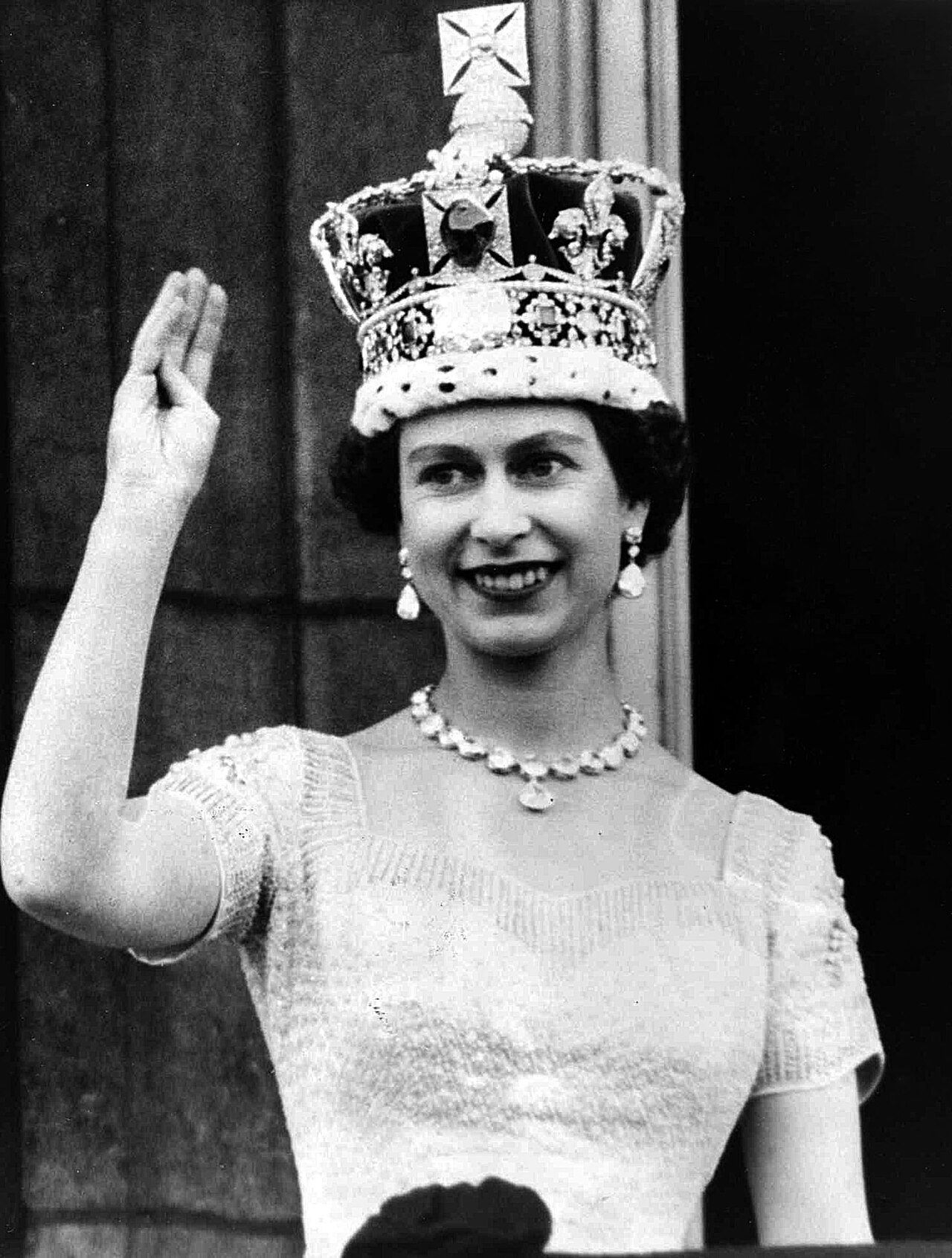
On 2 June 1953 Elizabeth II was crowned at Westminster Abbey, sixteen months after she succeeded her father George VI — the first British coronation to be televised, watched by millions. June 2 is also the day the Vandals sacked Rome, Italy voted to become a republic, and the Indian Citizenship Act made Native Americans United States citizens.
Choose another date: open the On This Day calendar to browse events, births and deaths for any day of the year.
At a Glance
- Crowned
- 2 June 1953, at Westminster Abbey, by the Archbishop of Canterbury, Geoffrey Fisher
- Accession
- Elizabeth succeeded George VI on 6 February 1952, aged 25, while on tour in Kenya
- Age at coronation
- 27 — elder daughter of George VI
- Television first
- The first British coronation televised in full, against the advice of the prime minister and cabinet
- Audience
- An estimated 27 million people watched in the United Kingdom alone
- The reign
- Lasting until her death on 8 September 2022 — at over 70 years, the longest reign in British history
Events on this day
- 455Vandal forces under King Genseric begin the sack of Rome, plundering the city systematically for two weeks.
- 1098Crusader forces capture Antioch after an eight-month siege, a turning point of the First Crusade.
- 1692Bridget Bishop becomes the first person tried in the Salem witch trials; she was convicted and hanged eight days later.
- 1763During Pontiac's Rebellion, Chippewa warriors capture Fort Michilimackinac from the British by staging a lacrosse game outside its gates.
- 1865Confederate General Edmund Kirby Smith surrenders his forces at Galveston, Texas — the last major Confederate surrender of the American Civil War.
- 1886President Grover Cleveland marries Frances Folsom in the White House, the only presidential wedding held there; at 21 she remains the youngest first lady.
- 1896Guglielmo Marconi applies for the British patent for his wireless telegraphy system, the foundation of radio.
- 1924President Calvin Coolidge signs the Indian Citizenship Act, granting United States citizenship to Native Americans born in the country.
- 1935Babe Ruth announces his retirement from baseball, ending his career with 714 home runs.
- 1946Italians vote in a referendum to abolish the monarchy and make Italy a republic.
- 1953Elizabeth II is crowned at Westminster Abbey in the first coronation to be televised — the featured story above.
- 1966NASA's Surveyor 1 makes the first American soft landing on the Moon, transmitting photographs from the surface.
- 1997Timothy McVeigh is convicted of the 1995 Oklahoma City bombing, which killed 168 people.
- 2015Sepp Blatter announces his resignation as president of FIFA, days after his re-election, amid a corruption scandal.
Born on this day
- 1740Marquis de Sade — French aristocrat and writer whose name became a byword for cruelty.
- 1840Thomas Hardy — English novelist of Tess of the d'Urbervilles and Far from the Madding Crowd.
- 1904Johnny Weissmuller — Olympic swimmer who won five gold medals and became Hollywood's Tarzan.
- 1940Constantine II — the last king of Greece, who reigned from 1964 until the monarchy's abolition.
- 1951Kenneth Chenault — American business executive, longtime chairman and chief executive of American Express.
Died on this day
- 1941Lou Gehrig — New York Yankees first baseman, dead at 37 of the motor neurone disease that now bears his name.
- 1970Bruce McLaren — New Zealand racing driver and founder of the McLaren team, killed testing a car at Goodwood, aged 32.
- 2008Bo Diddley — American guitarist whose signature beat helped shape rock and roll.
The featured story: Elizabeth II is crowned at Westminster Abbey, 2 June 1953
Elizabeth II had already been queen for sixteen months when she was crowned. She succeeded her father, George VI, on 6 February 1952, while on tour in Kenya, and the coronation was set for 2 June 1953 to allow time for mourning and for the enormous preparations a modern coronation required. The young queen — 27 years old — drove the planning herself, and her most consequential decision concerned the cameras.
Television was the argument of the coronation. The prime minister, Winston Churchill, and the cabinet opposed broadcasting the service, fearing it would turn a sacred ceremony into a spectacle watched in pubs and front rooms by people in hats, drinking tea. Elizabeth insisted the service should be televised, subject only to limits for its most sacred moments. She won. The BBC installed cameras in Westminster Abbey, and the coronation became the event that sold television to Britain: an estimated 27 million people in the United Kingdom watched, many on sets bought or rented for the day, and the pictures were flown across the Atlantic so that North Americans could see them the same evening.
The service itself followed a pattern nearly a thousand years old. The queen processed into the abbey in the Gold State Coach, wearing a dress by Norman Hartnell embroidered with the emblems of Britain and the Commonwealth — the Tudor rose, the Scottish thistle, the Welsh leek, the Canadian maple leaf. She took the coronation oath, was anointed with holy oil beneath a canopy — the one part of the rite the cameras were not permitted to show — and was crowned by the Archbishop of Canterbury, Geoffrey Fisher, with St Edward's Crown, before receiving the homage of the lords and the acclamation of the congregation: 'God save the Queen.'
Among the reporters covering the day for an American newspaper was Jacqueline Bouvier, the future Jacqueline Kennedy, filing for the Washington Times-Herald. The coronation fixed the template for royal spectacle in the media age and launched a reign that lasted until Elizabeth's death in September 2022 — at more than 70 years, the longest of any British monarch. The queen crowned on 2 June 1953 became, for most of her subjects, the only monarch they ever knew.
Why this date matters
June 2 is a date of transfers of legitimacy: Rome's fall to the Vandals, a republic voted into being in Italy, citizenship extended by statute in the United States, and a crown placed on a young queen's head before the largest audience any coronation had ever had. Its recurring theme is the moment authority becomes visible — and, in 1953, televised. The coronation of Elizabeth II stands at the centre of the date because it joined the oldest ritual on the page to the newest medium, and because the reign it launched outlasted almost everything else recorded here.
Sources
- Encyclopaedia Britannica — On This Day: June 2
- HISTORY — What Happened on June 2
- Wikipedia — June 2
- The Royal Family — 50 Facts About Queen Elizabeth II's Coronation
The facts on this page were checked against these sources on 19 November 2026. The History Trail's permanent pages are researched and written for this site; the live profiles elsewhere on The History Trail are assembled automatically from Wikipedia and Wikidata.
About the Author
Researched and written by the The History Trail Editorial Team — the accountable editorial function behind this site's permanent story pages. The team works from the published sources cited on each page; it does not invent historians, reviewers or credentials, and it corrects errors openly.
Fact Check
Every load-bearing fact on this page traces to one of the sources listed above, and significant claims link to their source in the text. Our checking method is described on the methodology page; errors can be reported via the corrections page.
Sources & Citations
Cite this page as: The History Trail Editorial Team, The History Trail — this article's title, publication and update dates are shown beneath its headline. The full source list appears under Sources above; the site's source standards are on the sources page.