
On This Day
March 24 in History
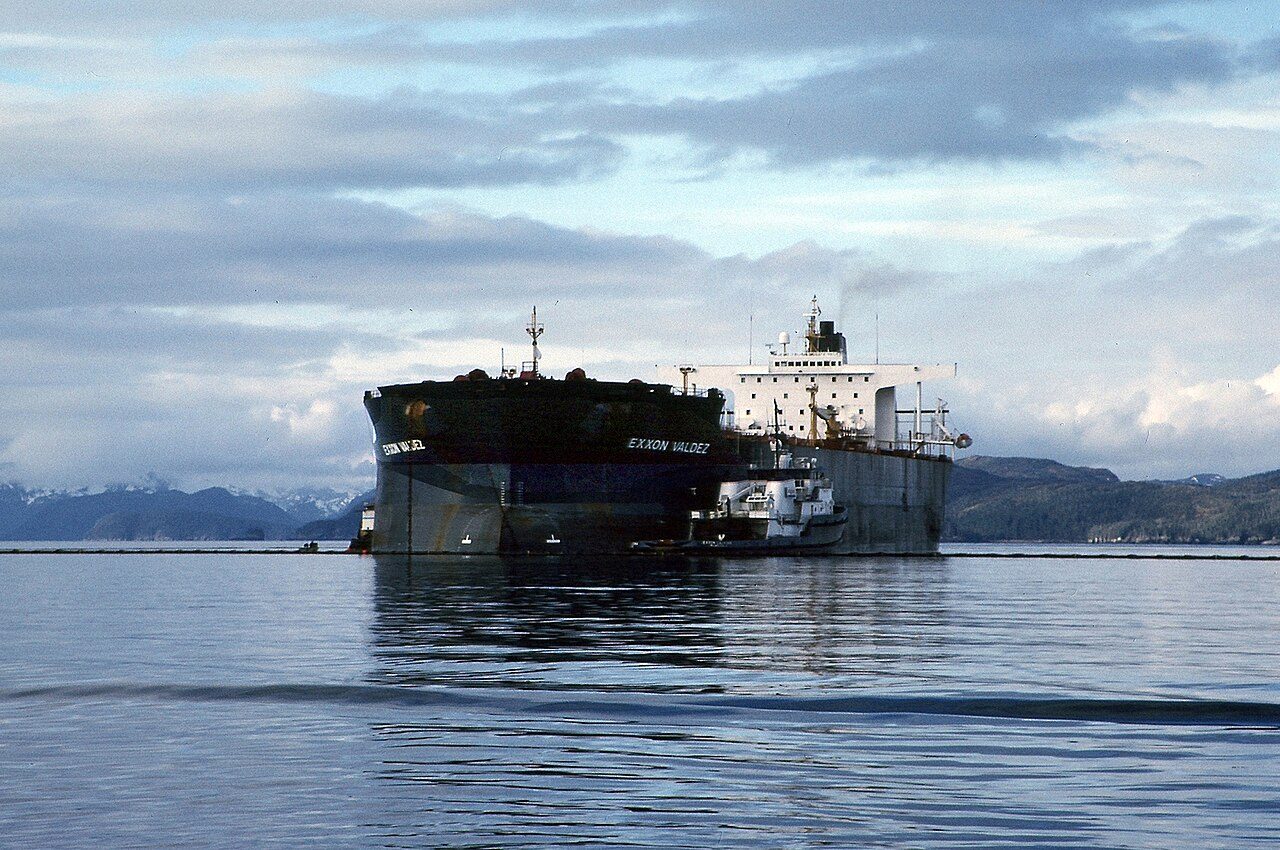
Just after midnight on 24 March 1989, the supertanker Exxon Valdez, outward bound from Alaska with some 53 million gallons of crude oil, ran aground on Bligh Reef in Prince William Sound. Within hours about 11 million gallons had poured into one of the richest marine environments on Earth — the worst oil spill in American waters up to that time, and the disaster that rewrote the world's rules for carrying oil by sea. March 24 is also the day of the Great Escape from Stalag Luft III and of Robert Koch's announcement of the tuberculosis bacterium.
Choose another date: open the On This Day calendar to browse events, births and deaths for any day of the year.
At a Glance
- The ship
- The 987-foot Exxon Valdez, three years old, loaded with just under 1.3 million barrels of Prudhoe Bay crude for Long Beach, California
- The grounding
- 12:04 a.m., 24 March 1989, on Bligh Reef, after leaving the shipping lane to avoid ice
- On the bridge
- The third mate, who did not hold the required licence for those waters, was steering; Captain Joseph Hazelwood was below in his cabin
- The spill
- An estimated 11 million gallons of crude oil; NOAA records more than 1,300 miles of shoreline oiled
- The wildlife toll
- NOAA estimates include some 250,000 seabirds, 2,800 sea otters, 300 harbour seals and 250 bald eagles killed
- The law it made
- The US Oil Pollution Act of 1990 — liability for spills, a cleanup fund, and the phase-in of double-hulled tankers
Events on this day
- 1603Elizabeth I dies and James VI of Scotland succeeds her as James I of England, uniting the two crowns in one person.
- 1765Parliament passes the Quartering Act, requiring the American colonies to house and supply British troops — another grievance on the road to revolution.
- 1882Robert Koch announces in Berlin that he has identified the bacterium that causes tuberculosis, then responsible for roughly one death in seven in Europe and America.
- 1944Seventy-six Allied airmen escape from Stalag Luft III through a tunnel in the 'Great Escape'; most are recaptured, and 50 are murdered by the Gestapo on Hitler's orders.
- 1980Archbishop Óscar Romero, El Salvador's leading voice against state violence, is shot dead while celebrating Mass in San Salvador.
- 1989The Exxon Valdez grounds on Bligh Reef in Prince William Sound, Alaska — the featured story above.
- 2002Halle Berry and Denzel Washington win the Academy Awards for best actress and best actor, the first time both leading awards go to Black performers.
- 2008Bhutan holds its first parliamentary elections, as the Himalayan kingdom moves by its king's own design from absolute monarchy to constitutional democracy.
- 2015Germanwings flight 9525 is flown deliberately into a mountainside in the French Alps by its co-pilot, killing all 150 people aboard.
- 2016A UN tribunal at The Hague convicts Bosnian Serb leader Radovan Karadžić of genocide at Srebrenica and other war crimes, sentencing him to 40 years.
Born on this day
- 1820Fanny Crosby — American hymn writer, blind from infancy, who wrote thousands of hymns including 'Blessed Assurance'.
- 1874Harry Houdini — Hungarian-born escape artist whose handcuff, straitjacket and water-torture-cell escapes made him the most famous magician in the world.
- 1919Lawrence Ferlinghetti — American poet and publisher of the Beat generation, founder of San Francisco's City Lights bookshop.
- 1930Steve McQueen — American actor, the 'King of Cool' of Bullitt and The Great Escape.
- 1976Peyton Manning — American football quarterback, two-time Super Bowl winner and five-time NFL most valuable player.
Died on this day
- 1603Elizabeth I — queen of England for 45 years, dead at Richmond at 69; the Elizabethan age ends with her.
- 1882Henry Wadsworth Longfellow — America's most popular poet of his century, author of Hiawatha and Paul Revere's Ride.
- 1905Jules Verne — French novelist of Twenty Thousand Leagues Under the Seas and Around the World in Eighty Days, dead at Amiens at 77.
- 1980Óscar Romero — archbishop of San Salvador, assassinated at the altar for his defence of the poor; canonised by the Catholic Church in 2018.
- 2016Johan Cruyff — Dutch footballer and manager, the playing and coaching genius of Ajax, Barcelona and Total Football, dead at 68.
The featured story: the Exxon Valdez oil spill, 24 March 1989
The Exxon Valdez left the pipeline terminal at Valdez on the evening of 23 March 1989, carrying just under 1.3 million barrels of North Slope crude oil south to California. To clear icebergs calved from the Columbia Glacier, the ship was guided out of the normal traffic lane. The turn back toward the lane was never completed. At 12:04 in the morning of 24 March, with the third mate — an officer not licensed to pilot in Prince William Sound — on the bridge and Captain Joseph Hazelwood in his cabin, the tanker struck Bligh Reef at speed and stuck fast, tearing open eight of its eleven cargo tanks.
The oil came out at a rate the response could never match. NOAA records that within six hours some 10.9 million gallons had escaped; ultimately about 11 million gallons spread across Prince William Sound, and a storm three days later drove the slick onto beaches hundreds of miles apart. More than 1,300 miles of shoreline were oiled. The sound was one of the continent's great fisheries and wildlife refuges, and the toll NOAA later estimated — around 250,000 seabirds, 2,800 sea otters, 300 harbour seals, 250 bald eagles and billions of salmon and herring eggs — made the spill the defining environmental disaster of its generation. Cleanup employed some 11,000 people at its peak and cost Exxon a reported $2 billion, yet only a fraction of the oil was ever recovered.
Accountability came in pieces. The National Transportation Safety Board spread blame among the captain, the shipping company, the Coast Guard's traffic system and the industry's spill-response failures. Hazelwood was acquitted of the serious charges and convicted of a single count of negligent discharge of oil, fined $50,000 and ordered to 1,000 hours of community service; an Alaska court later overturned even that conviction on the ground that reporting the spill carried immunity. Civil litigation over damages ran for nearly two decades.
The spill's largest legacy is legal. In August 1990 the United States passed the Oil Pollution Act: strict liability for spill costs and restoration, a federal cleanup fund financed by a tax on oil, and a timetable phasing single-hulled tankers out of American waters in favour of double hulls. NOAA's damage-assessment and restoration programme, which has since handled dozens of spills, was created in the act's wake. The Exxon Valdez itself was repaired, renamed, and worked under other flags for two more decades; the sound, by many measures, has still not entirely come back.
Why this date matters
March 24 is a day of vessels and what escapes from them: a virus identified in a Berlin lecture room in 1882, 76 airmen crawling out of a tunnel in 1944, a nation's oil pouring out of a holed tanker in 1989. It also marks two opposed kinds of courage in public — an archbishop shot at his altar for speaking, and, in 2002 and 2008, doors opening at the Oscars and at Bhutan's first ballot boxes. The date's pattern is consequence: small openings, enormous outcomes.
Sources
- Encyclopaedia Britannica — On This Day: March 24
- HISTORY — This Day in History: March 24
- NOAA Office of Response and Restoration — Exxon Valdez Oil Spill
- NOAA — An Oil Spill's Silver Lining, Over Three Decades After Exxon Valdez
The facts on this page were checked against these sources on 19 November 2026. The History Trail's permanent pages are researched and written for this site; the live profiles elsewhere on The History Trail are assembled automatically from Wikipedia and Wikidata.
About the Author
Researched and written by the The History Trail Editorial Team — the accountable editorial function behind this site's permanent story pages. The team works from the published sources cited on each page; it does not invent historians, reviewers or credentials, and it corrects errors openly.
Fact Check
Every load-bearing fact on this page traces to one of the sources listed above, and significant claims link to their source in the text. Our checking method is described on the methodology page; errors can be reported via the corrections page.
Sources & Citations
Cite this page as: The History Trail Editorial Team, The History Trail — this article's title, publication and update dates are shown beneath its headline. The full source list appears under Sources above; the site's source standards are on the sources page.