
On This Day
March 23 in History
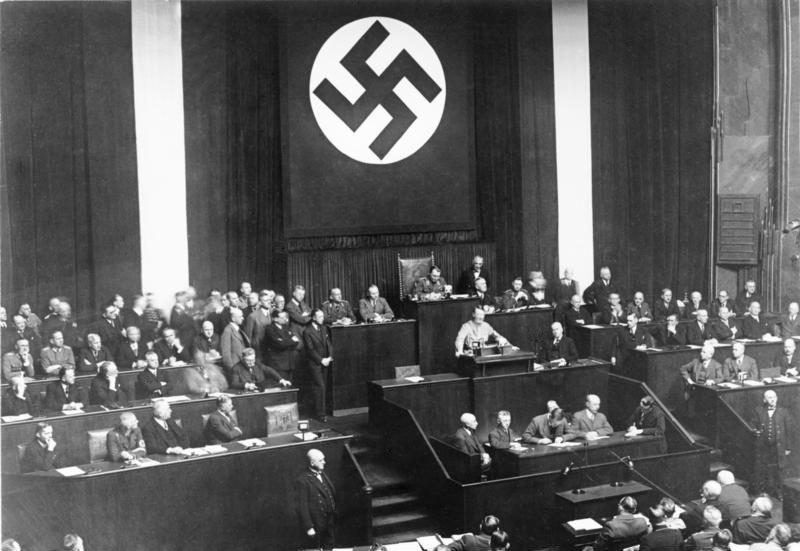
On 23 March 1933, meeting in a Berlin opera house because its own chamber had burned, the German Reichstag passed the Enabling Act by 441 votes to 94, authorising Adolf Hitler's cabinet to make laws — even laws breaking the constitution — without parliament or president. It was the legal foundation of the Nazi dictatorship, voted into being by a parliament from which the Communist deputies had already been arrested or driven out. March 23 is also the day Patrick Henry demanded liberty or death, and the day the Ever Given closed the Suez Canal.
Choose another date: open the On This Day calendar to browse events, births and deaths for any day of the year.
At a Glance
- The setting
- The Reichstag meets in the Kroll Opera House, its building gutted by fire on 27 February; SA men line the chamber
- The arithmetic
- A constitutional change needs two-thirds; the 81 Communist deputies are excluded, in prison or in flight
- The vote
- 441 to 94 — only the Social Democrats, led by Otto Wels, vote against
- The powers
- For four years the cabinet may enact laws, budgets and treaties without the Reichstag, including laws deviating from the constitution
- The signature
- President Hindenburg signs the act the same day
- The consequence
- Renewed again and again, the act remains the formal legal basis of Hitler's rule until 1945
Events on this day
- 1775Patrick Henry delivers his 'give me liberty or give me death' speech to the second Virginia Convention at St John's Church, Richmond, urging Virginia to arm against Britain.
- 1806Lewis and Clark begin the journey home from the Pacific, having completed the first American overland expedition to the western ocean; they reach St Louis in September.
- 1849At Novara, Radetzky's Austrian army crushes the Piedmontese in the First Italian War of Independence, forcing King Charles Albert to abdicate.
- 1857Elisha Otis installs the first commercial passenger elevator, in the Haughwout department store in New York City.
- 1933The Reichstag passes the Enabling Act, giving Hitler's cabinet power to legislate without parliament — the featured story above.
- 1957The US Army sells off its last combat pigeons, ending more than 50 years of military pigeon post; the hero bird Cher Ami had saved a battalion in 1918.
- 1976The International Covenant on Civil and Political Rights enters into force, giving legal effect to the human rights proclaimed in 1948.
- 1983President Ronald Reagan announces the Strategic Defense Initiative — 'Star Wars' — a proposed missile shield that reshapes the Cold War arms race.
- 1996Lee Teng-hui wins Taiwan's first direct presidential election, held under Chinese missile threats in the strait.
- 1998James Cameron's Titanic wins 11 Academy Awards, tying the record set by Ben-Hur.
- 2001The Russian space station Mir, designed for five years and in orbit for fifteen, burns up over the South Pacific in a controlled re-entry.
- 2021The container ship Ever Given runs aground across the Suez Canal, blocking one of the world's busiest trade routes for six days.
Born on this day
- 1769William Smith — English geologist who produced the first nationwide geological map of England and read the order of fossils in rock strata.
- 1823Schuyler Colfax — Speaker of the US House and vice president under Ulysses S. Grant.
- 1882Emmy Noether — German mathematician whose theorem linking symmetry and conservation laws underlies modern physics.
- 1908Joan Crawford — American film star, from Jazz Age flapper leads to the melodramas that made her a legend.
- 1910Akira Kurosawa — Japanese director of Rashomon and Seven Samurai, among the most influential filmmakers in cinema history.
- 1931Viktor Korchnoi — Soviet chess grandmaster, twice challenger for the world championship and the strongest player never to hold the title.
- 1956José Manuel Barroso — prime minister of Portugal and president of the European Commission from 2004 to 2014.
Died on this day
- 1801Paul I — emperor of Russia, assassinated by officers in his own palace in St Petersburg after an erratic and feared reign.
- 1992Friedrich Hayek — Austrian-born economist and philosopher of The Road to Serfdom, Nobel laureate and theorist of the free market.
- 2011Elizabeth Taylor — English-American actress, two-time Academy Award winner and tireless campaigner against AIDS, dead at 79.
- 2015Lee Kuan Yew — founding prime minister of Singapore, who led the city-state from 1959 to 1990 and shaped its rise, dead at 91.
The featured story: the Enabling Act, 23 March 1933
Hitler had been chancellor for seven weeks, and Germany was already half transformed. Appointed on 30 January 1933, he had persuaded President Hindenburg to dissolve the Reichstag and call elections; on 27 February the Reichstag building itself burned, and the regime blamed a Communist plot, suspending civil liberties by emergency decree and arresting thousands. The elections of 5 March, held amid SA terror, still gave the Nazis only a plurality — not the two-thirds majority needed to change the constitution. The Enabling Act was the device that closed the gap: a law, formally titled the Law to Remedy the Distress of People and Reich, transferring legislation itself to the cabinet.
The vote took place on 23 March in the Kroll Opera House, where the Reichstag sat among the ashes of its old home, with armed SA and SS men in and around the chamber. The arithmetic had been prepared by force: the 81 Communist deputies were in concentration camps, in hiding or excluded; the trade unions were being broken; the Centre Party's votes were bought with assurances about the Church and the presidency that were worthless within months. Only the Social Democrats, whose leader Otto Wels spoke against the bill knowing the risk, voted no. The act passed 441 to 94, and Hindenburg signed it the same day.
What those numbers enacted was the end of the Weimar constitution in all but name. For four years — a term renewed in 1937, 1939 and beyond — the cabinet could issue laws without parliament, approve treaties, draw up the budget, and enact statutes that expressly deviated from the constitution. Every later stage of the dictatorship, from the coordination of the states and the banning of parties to the Nuremberg Laws, was dressed in the legality this vote supplied. As Britannica puts it, the Enabling Act remained the constitutional basis of Hitler's dictatorship.
The contrast this date carries is uncomfortable and exact. On 23 March 1775 Patrick Henry told the Virginia Convention that liberty was worth dying for, and a legislature voted to arm itself against a king. On 23 March 1933 a legislature, intimidated and purged, voted its own powers away to a chancellor who never gave them back. Parliaments, the day teaches, are not only overthrown; sometimes they sign.
Why this date matters
No date in March holds a sharper argument with itself. The same calendar square carries Henry's demand for liberty in 1775 and the Reichstag's surrender of it in 1933; the covenant on civil and political rights entering into force in 1976 and a container ship throttling world trade in 2021. March 23 keeps returning to the question of what assemblies do with their power — spend it on freedom, sign it away, or write it into law for everyone. The answers it has collected cover the whole range.
Sources
- Encyclopaedia Britannica — On This Day: March 23
- HISTORY — This Day in History: March 23
- Encyclopaedia Britannica — Enabling Act
- United States Holocaust Memorial Museum, Holocaust Encyclopedia — The Enabling Act
The facts on this page were checked against these sources on 19 November 2026. The History Trail's permanent pages are researched and written for this site; the live profiles elsewhere on The History Trail are assembled automatically from Wikipedia and Wikidata.
About the Author
Researched and written by the The History Trail Editorial Team — the accountable editorial function behind this site's permanent story pages. The team works from the published sources cited on each page; it does not invent historians, reviewers or credentials, and it corrects errors openly.
Fact Check
Every load-bearing fact on this page traces to one of the sources listed above, and significant claims link to their source in the text. Our checking method is described on the methodology page; errors can be reported via the corrections page.
Sources & Citations
Cite this page as: The History Trail Editorial Team, The History Trail — this article's title, publication and update dates are shown beneath its headline. The full source list appears under Sources above; the site's source standards are on the sources page.