
On This Day
February 14 in History
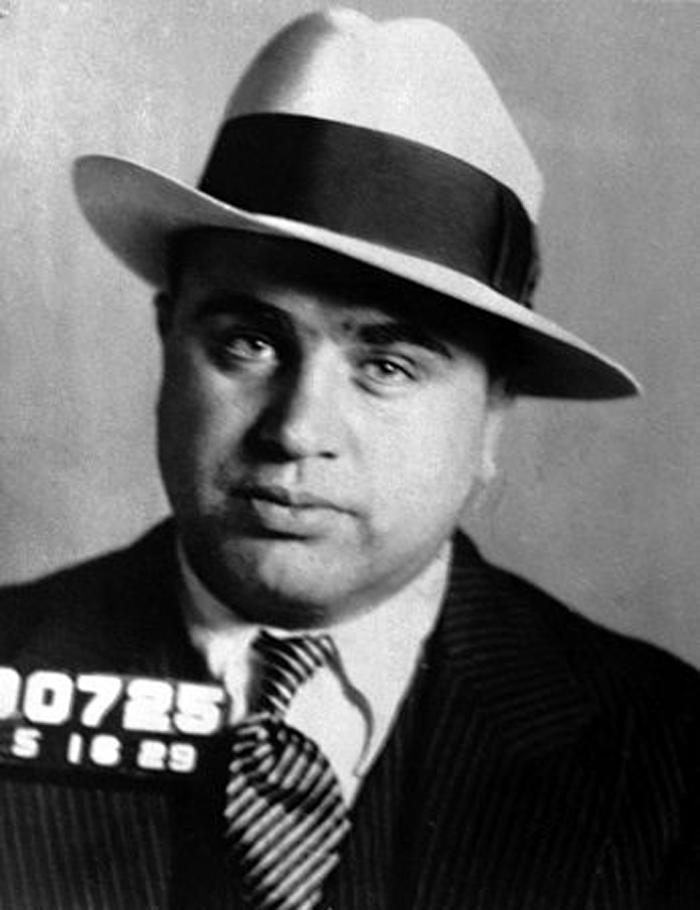
On 14 February 1929, in a garage on North Clark Street in Chicago, gunmen posing as police officers lined seven men against a wall and shot them dead. The St. Valentine's Day Massacre — the climax of the gang war between Al Capone and Bugs Moran — shocked even a Prohibition-weary America and set the federal government on the road to destroying Capone's empire. February 14 is also the day Captain Cook was killed in Hawaii and Voyager 1 took the Pale Blue Dot photograph.
Choose another date: open the On This Day calendar to browse events, births and deaths for any day of the year.
At a Glance
- The setting
- Prohibition-era Chicago, where Capone's South Side gang and Moran's North Siders fight over the illegal liquor trade
- The place
- A garage at 2122 North Clark Street, headquarters of Moran's bootlegging operation
- The killers
- Four men, two dressed as police officers, who stage a fake raid so the victims offer no resistance
- The victims
- Seven men — five Moran gang members, an associate and an optometrist who liked gangsters' company; Moran himself escapes by arriving late
- The evidence
- Some 70 shell casings; the guns are later traced to a Capone enforcer, but no one is ever convicted of the murders
- The consequence
- Public revulsion turns the full weight of federal investigation onto Capone, who is jailed for tax evasion in 1931
Events on this day
- 1779Captain James Cook is killed by Native Hawaiians at Kealakekua Bay during his third voyage to the Pacific.
- 1849James K. Polk is photographed in the White House, becoming the first American president photographed while in office.
- 1876Alexander Graham Bell files his patent application for the telephone, hours before Elisha Gray files a similar caveat.
- 1920The League of Women Voters is founded in Chicago, with Carrie Chapman Catt as its driving force, months before American women win the vote nationwide.
- 1929Seven men of the Moran gang are shot dead in a Chicago garage in the St. Valentine's Day Massacre — the featured story above.
- 1943Rommel's Afrika Korps opens the Battle of the Kasserine Pass in Tunisia, inflicting the United States' first major defeat of the war in Europe's theatre.
- 1950The Soviet Union and the People's Republic of China sign a treaty of friendship, alliance and mutual assistance in Moscow.
- 1962First Lady Jacqueline Kennedy leads television viewers on a televised tour of the restored White House, watched by millions.
- 1989Iran's Ayatollah Khomeini issues a fatwa calling for the death of Salman Rushdie, author of The Satanic Verses.
- 1990Voyager 1, some 3.7 billion miles from the Sun, turns its camera homeward and takes the Pale Blue Dot photograph of Earth.
- 2005Steve Chen, Chad Hurley and Jawed Karim register YouTube, the video-sharing site Google will buy the following year for $1.65 billion.
- 2018A gunman kills 17 people and wounds 17 more at Marjory Stoneman Douglas High School in Parkland, Florida.
Born on this day
- 1760Richard Allen — founder of the African Methodist Episcopal Church and a leading Black abolitionist in early America.
- 1766Thomas Malthus — English economist whose essay on population argued that numbers always tend to outrun the food supply.
- 1818Frederick Douglass — abolitionist, orator and author, born enslaved in Maryland, who chose February 14 as his birthday.
- 1894Jack Benny — American comedian whose deadpan radio and television persona made him a star for four decades.
- 1913Jimmy Hoffa — American labour leader, president of the Teamsters, whose disappearance in 1975 remains unsolved.
- 1946Gregory Hines — American tap dancer and actor who revived tap for a new generation on stage and screen.
Died on this day
- 1400Richard II — deposed king of England, dead at Pontefract Castle, probably starved, weeks after an attempted rising in his favour.
- 1779James Cook — English navigator and chart-maker of the Pacific, killed on the beach at Kealakekua Bay, Hawaii, at 50.
- 1891William Tecumseh Sherman — Union general of the American Civil War, famed and blamed for his March to the Sea, dead in New York at 71.
- 2003Dolly the sheep — the first mammal cloned from an adult cell, euthanised at the Roslin Institute in Scotland at six years old.
The featured story: the St. Valentine's Day Massacre, 14 February 1929
Prohibition had made Chicago's gangsters rich and its streets a battlefield. Through the 1920s Al Capone's South Side organisation and George Bugs Moran's North Siders fought over the trade in illegal beer and liquor with bombings, hijackings and assassinations, and by the winter of 1929 the war was approaching its climax. On the morning of 14 February, seven men were waiting in Moran's headquarters, a garage at 2122 North Clark Street, for a delivery of hijacked whisky. Moran himself, approaching the building, saw what he took to be a police raid in progress — and kept walking. It saved his life.
Inside, four men had entered, two of them in police uniforms. Believing it was an ordinary raid, the seven offered no resistance: they faced the brick wall, hands up, as if for a search. The two uniformed men and their companions then opened fire with Thompson submachine guns and shotguns. Some seventy rounds were fired. Six men died where they stood; the seventh, Frank Gusenberg, lived for three hours and, true to the gangster code, told police that nobody shot him. Photographs of the bodies beneath the bullet-pocked wall went around the world, and the St. Valentine's Day Massacre became the defining image of gangland Chicago.
Capone was in Florida, sunning himself and talking to reporters — an alibi as public as he could make it. No one was ever tried for the murders. But ballistics evidence later linked the guns to men in Capone's orbit, and the public mood had turned decisively: a massacre staged as a fake police raid, in daylight, on Valentine's Day, made the gang wars impossible for Washington to treat as a local nuisance. Federal agencies redoubled their work on Capone himself, and the case that finally removed him was built not on murder but on money — in 1931 he was convicted of income tax evasion and sentenced to eleven years.
The massacre thus achieved the opposite of its purpose. Moran survived, diminished, and retired from the front rank of crime; Capone, the presumed winner, was destroyed by the attention the killings brought down on him, and died in prison's shadow in 1947, his empire long gone. Prohibition itself was repealed in 1933. What remains is the photograph of that wall — and the date, fixed in American memory to a crime rather than to the saint whose feast it is.
Why this date matters
Valentine's Day is supposed to belong to lovers, and February 14 keeps trying to return to type: it is the birthday Frederick Douglass chose for himself, remembering his mother calling him her little Valentine; it is the day Voyager 1 looked back and photographed Earth as a mote of dust. But the date also carries Cook's violent death on a Hawaiian beach in 1779, the fatwa against Salman Rushdie in 1989 and the Parkland school shooting in 2018. No date in the calendar holds tenderness and bloodshed in quite this proportion — which is why its most famous event is a massacre named for a saint of love.
Sources
- Encyclopaedia Britannica — On This Day: February 14
- HISTORY — What Happened on February 14
- Encyclopaedia Britannica — Frederick Douglass
The facts on this page were checked against these sources on 19 November 2026. The History Trail's permanent pages are researched and written for this site; the live profiles elsewhere on The History Trail are assembled automatically from Wikipedia and Wikidata.
About the Author
Researched and written by the The History Trail Editorial Team — the accountable editorial function behind this site's permanent story pages. The team works from the published sources cited on each page; it does not invent historians, reviewers or credentials, and it corrects errors openly.
Fact Check
Every load-bearing fact on this page traces to one of the sources listed above, and significant claims link to their source in the text. Our checking method is described on the methodology page; errors can be reported via the corrections page.
Sources & Citations
Cite this page as: The History Trail Editorial Team, The History Trail — this article's title, publication and update dates are shown beneath its headline. The full source list appears under Sources above; the site's source standards are on the sources page.