
On This Day
March 22 in History
On 22 March 1972 the United States Senate approved the Equal Rights Amendment — 'Equality of rights under the law shall not be denied or abridged by the United States or by any State on account of sex' — and sent it to the state legislatures for ratification, completing its passage through Congress almost half a century after it was first proposed. Hawaii ratified within hours. What followed was one of the great unfinished battles of American politics. March 22 is also the day of the Stamp Act, the Beatles' first album and Hugo Grotius's escape in a book chest.
Choose another date: open the On This Day calendar to browse events, births and deaths for any day of the year.
At a Glance
- First proposed
- 1923 — written by Alice Paul and the National Woman's Party, three years after women won the vote
- The text
- 'Equality of rights under the law shall not be denied or abridged by the United States or by any State on account of sex'
- Through Congress
- Passed the House in October 1971 and the Senate on 22 March 1972, by the required two-thirds majorities
- The race
- Hawaii ratified the same day; some 30 more states followed within a year — 38 were needed
- The deadline
- Congress set ratification by 22 March 1979; in 1978 it extended the deadline to 30 June 1982
- The stall
- By the deadline 35 states had ratified, three short; Nevada (2017), Illinois (2018) and Virginia (2020) later brought the count to 38, leaving the ERA's legal status disputed
Events on this day
- 1621Hugo Grotius, the Dutch jurist later called the father of international law, escapes his life sentence in Loevestein Castle hidden in a chest of books, in a plot organised by his wife.
- 1622Opechancanough leads a coordinated attack on Virginia's Jamestown settlements, killing at least 347 colonists and opening the Powhatan War.
- 1765Britain's Parliament passes the Stamp Act, taxing printed paper throughout the American colonies — the measure that turns colonial grievance into organised resistance.
- 1790Thomas Jefferson takes office as the first United States secretary of state, under President George Washington.
- 1893The first women's college basketball game is played at Smith College in Massachusetts, behind closed doors, a year after the sport's invention.
- 1933President Franklin D. Roosevelt signs the Beer and Wine Revenue Act, legalising low-alcohol beer and wine and taking the first legislative step toward ending Prohibition.
- 1945The Arab League is founded in Cairo by Egypt, Iraq, Transjordan, Lebanon, Saudi Arabia and Syria, to coordinate the Arab states.
- 1963The Beatles' first album, Please Please Me, is released in Britain — recorded in a single day the previous month.
- 1972The US Senate passes the Equal Rights Amendment and sends it to the states for ratification — the featured story above.
- 2019Special counsel Robert Mueller delivers his report on Russian interference in the 2016 election to the US attorney general, ending his two-year investigation.
Born on this day
- 1394Ulugh Beg — Timurid ruler of Samarkand and astronomer whose star tables were among the most accurate of the pre-telescope age.
- 1908Louis L'Amour — American author of more than a hundred Western novels, among the bestselling storytellers of his century.
- 1923Marcel Marceau — French mime artist whose silent character Bip made him world famous.
- 1929Yayoi Kusama — Japanese artist known for her polka-dot works and Infinity Mirror Rooms.
- 1930Stephen Sondheim — American composer and lyricist who transformed the Broadway musical with Company, Sweeney Todd and Into the Woods.
- 1931William Shatner — Canadian actor who captained the starship Enterprise as James T. Kirk in Star Trek.
- 1948Andrew Lloyd Webber — British composer of Cats, The Phantom of the Opera and other long-running musicals.
- 1976Reese Witherspoon — American actress and producer, Academy Award winner for Walk the Line.
Died on this day
- 1687Jean-Baptiste Lully — Italian-born composer to Louis XIV, dead of gangrene after striking his foot with the staff he used to beat time while conducting.
- 1820Stephen Decatur — celebrated US Navy captain, killed at 41 in a duel with Commodore James Barron.
- 1832Johann Wolfgang von Goethe — Germany's greatest writer, author of Faust, dead at Weimar at 82.
- 2001William Hanna — American animator who with Joseph Barbera created Tom and Jerry, The Flintstones and Scooby-Doo.
The featured story: the Equal Rights Amendment passes Congress, 22 March 1972
The Equal Rights Amendment was born in the victory of another campaign. In 1923, three years after the Nineteenth Amendment gave American women the vote, Alice Paul and the National Woman's Party proposed the next step: a constitutional guarantee that equality of rights could not be denied on account of sex. The idea went nowhere for decades — opposed, at different times, by labour unions fearing the loss of protective laws for women workers and by conservatives fearing its reach — until the women's movement of the 1960s revived it. Under leaders such as Representative Bella Abzug, Betty Friedan and Gloria Steinem, the amendment won its two-thirds majority in the House of Representatives in October 1971.
On 22 March 1972 the Senate followed, and the ERA went to the states needing 38 ratifications. The start was a rout: Hawaii ratified the same day, and within a year some 30 more states had joined it. Ratification looked like a formality. Instead it became a war. Phyllis Schlafly's STOP ERA movement mobilised conservative women who argued the amendment would abolish protections, subject women to the draft and erase laws they valued; statehouse battles turned ferocious, a handful of states voted to rescind (rescissions whose legality was never settled), and the count stalled at 35 — three short.
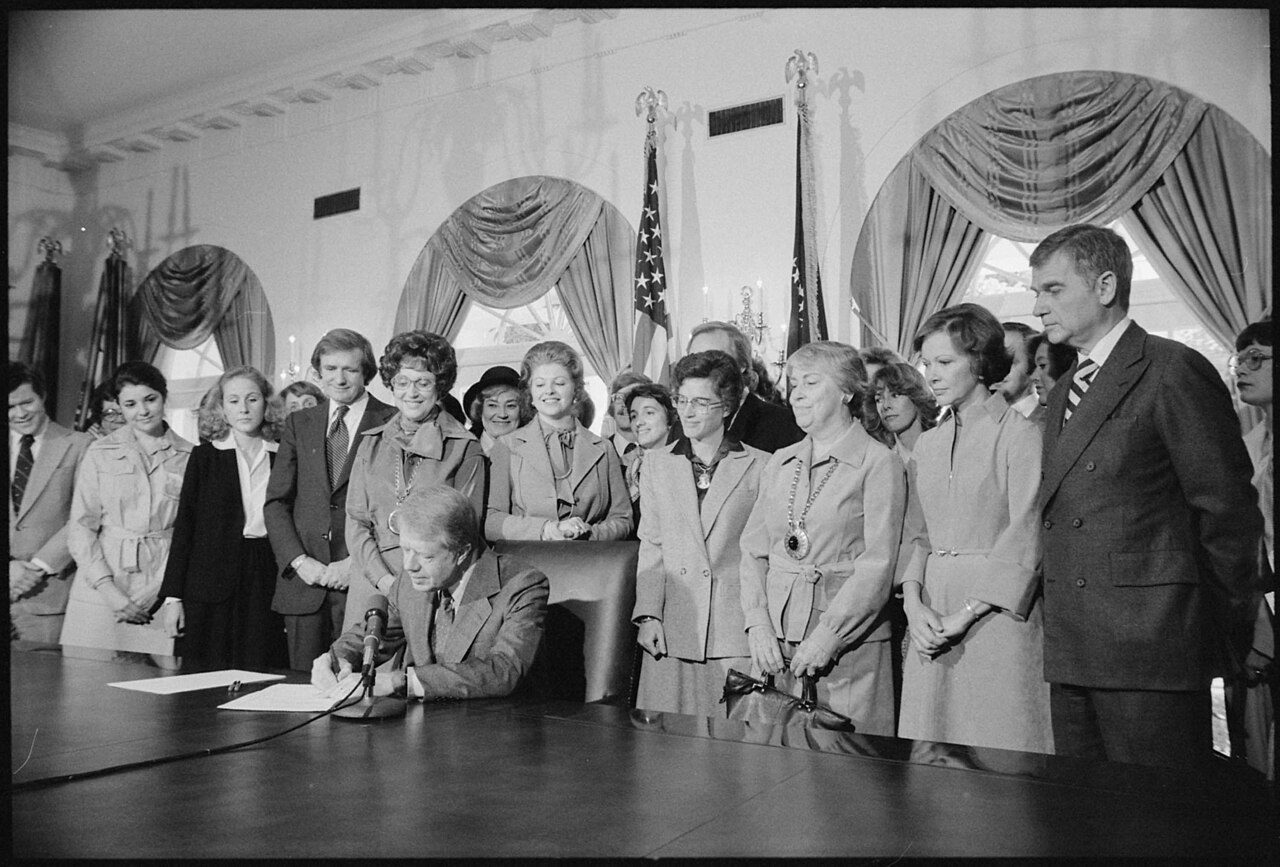
Congress had attached a deadline: ratification by 22 March 1979, exactly seven years on. In 1978, after a huge march on Washington, Congress voted to extend the deadline to 30 June 1982, and President Carter signed the extension — the signing pictured above. It changed nothing: no further state ratified in the extension window, and on 30 June 1982 the ERA was declared dead, three states short of the 38 required.
Except that it refused to stay dead. In 2017 Nevada ratified, in 2018 Illinois, and in January 2020 Virginia became the 38th state — the number the Constitution requires. Supporters argue the amendment is therefore part of the Constitution and the old deadline, which sat in the proposing resolution rather than the amendment's text, can be lifted by Congress; opponents and several court rulings disagree. More than a century after Alice Paul drafted it, and half a century after the Senate vote of 22 March 1972, the Equal Rights Amendment remains what it has always been: 24 words, fully ratified on paper by one count, and still fought over.
Why this date matters
March 22 keeps staging arguments about who counts. In 1765 Parliament taxed the colonies without asking them; in 1972 Congress sent the states an amendment declaring sex no bar to equal rights, and the states argued for fifty years. Between those poles sit the day's escapes and beginnings — Grotius smuggled out in a book chest in 1621, the Arab League founded in 1945, four Liverpool musicians releasing a first album in 1963. It is a date for texts with long consequences: a tax act, an amendment, a debut record.
Sources
- Encyclopaedia Britannica — On This Day: March 22
- HISTORY — This Day in History: March 22
- HISTORY — Equal Rights Amendment passed by Congress
- Jimmy Carter Library (National Archives) — The ERA and You
The facts on this page were checked against these sources on 19 November 2026. The History Trail's permanent pages are researched and written for this site; the live profiles elsewhere on The History Trail are assembled automatically from Wikipedia and Wikidata.
About the Author
Researched and written by the The History Trail Editorial Team — the accountable editorial function behind this site's permanent story pages. The team works from the published sources cited on each page; it does not invent historians, reviewers or credentials, and it corrects errors openly.
Fact Check
Every load-bearing fact on this page traces to one of the sources listed above, and significant claims link to their source in the text. Our checking method is described on the methodology page; errors can be reported via the corrections page.
Sources & Citations
Cite this page as: The History Trail Editorial Team, The History Trail — this article's title, publication and update dates are shown beneath its headline. The full source list appears under Sources above; the site's source standards are on the sources page.