
On This Day
March 21 in History
On 21 March 1960, at the township of Sharpeville south of Johannesburg, South African police opened fire on a crowd of Black protesters demonstrating against apartheid's pass laws, killing 69 people and wounding 180. The Sharpeville massacre turned the world's eyes on apartheid, pushed South Africa's liberation movements toward armed resistance, and is the reason 21 March is now marked worldwide against racial discrimination. The date is also the day Alcatraz prison closed and the Selma to Montgomery march set out.
Choose another date: open the On This Day calendar to browse events, births and deaths for any day of the year.
At a Glance
- The protest
- A campaign by the Pan-Africanist Congress against the pass laws; leader Robert Sobukwe had surrendered himself for arrest that morning
- The shooting
- Police fired on the crowd outside Sharpeville police station; 69 people were killed, including 8 women and 10 children, and 180 wounded
- The pass laws
- Rules requiring Black South Africans to carry pass books controlling where they could live, work and travel
- The reaction at home
- A state of emergency followed; the ANC and PAC were banned, and within two years both had formed armed wings
- The reaction abroad
- The UN Security Council condemned South Africa in Resolution 134, its first such action on apartheid
- The legacy
- In 1966 the UN made 21 March the International Day for the Elimination of Racial Discrimination; in South Africa it is Human Rights Day
Events on this day
- 1778British Loyalist and Hessian forces surprise a New Jersey militia detachment at Hancock's Bridge, killing some 20 men in a night attack during the American Revolutionary War.
- 1918Germany launches the Spring Offensive on the Western Front, its last great attempt to win the First World War before American troops arrive in strength.
- 1925Tennessee's Butler Act, banning the teaching of human evolution in public schools, is signed into law — setting up the Scopes trial four months later.
- 1960South African police kill 69 anti-pass protesters at Sharpeville — the featured story above.
- 1963The federal penitentiary on Alcatraz Island in San Francisco Bay closes, its last prisoners transferred out; high costs and crumbling buildings doom 'the Rock' after 29 years.
- 1965Martin Luther King Jr. leads some 3,200 civil rights marchers out of Selma, Alabama, at the start of the third, successful Selma to Montgomery march for voting rights.
- 1980President Jimmy Carter announces that the United States will boycott the Moscow Summer Olympics in protest at the Soviet invasion of Afghanistan.
- 1990Namibia becomes independent from South Africa after decades of occupation and guerrilla war, with Sam Nujoma sworn in as its first president.
- 1999Bertrand Piccard and Brian Jones land in Egypt, completing the first non-stop balloon flight around the world, begun in Switzerland 19 days earlier.
Born on this day
- 1685Johann Sebastian Bach — German composer whose works brought Baroque music to its peak; music director at St Thomas's, Leipzig.
- 1768Joseph Fourier — French mathematician and physicist who showed how heat flows, and whose Fourier series underlies modern signal analysis.
- 1806Benito Juárez — Mexican statesman and president, the Indigenous reformer who defended the republic against French intervention.
- 1880Hans Hofmann — German-born painter and teacher who carried European modernism into American abstract art.
- 1923Nizar Qabbani — Syrian poet and diplomat, among the most widely read love poets in modern Arabic.
- 1960Ayrton Senna — Brazilian racing driver, three-time Formula One world champion, killed at Imola in 1994.
Died on this day
- 1487Nicholas of Flüe — Swiss hermit and mystic, later patron saint of Switzerland, whose counsel was credited with keeping the Swiss cantons from civil war.
- 1556Thomas Cranmer — first Protestant archbishop of Canterbury, architect of the English prayer book, burned at the stake under Mary I.
- 2017Martin McGuinness — former IRA commander turned Sinn Féin negotiator and deputy first minister of Northern Ireland, a central figure of the peace process.
The featured story: the Sharpeville massacre, 21 March 1960
The pass laws were apartheid's everyday machinery. Every Black South African was required to carry a pass book recording permission to live, work and travel, and to produce it on demand; failing to do so was a criminal offence that filled the prisons. In March 1960 the Pan-Africanist Congress, a breakaway rival of the African National Congress led by Robert Sobukwe, called a campaign against the passes: supporters were to leave their books at home, present themselves at police stations and court arrest, peacefully and in numbers the system could not process. Sobukwe himself surrendered at Orlando police station that morning, as planned.
At Sharpeville, a township near Vereeniging south of Johannesburg, a crowd of some 5,000 to 7,000 people gathered outside the police station through the morning. The police inside, reinforced to roughly 300 officers with armoured cars, grew steadily more frightened; low-flying jets were sent to intimidate the crowd. Shortly before two o'clock, after scuffles at the fence, the police opened fire without warning and kept firing as the crowd fled. When it stopped, 69 people were dead — among them 8 women and 10 children — and 180 were wounded. Most of the dead, the photographs showed, had been shot in the back.
The government answered protest with repression: a state of emergency, some 18,000 detentions, and in April the banning of both the ANC and the PAC. But Sharpeville had broken something. Abroad, the UN Security Council passed Resolution 134, condemning South Africa — the first time it had directly criticised a member state over racial discrimination — and investors began pulling money out. At home, the lesson the liberation movements drew was that peaceful protest would be met with bullets. Nelson Mandela and others concluded that non-violence alone had failed; in 1961 the ANC founded its armed wing, Umkhonto we Sizwe, and the long struggle entered a new and harder phase.
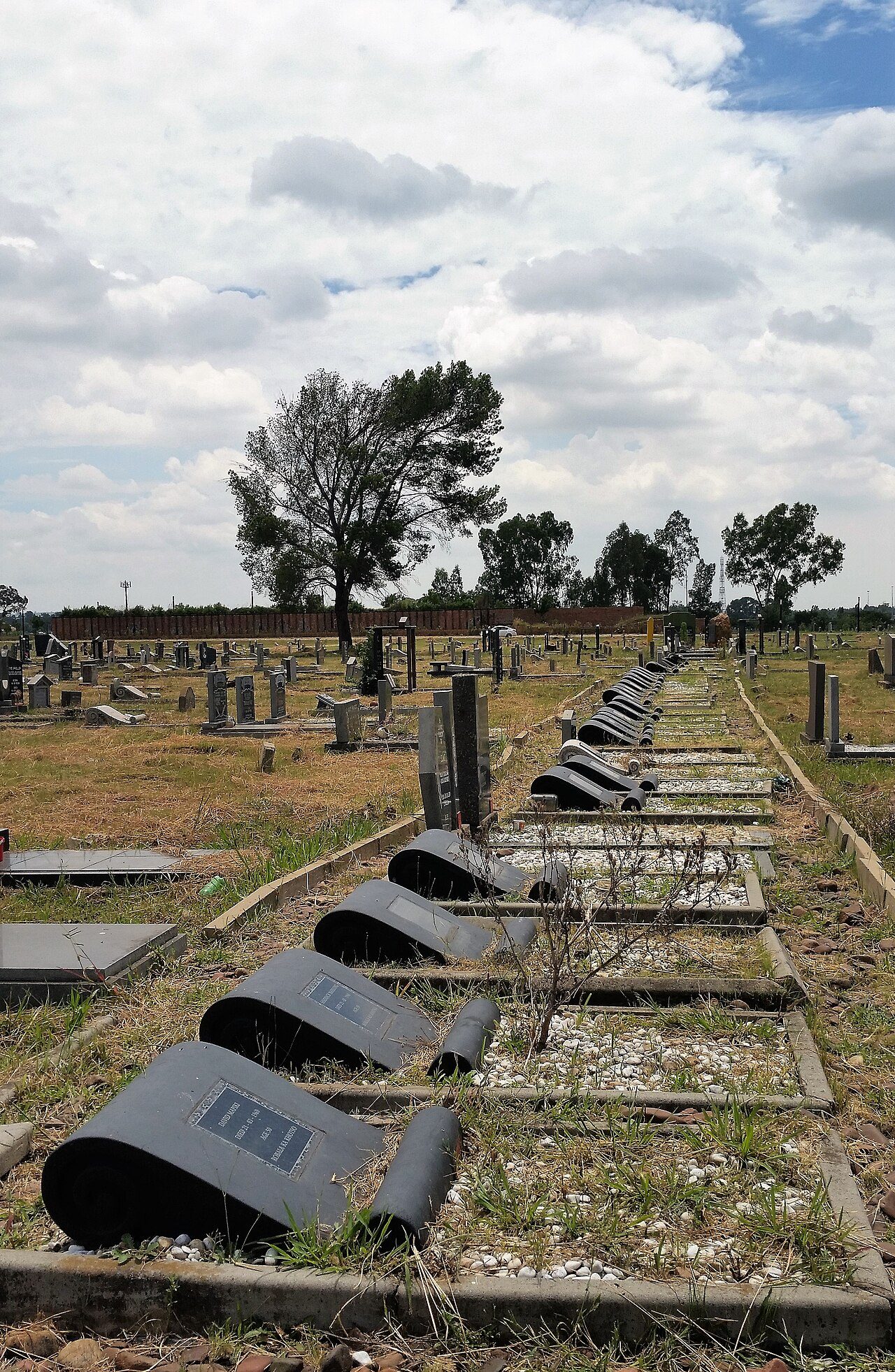
The date now belongs to the victims. In 1966 the United Nations proclaimed 21 March the International Day for the Elimination of Racial Discrimination, observed every year since. In post-apartheid South Africa it is a public holiday, Human Rights Day, and the graves at Phelindaba Cemetery — photographed above — are a national heritage site, inscribed in 2024 on UNESCO's World Heritage List as part of the Nelson Mandela Legacy Sites. The pass books are gone; the day they were protested is not forgotten.
Why this date matters
March 21 is a day on which crowds faced power. At Sharpeville in 1960 the crowd was unarmed and the power was a police line; five years later to the day, marchers set out from Selma under federal protection to claim the vote, and won it. The date also holds quieter endings and beginnings — Alcatraz emptying in 1963, Namibia beginning in 1990, a balloon closing its circle around the Earth in 1999. Its official meanings, Human Rights Day and the UN's day against racial discrimination, were not assigned at random: they are this date's own history, formally remembered.
Sources
- Encyclopaedia Britannica — On This Day: March 21
- HISTORY — This Day in History: March 21
- HISTORY — Massacre in Sharpeville
- South African Government — International Day for the Elimination of Racial Discrimination
The facts on this page were checked against these sources on 19 November 2026. The History Trail's permanent pages are researched and written for this site; the live profiles elsewhere on The History Trail are assembled automatically from Wikipedia and Wikidata.
About the Author
Researched and written by the The History Trail Editorial Team — the accountable editorial function behind this site's permanent story pages. The team works from the published sources cited on each page; it does not invent historians, reviewers or credentials, and it corrects errors openly.
Fact Check
Every load-bearing fact on this page traces to one of the sources listed above, and significant claims link to their source in the text. Our checking method is described on the methodology page; errors can be reported via the corrections page.
Sources & Citations
Cite this page as: The History Trail Editorial Team, The History Trail — this article's title, publication and update dates are shown beneath its headline. The full source list appears under Sources above; the site's source standards are on the sources page.