
Things
Neptune
Neptune is the only planet discovered on paper. Astronomers found it not by scanning the sky but by arithmetic: Uranus was wandering off its predicted path, and the numbers said another world must be pulling at it. It was, and the telescope found it the first night anyone looked.
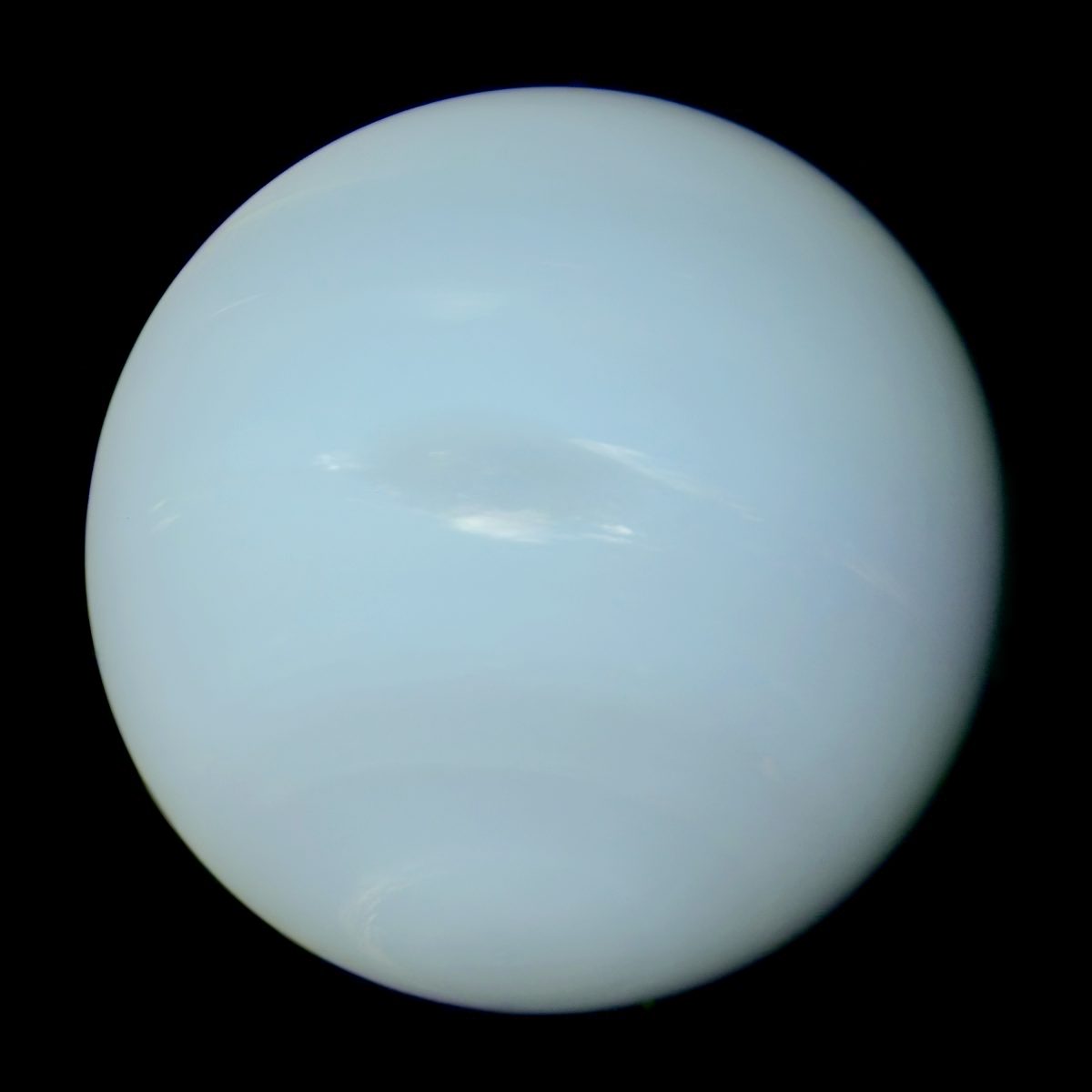
At a Glance
- Position
- Eighth and most distant planet from the Sun
- Discovery
- 23 September 1846, by Johann Galle, from Urbain Le Verrier's predicted position
- Diameter
- 49,528 km — about four times wider than Earth
- Distance from the Sun
- 30 AU (about 4.5 billion km); sunlight takes 4 hours to arrive, and is some 900 times fainter than on Earth
- Day / year
- About 16 hours / about 165 Earth years — the first full orbit since discovery was completed only in 2011
- Winds
- The fastest in the solar system — over 2,000 km/h
- Moons
- 16 known; the largest, Triton, orbits backwards and vents icy geysers
- Visibility
- The only planet not visible to the naked eye
Introduction
Neptune is the edge of the planetary system: the eighth and most distant planet, thirty times farther from the Sun than Earth, in a cold so deep and a twilight so dim that high noon there would look like dusk here. Sunlight takes four hours to reach it and arrives some 900 times fainter than the light on Earth. No human eye can see it unaided — Neptune is the only planet that requires a telescope — and for most of history, no one knew to look.
It is an ice giant: a world about four times wider than Earth whose bulk is a hot, dense fluid of water, methane and ammonia over a small rocky core, wrapped in an atmosphere of hydrogen, helium and methane. That methane drinks the red light and reflects the blue, giving Neptune its colour. Despite receiving almost no energy from the Sun, it drives the most violent weather known — winds above 2,000 kilometres an hour, three times stronger than Jupiter's and nine times stronger than Earth's.
Background
Neptune's existence was an embarrassment in Uranus's bookkeeping. By the 1840s the seventh planet persistently drifted from its calculated orbit, and the French mathematician Urbain Le Verrier concluded that an unseen planet's gravity was responsible — and computed where it must be. He sent the position to Johann Galle at the Berlin Observatory, who found Neptune on his first night of searching, in 1846, within a degree of the prediction. John Couch Adams in England had reached a similar answer independently, and the discovery became a famous, slightly quarrelsome triumph of Newtonian mechanics.
The planet had actually been seen before: Galileo recorded it as a fixed star in 1612 and 1613, never suspecting it moved. Its retinue matches its strangeness. Triton, found just seventeen days after the planet, is the only large moon that orbits backwards — almost certainly a captured Kuiper Belt world — and despite a surface near −235°C it fires geysers of icy material eight kilometres into its thin air. Neptune also wears at least five faint rings, whose outer member is broken into bright arcs that, by the laws of motion, ought long ago to have smeared themselves out.
Timeline
- 1612–1613
Galileo records Neptune in his observing notes as a fixed star, unaware it is a planet.
- 23 September 1846
Acting on Le Verrier's calculations, Johann Galle finds Neptune at the Berlin Observatory on his first night of searching — the first planet located by mathematics.
- 10 October 1846
William Lassell discovers Triton, Neptune's largest moon, just seventeen days after the planet itself.
- 1949
Gerard Kuiper discovers Nereid, Neptune's third-largest moon — the last to be found before the space age.
- 1984
Astronomers gather the first solid evidence from Earth that Neptune is ringed.
- 25 August 1989
NASA's Voyager 2 flies past Neptune — the first and still the only spacecraft visit — photographing the Great Dark Spot and passing about 4,800 km above the north pole.
- 2011
Neptune completes its first full 165-year orbit of the Sun since its discovery.
- 2013
A fourteenth moon is identified in Hubble Space Telescope images, later named Hippocamp; the known family has since grown to sixteen.
- 2024
Researchers reprocess the Voyager 2 images and show Neptune's true colour is a paler blue-green, much closer to Uranus than the famous deep-blue portraits suggested.
Significance
Neptune's discovery was the nineteenth century's cleanest demonstration that the universe is computable. A planet nobody had seen was inferred from decimal places, predicted to within a degree, and found on demand. It validated gravitation as a tool not merely of description but of discovery — the same logic later used to map dark matter's effects and to predict, from wobbles in starlight, thousands of exoplanets around other stars.
The planet itself matters as the type specimen of a class. Ice giants turned out to be the most common kind of planet in the galaxy — worlds of Neptune's size dominate the exoplanet census — yet our own example has been visited once, briefly, in 1989. Its supersonic winds on minimal sunlight, its tipped-over magnetic field, its captured moon and impossible ring arcs are standing challenges: the most typical planet we know is the one we understand least.
Legacy
Voyager 2's single flyby remains the whole of our close-up knowledge, and its data still anchors the science: the Great Dark Spot it photographed has since vanished while new dark storms have formed, watched from Earth by Hubble. Neptune has completed exactly one full year since we found it — one Neptunian year of study, most of it at a distance of billions of kilometres.
A dedicated ice-giant mission is among planetary science's most argued-for next steps. Until one flies, Neptune stays as Le Verrier left it: a triumph of inference at the edge of the light, a blue world we deduced before we saw, still keeping most of its weather to itself.
Sources
The facts on this page were checked against these sources on 19 November 2026. The History Trail's permanent pages are researched and written for this site; the live profiles elsewhere on The History Trail are assembled automatically from Wikipedia and Wikidata.
About the Author
Researched and written by the The History Trail Editorial Team — the accountable editorial function behind this site's permanent story pages. The team works from the published sources cited on each page; it does not invent historians, reviewers or credentials, and it corrects errors openly.
Fact Check
Every load-bearing fact on this page traces to one of the sources listed above, and significant claims link to their source in the text. Our checking method is described on the methodology page; errors can be reported via the corrections page.
Sources & Citations
Cite this page as: The History Trail Editorial Team, The History Trail — this article's title, publication and update dates are shown beneath its headline. The full source list appears under Sources above; the site's source standards are on the sources page.