
Years
1944 in History
1944 is the year of D-Day, when some 156,000 Allied troops landed on five Normandy beaches in the largest seaborne invasion in history and opened the liberation of Western Europe. Paris was freed in August, the Warsaw Uprising rose and was crushed, and Germany's last great offensive opened in the Ardennes in December.
At a Glance
- Defining event
- D-Day, 6 June 1944: some 156,000 Allied troops land on five Normandy beaches
- The armada
- More than 5,000 ships and landing craft and over 11,000 aircraft support the landings
- D-Day cost
- Allied casualties estimated at about 10,000, of whom 4,414 are confirmed killed
- Paris liberated
- 25 August 1944, after four years of German occupation
- Warsaw Uprising
- 1 August to 2 October: 63 days, ended by the Home Army's surrender
- Closed the year
- Germany launches the Battle of the Bulge, 16 December, its last great offensive
The defining story: D-Day
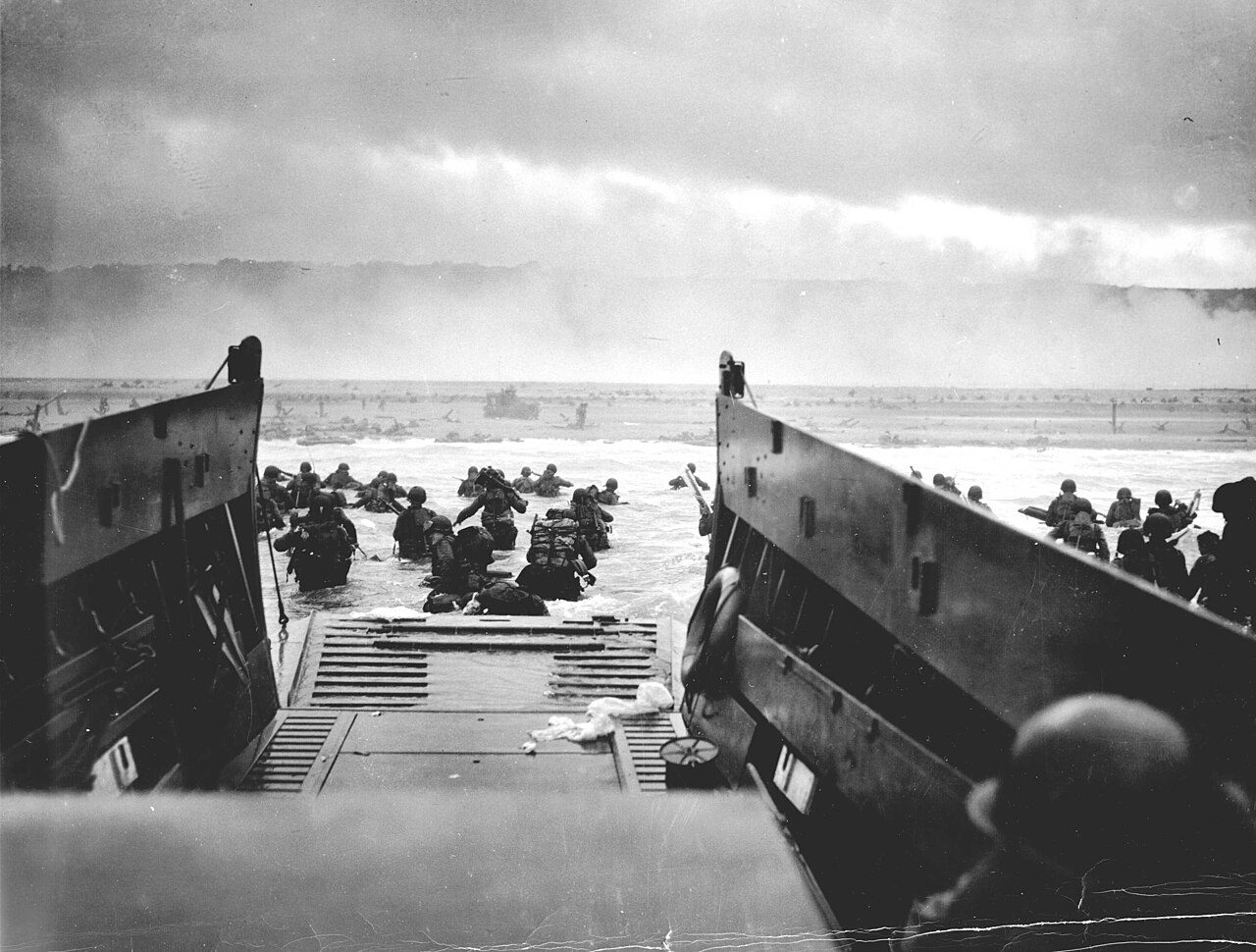
D-Day was the most heavily prepared gamble of the Second World War. By the spring of 1944 the Allies had assembled in southern England an invasion force of some 156,000 men for the first day alone, supported by more than 5,000 ships and landing craft and over 11,000 aircraft. An elaborate deception, Operation Fortitude, worked to convince the Germans that the blow would fall at the Pas-de-Calais, the shortest crossing. The supreme commander, General Dwight D. Eisenhower, had fixed the landings for 5 June, and then, with a storm battering the Channel, postponed them by a day on the forecast of his meteorologist, Group Captain James Stagg, who promised a brief window of tolerable weather on the 6th. The photograph on this page, troops of the US 1st Infantry Division leaving a landing craft at Omaha Beach that morning, was taken by the Coast Guard photographer Robert F. Sargent and became the invasion's defining image.
The invasion began in darkness. Shortly after midnight, more than 18,000 British and American paratroopers and glider troops dropped behind the beaches to seize bridges and causeways. At dawn the greatest naval bombardment of the war opened on the German Atlantic Wall, and from 6:30 in the morning the infantry went ashore on five beaches: Utah and Omaha for the Americans, Gold and Sword for the British, Juno for the Canadians. At Omaha, where a German infantry division waited on the bluffs, the first waves were cut down in the surf and among the obstacles, and for hours the landing hung in the balance. By nightfall all five beachheads were held and some 156,000 troops were ashore, but the cost was severe: Allied casualties for 6 June are estimated at about 10,000 men, of whom 4,414 are confirmed killed, and the city of Caen, a first-day objective, would not fall for weeks.
The summer that followed carried the war across three continents. In January the Siege of Leningrad had finally been lifted, 872 days after the city was encircled. In the Pacific, American Marines stormed ashore on Saipan in June, and the Battle of the Philippine Sea destroyed Japanese naval air power, costing Japan three carriers and some 600 aircraft. On 20 July, German officers led by Colonel Claus von Stauffenberg tried to kill Hitler with a bomb; he survived, and Stauffenberg was executed the next day. On 1 August the Polish Home Army, some 50,000 troops, rose against the German occupation of Warsaw while the Red Army halted across the Vistula and remained idle; the same day, in hiding in Amsterdam, Anne Frank wrote the final entry in her diary, and on 4 August she and the seven others in the Secret Annex were arrested after 761 days in hiding.
Paris was liberated on 25 August, as the French 2nd Armoured Division and the Resistance forced the surrender of the German garrison and Charles de Gaulle walked to the Hotel de Ville. But Warsaw's rising ended on 2 October after 63 days, the Home Army surrendering before the Germans deported the population and razed the city. In September Operation Market Garden, the airborne bid to end the war by Christmas, failed at Arnhem; in October the first organised kamikaze attacks were flown at Leyte Gulf; and on 16 December Germany launched its last great offensive in the Ardennes, the Battle of the Bulge, whose besieged garrison at Bastogne was relieved by Patton's tanks on 26 December.
Timeline of 1944
- 27 January
The Siege of Leningrad is finally lifted, 872 days after German forces encircled the city.
- 24 March
Seventy-six Allied airmen escape from Stalag Luft III in the 'Great Escape'; most are recaptured and 50 are murdered by the Gestapo.
- 6 June
Allied forces land in Normandy on D-Day, some 156,000 troops on five beaches.
- 20 June
The Battle of the Philippine Sea ends in decisive American victory, costing Japan three carriers and some 600 aircraft.
- 22 June
President Roosevelt signs the G.I. Bill, offering education, housing and unemployment benefits to returning veterans.
- 20 July
Adolf Hitler survives the assassination attempt led by Colonel Claus von Stauffenberg.
- 1 August
The Warsaw Uprising begins, as the Polish Home Army rises against the German occupation of Warsaw.
- 4 August
Anne Frank and the seven others in the Secret Annex in Amsterdam are arrested after 761 days in hiding.
- 25 August
Paris is liberated as the German garrison surrenders to Free French forces.
- 17 September
Operation Market Garden begins: Allied paratroopers drop behind German lines in the Netherlands; the plan fails at Arnhem.
- 2 October
The Warsaw Uprising ends after 63 days, as the Polish Home Army surrenders.
- 25 October
Japanese pilots fly the first organised kamikaze attacks at the Battle of Leyte Gulf.
- 16 December
Germany launches its last great offensive of the war in the Ardennes, beginning the Battle of the Bulge.
- 26 December
Tanks of Patton's Third Army break through to relieve the besieged garrison at Bastogne.
Why 1944 still matters
Normandy was the hinge of the war in the West: the moment the Western Allies returned to France in strength and Nazi Germany's defeat became a matter of time. Within eleven months of the landings Germany had surrendered, and the armies that came ashore on D-Day had liberated Paris, crossed the Rhine and met the Red Army in the heart of Germany. The invasion's planning, its deception, its weather gamble and its multinational scale remain the benchmark against which every later amphibious and coalition operation is measured, and its cemeteries above the beaches are still the war's most visited ground in the West.
The year also built the peace's machinery while the fighting ran on. The Dumbarton Oaks conference, opened in August and concluded in October, agreed the framework that became the United Nations. In Washington, the G.I. Bill signed in June offered returning veterans education, housing and unemployment benefits, a settlement that reshaped American society for a generation. Against those constructions stand the year's warnings: the murder of 50 recaptured escapers after the Great Escape, the crushing of Warsaw while an ally watched from across the river, and Anne Frank's diary falling silent three days before her arrest. Her papers, scattered in the raid, were saved by the helper Miep Gies, which is why the diary survived to be published in 1947.
1944 on The History Trail
Four of 1944's days carry featured stories on The History Trail, from the Normandy beaches to the streets of Warsaw and Paris.
- June 6 in History — D-Day: Allied forces land in Normandy in the largest seaborne invasion in history.
- August 1 in History — The Warsaw Uprising begins as the Polish Home Army rises against the occupation.
- August 4 in History — Anne Frank and her family are captured in the Secret Annex in Amsterdam.
- August 25 in History — Paris is liberated after four years of German occupation.
- United States dollar — A permanent page from the site's collection, among the stories this year touches.
- Nelson Mandela — A permanent page from the site's collection, among the stories this year touches.
Sources
- Encyclopaedia Britannica — On This Day: January 27
- Encyclopaedia Britannica — On This Day: March 24
- Encyclopaedia Britannica — On This Day: June 5
- Encyclopaedia Britannica — On This Day: June 6
- Imperial War Museums — 10 Things You Need to Know About D-Day
- Smithsonian Magazine — The Day That Changed the World
The facts on this page were checked against these sources on 19 November 2026. The History Trail's permanent pages are researched and written for this site; the live profiles elsewhere on The History Trail are assembled automatically from Wikipedia and Wikidata.
About the Author
Researched and written by the The History Trail Editorial Team — the accountable editorial function behind this site's permanent story pages. The team works from the published sources cited on each page; it does not invent historians, reviewers or credentials, and it corrects errors openly.
Fact Check
Every load-bearing fact on this page traces to one of the sources listed above, and significant claims link to their source in the text. Our checking method is described on the methodology page; errors can be reported via the corrections page.
Sources & Citations
Cite this page as: The History Trail Editorial Team, The History Trail — this article's title, publication and update dates are shown beneath its headline. The full source list appears under Sources above; the site's source standards are on the sources page.