
Years
1942 in History
1942 is the year the Second World War turned. The United States destroyed four Japanese carriers at Midway, the Axis advance was halted at El Alamein and reversed at Stalingrad, and American Marines opened their first offensive at Guadalcanal. It was also the year the Holocaust's machinery was coordinated at Wannsee and the atomic age began under a Chicago football stand.
At a Glance
- Defining event
- The Battle of Midway, 4 June 1942: Japan loses four fleet carriers and the initiative in the Pacific
- Eastern Front
- Soviet pincers complete the encirclement of the German Sixth Army at Stalingrad, 23 November
- North Africa
- The Second Battle of El Alamein opens, 23 October, against Rommel's Afrika Korps
- First US offensive
- Marines land on Guadalcanal, 7 August, opening Operation Watchtower
- The Holocaust
- Nazi officials coordinate the 'Final Solution' at the Wannsee Conference, 20 January
- Atomic age begins
- Fermi's team achieves the first controlled nuclear chain reaction in Chicago, 2 December
The defining story: Midway and the turning of the tide
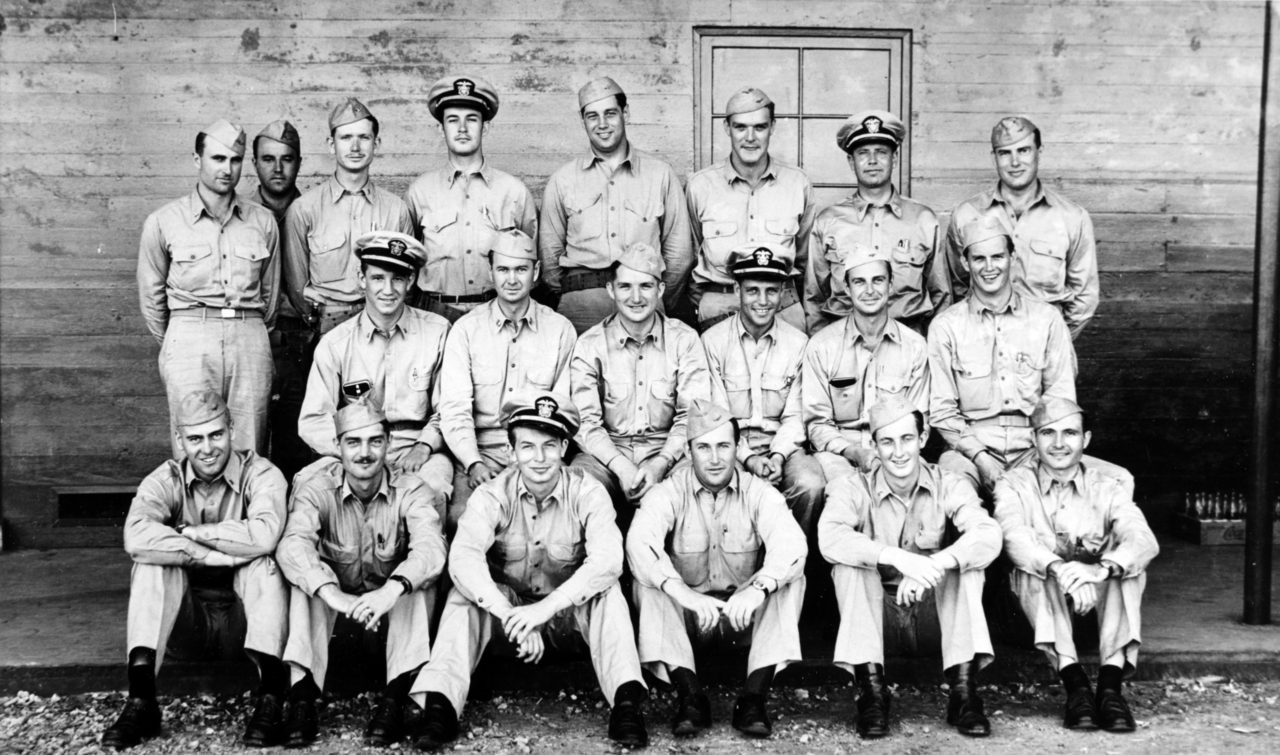
Midway was an ambush, and the Japanese sailed into it blind. Six months after Pearl Harbor, Admiral Isoroku Yamamoto planned to seize Midway Atoll and destroy the US Pacific Fleet's carriers when they came to its defence. What he did not know was that American codebreakers at Station HYPO in Hawaii, led by Commander Joseph Rochefort, had broken enough of the Japanese naval code to read the plan, and had confirmed the target, codenamed AF, by arranging for Midway to report in the clear that its water plant had failed; Japan obligingly signalled that AF was short of water. Admiral Chester Nimitz therefore placed his three carriers, Enterprise, Hornet and a Yorktown patched together in roughly three days after her mauling at the Coral Sea, northeast of Midway, out of sight, and waited. The pilots photographed for this page, Torpedo Squadron Three from Yorktown at Kaneohe in late May, were among the men who flew into that ambush from the other side.
On the morning of 4 June, Japanese aircraft struck Midway's airfield while their four fleet carriers prepared a second strike. American torpedo bombers attacked in waves and were slaughtered, Torpedo Squadron 8 losing every one of its fifteen aircraft, but their sacrifice dragged the Japanese fighter screen down to sea level and left the carriers' decks crowded with refuelling and rearming planes. At about 10:20 that morning, dive-bombers from Enterprise and Yorktown arrived overhead almost unopposed, and within minutes Akagi, Kaga and Soryu were burning wrecks. The surviving carrier, Hiryu, launched a counterstrike that crippled Yorktown, but American dive-bombers fatally hit Hiryu later the same day. Japan had lost four fleet carriers, a heavy cruiser, more than 200 aircraft and, by common estimate, some 3,000 men; American losses were about 300. Midway did not end the Pacific War, but it ended Japan's ability to win it.
The same reversal ran on every front that autumn. In Egypt, the First Battle of El Alamein in July halted the Axis advance toward the Suez Canal, and on 23 October Montgomery's Eighth Army opened the Second Battle of El Alamein against Rommel's Afrika Korps. In August the US 1st Marine Division landed on Guadalcanal in Operation Watchtower, the first American offensive of the war, to seize the airfield Japan was building there, beginning a six-month campaign of attrition. And at Stalingrad, on 19 November, the Red Army launched Operation Uranus; on 23 November its pincers met south of Kalach, trapping the German Sixth Army, an estimated quarter-million Axis troops, in the pocket.
The year's darkness kept pace with its turning. In January, Nazi officials met at the Wannsee Conference in Berlin to coordinate the Final Solution, the machinery of the Holocaust, and in July the SS began deporting Jews from the Warsaw Ghetto to the Treblinka killing centre under the euphemism of resettlement; about 265,000 people were deported and murdered in the two-month action. In America, President Roosevelt's Executive Order 9066 in February authorised the removal of some 120,000 people of Japanese ancestry from the West Coast to incarceration camps. And on 2 December, beneath the stands of the University of Chicago's Stagg Field, Enrico Fermi's team achieved the first controlled, self-sustaining nuclear chain reaction, reported to Washington in the coded words that the Italian navigator had landed.
Timeline of 1942
- 20 January
Nazi officials meet at the Wannsee Conference in Berlin to coordinate the 'Final Solution'.
- 15 February
Singapore, Britain's great stronghold in Asia, falls to Japanese forces after a week of fighting.
- 19 February
President Roosevelt signs Executive Order 9066, authorising the removal of people of Japanese ancestry from the West Coast.
- 18 April
Sixteen American B-25 bombers under James Doolittle raid Tokyo from the carrier Hornet, the first attack on the Japanese home islands.
- 4 May
The Battle of the Coral Sea begins, the first naval battle fought entirely by carrier aircraft.
- 4 June
The Battle of Midway begins; over four days Japan loses four fleet carriers.
- 22 July
Deportations from the Warsaw Ghetto to the Treblinka killing centre begin; about 265,000 people are deported and murdered in two months.
- 7 August
US Marines land on Guadalcanal, opening the first American offensive of the Second World War.
- 23 October
The Second Battle of El Alamein begins in Egypt, as Montgomery's Eighth Army attacks Rommel's Afrika Korps.
- 19 November
The Red Army launches Operation Uranus, the counteroffensive that encircles the German Sixth Army at Stalingrad.
- 23 November
Soviet forces complete the encirclement of the German Sixth Army at Stalingrad.
- 26 November
The film Casablanca, starring Humphrey Bogart and Ingrid Bergman, premieres in New York City.
- 2 December
Enrico Fermi's team achieves the first controlled, self-sustaining nuclear chain reaction in Chicago.
Why 1942 still matters
Before 1942 the Axis powers were winning everywhere that mattered; after it, they were winning nowhere for long. Midway cost Japan the carriers and, still less replaceable, the veteran pilots it could not train again, and the initiative in the Pacific passed permanently to the United States. El Alamein and the Stalingrad encirclement did the same work in Africa and Europe within five weeks of each other: from the winter of 1942 the strategic question was no longer whether the Axis would win, but how long its defeat would take and what it would cost. Guadalcanal proved the pattern could be sustained at the end of the longest supply lines in the world.
The year also fixed the century's two darkest legacies. Wannsee and the Warsaw deportations mark the Holocaust's passage into industrial system, the point at which murder became administration; the organisations founded in response, such as Zegota, the Council to Aid Jews set up in occupied Warsaw in December, mark the resistance to it. And Fermi's chain reaction under Stagg Field opened the atomic age as deliberately as Midway opened the Pacific reversal: within three years the work that began there produced the weapons used on Hiroshima and Nagasaki. The first American patient successfully treated with penicillin, in March, points to the other postwar world being born at the same time, the antibiotic one.
1942 on The History Trail
Five of 1942's days carry featured stories on The History Trail, from an executive order in Washington to the pocket at Stalingrad.
- February 19 in History — Roosevelt signs Executive Order 9066 and the West Coast removals are authorised.
- June 4 in History — The Battle of Midway begins, the ambush that costs Japan four fleet carriers.
- July 22 in History — Deportations from the Warsaw Ghetto to Treblinka begin.
- August 7 in History — US Marines land on Guadalcanal in the first American offensive of the war.
- November 23 in History — Soviet pincers complete the encirclement of the German Sixth Army at Stalingrad.
- World War II — The war whose tide turned in 1942, told as a permanent story on The History Trail.
Sources
- HISTORY — What Happened on January 20
- Encyclopaedia Britannica — On This Day: February 15
- Encyclopaedia Britannica — On This Day: February 19
- Encyclopaedia Britannica — On This Day: April 18
- Encyclopaedia Britannica — On This Day: May 4
The facts on this page were checked against these sources on 19 November 2026. The History Trail's permanent pages are researched and written for this site; the live profiles elsewhere on The History Trail are assembled automatically from Wikipedia and Wikidata.
About the Author
Researched and written by the The History Trail Editorial Team — the accountable editorial function behind this site's permanent story pages. The team works from the published sources cited on each page; it does not invent historians, reviewers or credentials, and it corrects errors openly.
Fact Check
Every load-bearing fact on this page traces to one of the sources listed above, and significant claims link to their source in the text. Our checking method is described on the methodology page; errors can be reported via the corrections page.
Sources & Citations
Cite this page as: The History Trail Editorial Team, The History Trail — this article's title, publication and update dates are shown beneath its headline. The full source list appears under Sources above; the site's source standards are on the sources page.