
On This Day
February 19 in History
On 19 February 1942, ten weeks after Pearl Harbor, President Franklin D. Roosevelt signed Executive Order 9066. The order said nothing about any ethnic group — and was used to force some 120,000 people of Japanese ancestry, nearly 70,000 of them American citizens, from their West Coast homes into incarceration camps. February 19 is now observed by Japanese American communities as the Day of Remembrance. It is also the day the Marines landed on Iwo Jima in 1945 and Copernicus was born in 1473.
Choose another date: open the On This Day calendar to browse events, births and deaths for any day of the year.
At a Glance
- The order
- Executive Order 9066, signed 19 February 1942, authorising the military to exclude any persons from designated military areas
- Who it struck
- People of Japanese ancestry on the West Coast — about 120,000 removed over the following months, nearly 70,000 of them U.S. citizens, in the National Archives' account
- The justification
- Fear of espionage and sabotage after Pearl Harbor — a commission later found no evidence of any such threat and no military necessity
- The camps
- Ten War Relocation Authority camps in remote inland sites, where families lived behind wire, some until 1946
- The courts
- The Supreme Court upholds the programme in Korematsu v. United States (1944); the ruling is repudiated in later decades
- The reckoning
- President Ford formally terminates the order's authority in 1976; the Civil Liberties Act of 1988 brings a national apology and reparations to survivors
Events on this day
- 1674England and the Netherlands sign the Treaty of Westminster, ending the Third Anglo-Dutch War; the Dutch colony of New Amsterdam passes permanently to England.
- 1807Former vice-president Aaron Burr is arrested in Alabama on charges of treason for his mysterious western conspiracy.
- 1847The first rescue party reaches the stranded Donner Party in the Sierra Nevada, finding survivors of the wagon train that had been snowbound since November.
- 1864The Fraternal Order of Knights of Pythias is founded in Washington, D.C., one of the first American fraternal orders chartered by Congress.
- 1878Thomas Edison receives the patent for his phonograph, the first machine that could both record and reproduce sound.
- 1915British and French warships open the naval attack on the Dardanelles, the first stage of the campaign that becomes Gallipoli.
- 1942President Franklin D. Roosevelt signs Executive Order 9066 — the featured story above.
- 1945Some 30,000 U.S. Marines land on Iwo Jima, opening one of the fiercest battles of the Pacific war.
- 1949The first Bollingen Prize in poetry is awarded to Ezra Pound for The Pisan Cantos, a choice that ignites a lasting controversy.
- 1959Britain, Greece and Turkey sign the London and Zurich agreements granting independence to Cyprus.
- 1985The first episode of the BBC soap opera EastEnders is broadcast.
Born on this day
- 1473Nicolaus Copernicus — Polish astronomer whose heliocentric model, published in 1543, placed the Sun at the centre of the system and began the Scientific Revolution.
- 1717David Garrick — English actor, playwright and theatre manager who dominated the London stage of the 18th century.
- 1940Smokey Robinson — American singer and songwriter, leader of the Miracles and a chief architect of the Motown sound.
- 1960Prince Andrew — second son of Queen Elizabeth II, born at Buckingham Palace.
- 1963Seal — British singer whose hits include Crazy and Kiss from a Rose.
Died on this day
- 1408Henry Percy, Earl of Northumberland — rebel magnate killed at the Battle of Bramham Moor, ending the Percy family's rising against Henry IV.
- 1951André Gide — French novelist and Nobel laureate, author of The Immoralist and The Counterfeiters, dead in Paris at 81.
- 1997Deng Xiaoping — paramount leader of China, architect of the market reforms that transformed its economy, dead in Beijing at 92.
- 2016Harper Lee — American novelist, author of To Kill a Mockingbird, dead in Monroeville, Alabama, at 89.
- 2016Umberto Eco — Italian novelist and scholar, author of The Name of the Rose, dead in Milan at 84 — on the same day as Harper Lee.
The featured story: Roosevelt signs Executive Order 9066, 19 February 1942
Executive Order 9066 is two paragraphs long and mentions no one. Signed by President Franklin D. Roosevelt on 19 February 1942, it authorised the secretary of war and military commanders to designate military areas from which any or all persons might be excluded. In the fear that followed the attack on Pearl Harbor — fear fed by decades of anti-Asian prejudice on the West Coast — everyone understood what the words would mean in practice. The Western Defense Command designated the entire West Coast a military area, and over the following six months some 120,000 men, women and children of Japanese ancestry were ordered out of their homes. Nearly 70,000 of them, in the National Archives' figure, were American citizens.
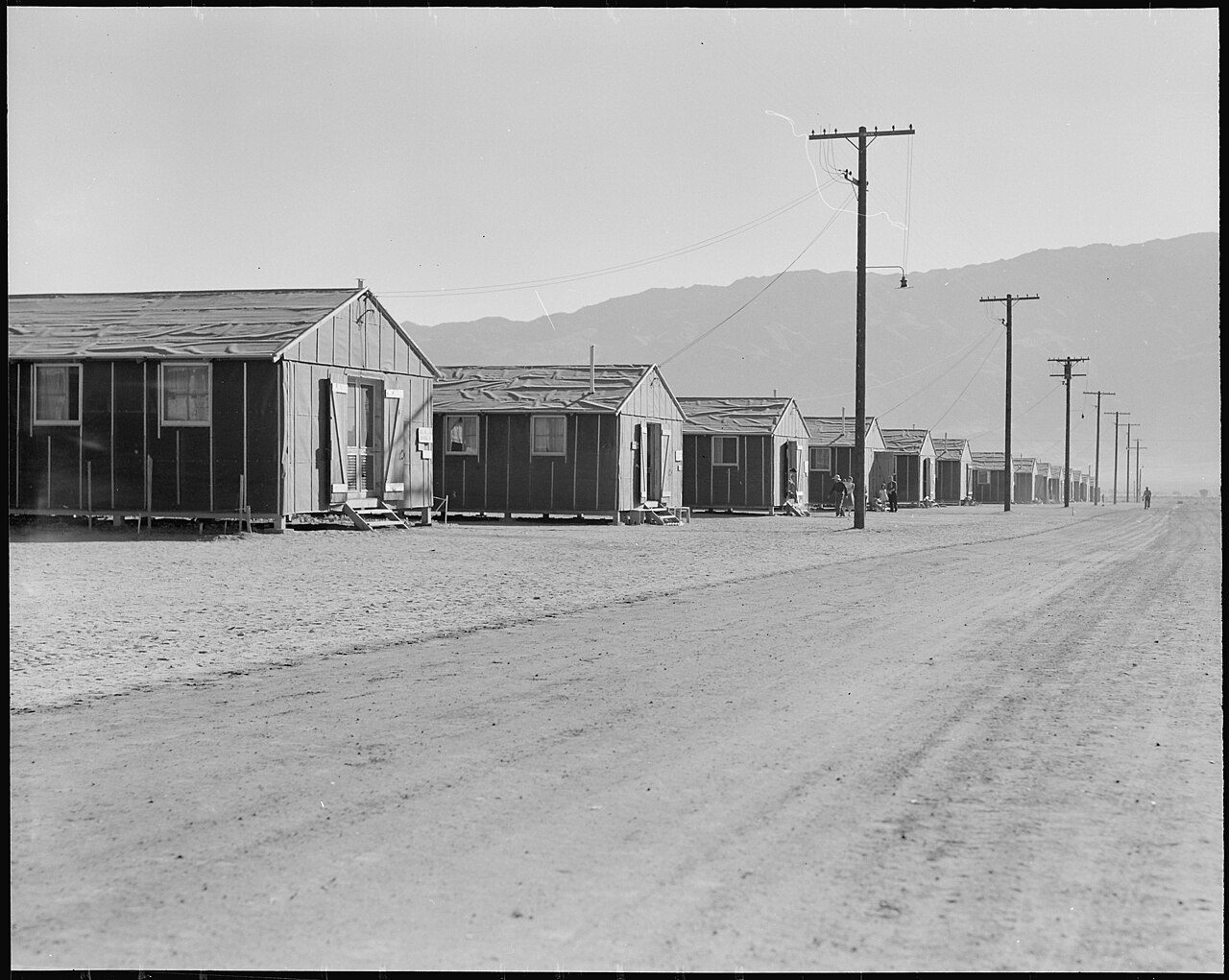
Families were given days to sell, store or abandon businesses, farms, houses and possessions built over lifetimes. They reported to assembly centres — fairgrounds, racetracks, stockyards — and were then shipped to ten War Relocation Authority camps in remote and desolate places: Manzanar in California's Owens Valley, Tule Lake, Heart Mountain in Wyoming, Minidoka in Idaho, and others, where they lived in tar-paper barracks behind barbed wire, under guard towers, in dust storms and winter cold. No charge was brought against any of them; no hearing established anyone's disloyalty. The Supreme Court, asked to intervene, upheld the programme in 1944 in Korematsu v. United States, one of the most condemned decisions in its history.
The injustice was compounded by a paradox the government itself acknowledged: from behind the wire, young Japanese American men volunteered and were drafted to fight for the country that had imprisoned their families. The 442nd Regimental Combat Team, recruited largely from the camps, became one of the most decorated units in American military history in the battlefields of Italy and France. The camps emptied through 1945 and the last closed in 1946; the internees were given, in the era's bleak formula, twenty-five dollars and a train ticket, and went home to rebuild from nothing.
The reckoning took decades. In 1976 President Gerald Ford, signing a proclamation on the order's anniversary, called 19 February 1942 a sad day in American history and formally confirmed the termination of Executive Order 9066. A congressional commission, reviewing the record in the 1980s, concluded in its report Personal Justice Denied that the removals had rested on race prejudice, war hysteria and a failure of political leadership — not military necessity. In 1988 the Civil Liberties Act delivered a formal national apology and reparations to surviving internees. Japanese American communities now mark every 19 February as a Day of Remembrance: the anniversary of a signature, and a standing warning about what fear can make a democracy sign.
Why this date matters
February 19 is the calendar's lesson in how a single signature travels. Copernicus, born on it in 1473, signed nothing but rearranged the universe; Edison patented the phonograph on it in 1878 and rearranged sound. On it in 1847 rescuers reached the Donner Party; in 1945 Marines stormed Iwo Jima, three years to the day after a president's signature uprooted 120,000 of his own people — the Pacific war's beginning at home and its end abroad, folded into one date. It is fitting that Japanese Americans chose this day, of all days, as their Day of Remembrance.
Sources
- Encyclopaedia Britannica — On This Day: February 19
- National Archives (Pieces of History) — Japanese American Internment: Righting a Wrong
- Encyclopaedia Britannica — World War II: Iwo Jima
- HISTORY — What Happened on February 19
The facts on this page were checked against these sources on 19 November 2026. The History Trail's permanent pages are researched and written for this site; the live profiles elsewhere on The History Trail are assembled automatically from Wikipedia and Wikidata.
About the Author
Researched and written by the The History Trail Editorial Team — the accountable editorial function behind this site's permanent story pages. The team works from the published sources cited on each page; it does not invent historians, reviewers or credentials, and it corrects errors openly.
Fact Check
Every load-bearing fact on this page traces to one of the sources listed above, and significant claims link to their source in the text. Our checking method is described on the methodology page; errors can be reported via the corrections page.
Sources & Citations
Cite this page as: The History Trail Editorial Team, The History Trail — this article's title, publication and update dates are shown beneath its headline. The full source list appears under Sources above; the site's source standards are on the sources page.