
On This Day
February 20 in History
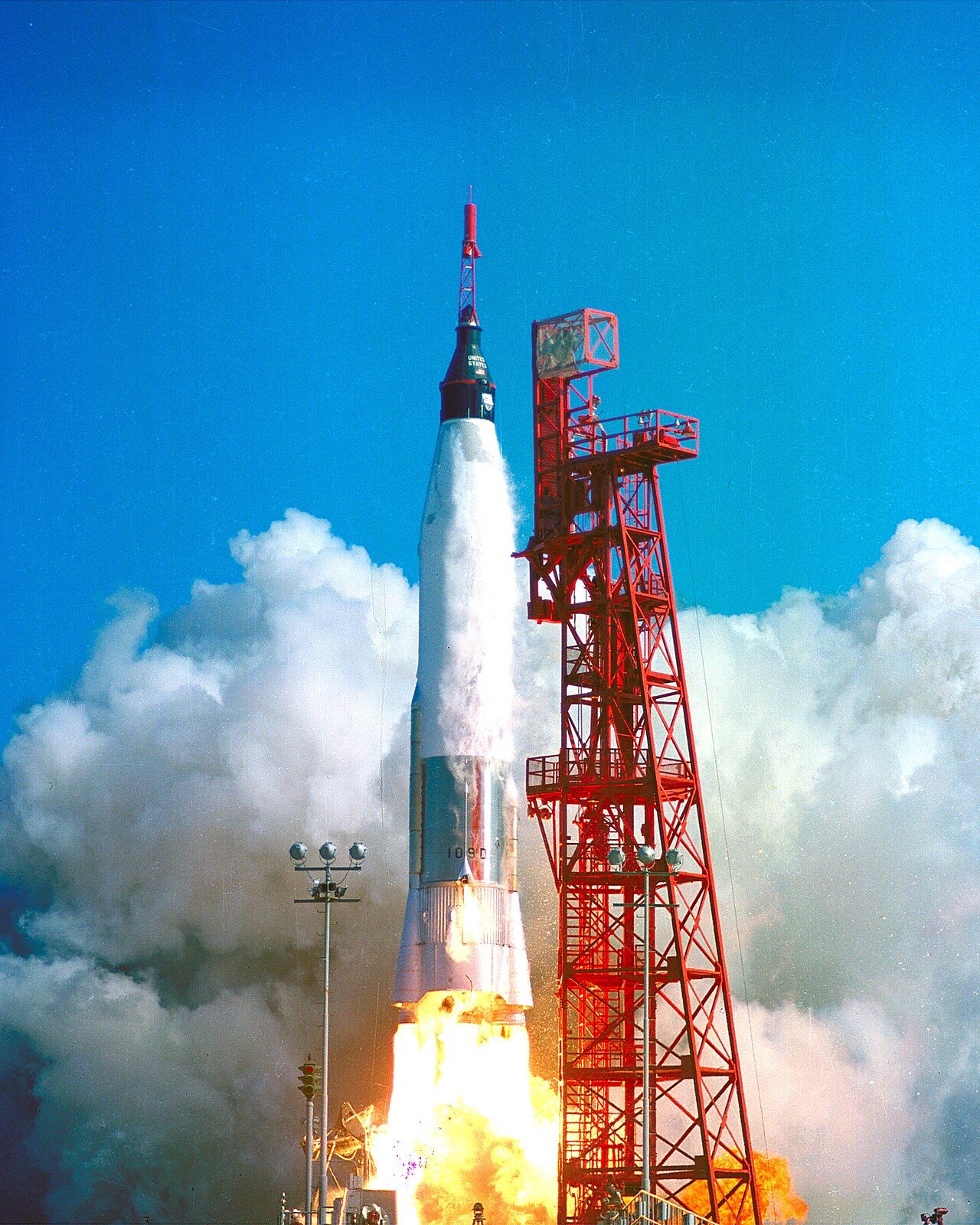
On 20 February 1962 John Glenn became the first American to orbit the Earth, circling the planet three times aboard the Mercury capsule Friendship 7 and putting the United States back into the space race. February 20 is also the day Congress banned duelling in Washington, a volcano rose out of a Mexican cornfield, and the Soviet Union launched the first module of the Mir space station.
Choose another date: open the On This Day calendar to browse events, births and deaths for any day of the year.
At a Glance
- Mission
- Mercury-Atlas 6, launched from Cape Canaveral, Florida
- Launch
- 9:47 a.m. EST, 20 February 1962
- Capsule
- Friendship 7, a Mercury capsule carried on an Atlas rocket
- Orbits
- Three orbits of the Earth in 4 hours, 55 minutes and 23 seconds
- Splashdown
- Atlantic Ocean, east of Grand Turk Island in the Turks and Caicos
- The scare
- A faulty switch wrongly signalled that the heat shield had loosened; the retrorocket pack was left strapped on through re-entry to hold the shield in place
- Context
- Glenn followed Yuri Gagarin's single Soviet orbit of April 1961 and two short American suborbital flights
Events on this day
- 1792President George Washington signs the Postal Service Act, putting the United States Post Office on a permanent footing as a federal institution.
- 1839Congress makes duelling illegal in Washington, D.C., a year after Representative Jonathan Cilley of Maine was killed in a duel with a fellow congressman.
- 1864Confederate forces defeat the Union at the Battle of Olustee, the largest battle of the American Civil War fought in Florida.
- 1942Lieutenant Edward O'Hare shoots down five Japanese bombers attacking his aircraft carrier near Rabaul, becoming the first American flying ace of the Second World War.
- 1943The volcano Parícutin begins erupting from a cornfield in Michoacán, Mexico; it grows into a mountain over nine years without directly killing anyone.
- 1962John Glenn becomes the first American to orbit the Earth, circling the planet three times aboard Friendship 7 — the featured story above.
- 1985Ireland's parliament approves the sale of contraceptives, a landmark loosening of one of the strictest such regimes in Europe.
- 1986The Soviet Union launches the core module of Mir, the space station that will be assembled in orbit over the following decade.
- 1998Fifteen-year-old American Tara Lipinski wins the women's figure skating title at the Nagano Winter Olympics, becoming the youngest champion in the event's history.
- 2003A fire ignited by stage pyrotechnics sweeps through the Station nightclub in West Warwick, Rhode Island, killing 100 people.
- 2016Cyclone Winston, the strongest tropical cyclone yet recorded in the Southern Hemisphere, strikes Fiji and kills 44 people.
Born on this day
- 1902Ansel Adams — American photographer whose black-and-white landscapes defined the wilderness of the American West.
- 1925Robert Altman — American film director of M*A*S*H, Nashville and Gosford Park.
- 1927Sidney Poitier — Bahamian-American actor, the first Black performer to win the Academy Award for Best Actor.
- 1967Kurt Cobain — American singer and guitarist who fronted the rock band Nirvana.
- 1988Rihanna — Barbadian singer who became one of the best-selling recording artists in the world.
Died on this day
- 1895Frederick Douglass — American writer and orator who escaped slavery to become the leading abolitionist voice of his century.
- 1993Ferruccio Lamborghini — Italian industrialist who founded the sports-car company that bears his name.
- 2005Hunter S. Thompson — American journalist who pioneered gonzo journalism with Fear and Loathing in Las Vegas.
The featured story: John Glenn orbits the Earth, 20 February 1962
By the winter of 1962 the space race had a clear leader, and it was not the United States. In April 1961 the Soviet cosmonaut Yuri Gagarin had completed a full orbit of the Earth, while America's first two astronauts, Alan Shepard and Virgil Grissom, had managed only fifteen-minute suborbital hops that never circled the planet. The task of closing the gap fell to John Glenn, a 40-year-old Marine Corps pilot who had flown combat missions in two wars and was the oldest of the Mercury Seven, the military test pilots chosen as America's first astronauts. His mission, Mercury-Atlas 6, had been postponed again and again by weather and technical faults, and the delays only raised the pressure on the morning it finally flew.
At 9:47 a.m. Eastern time on 20 February 1962, the Atlas rocket lifted Friendship 7 from Cape Canaveral, Florida. Glenn's flight lasted 4 hours, 55 minutes and 23 seconds and carried him three times around the Earth, at altitudes between roughly 100 and 162 miles. He became the first American to see the sun set and rise repeatedly in a single day, and during his first orbit he reported something no one could explain: thousands of tiny glowing particles drifting around the capsule, which he called fireflies. A faulty thruster forced him to fly parts of the mission manually, but the flight was going well enough that the real drama, when it came, arrived not from the capsule but from a signal on the ground.
Midway through the flight, mission control received a telemetry reading suggesting that Friendship 7's landing bag had deployed early — which would mean the heat shield, the only thing protecting Glenn from the fire of re-entry, was being held in place by nothing but straps. The signal was wrong, the product of a faulty switch, but no one could know that at the time. Controllers made a nerve-held decision: after the retrorockets fired, Glenn would not jettison the retrorocket pack as planned, so that its straps would keep the shield pressed against the capsule through re-entry. Glenn flew home through a halo of flaming debris from the burning pack, unsure whether the shield beneath him was secure, and splashed down safely in the Atlantic east of Grand Turk Island.
The relief in the United States was enormous, and so was the celebration. Glenn became a national hero overnight, proof that American technology and nerve could match the Soviet Union's head start. The flight restored momentum to the young American space programme at the moment President Kennedy had committed it to reaching the Moon by the end of the decade, and it fixed the template of the astronaut as a public figure. Glenn himself left the space programme in 1964, served four terms as a United States senator from Ohio, and then, in October 1998, flew into space once more aboard the shuttle Discovery at the age of 77 — still, at that time, the oldest person ever to travel in space.
Why this date matters
February 20 is a day on which the modern world announced itself in stages. In 1792 the young United States gave itself a permanent postal service, one of the first networks to bind a continent together; in 1839 it tried to leave the age of the duel behind, at least in its capital. The twentieth century then takes the date over: a volcano is born in a cornfield in 1943, a space station begins in 1986, and between them, in 1962, an American finally circles the Earth. The day's thread is reach — of mail, of law, of rockets — and Glenn's three orbits are its boldest expression, the moment the reach became planetary.
Sources
- Encyclopaedia Britannica — On This Day: February 20
- HISTORY — This Day in History: February 20
- NASA — 60 Years Ago: John Glenn, the First American to Orbit the Earth Aboard Friendship 7
- Encyclopaedia Britannica — John Glenn
The facts on this page were checked against these sources on 19 November 2026. The History Trail's permanent pages are researched and written for this site; the live profiles elsewhere on The History Trail are assembled automatically from Wikipedia and Wikidata.
About the Author
Researched and written by the The History Trail Editorial Team — the accountable editorial function behind this site's permanent story pages. The team works from the published sources cited on each page; it does not invent historians, reviewers or credentials, and it corrects errors openly.
Fact Check
Every load-bearing fact on this page traces to one of the sources listed above, and significant claims link to their source in the text. Our checking method is described on the methodology page; errors can be reported via the corrections page.
Sources & Citations
Cite this page as: The History Trail Editorial Team, The History Trail — this article's title, publication and update dates are shown beneath its headline. The full source list appears under Sources above; the site's source standards are on the sources page.