
On This Day
February 23 in History
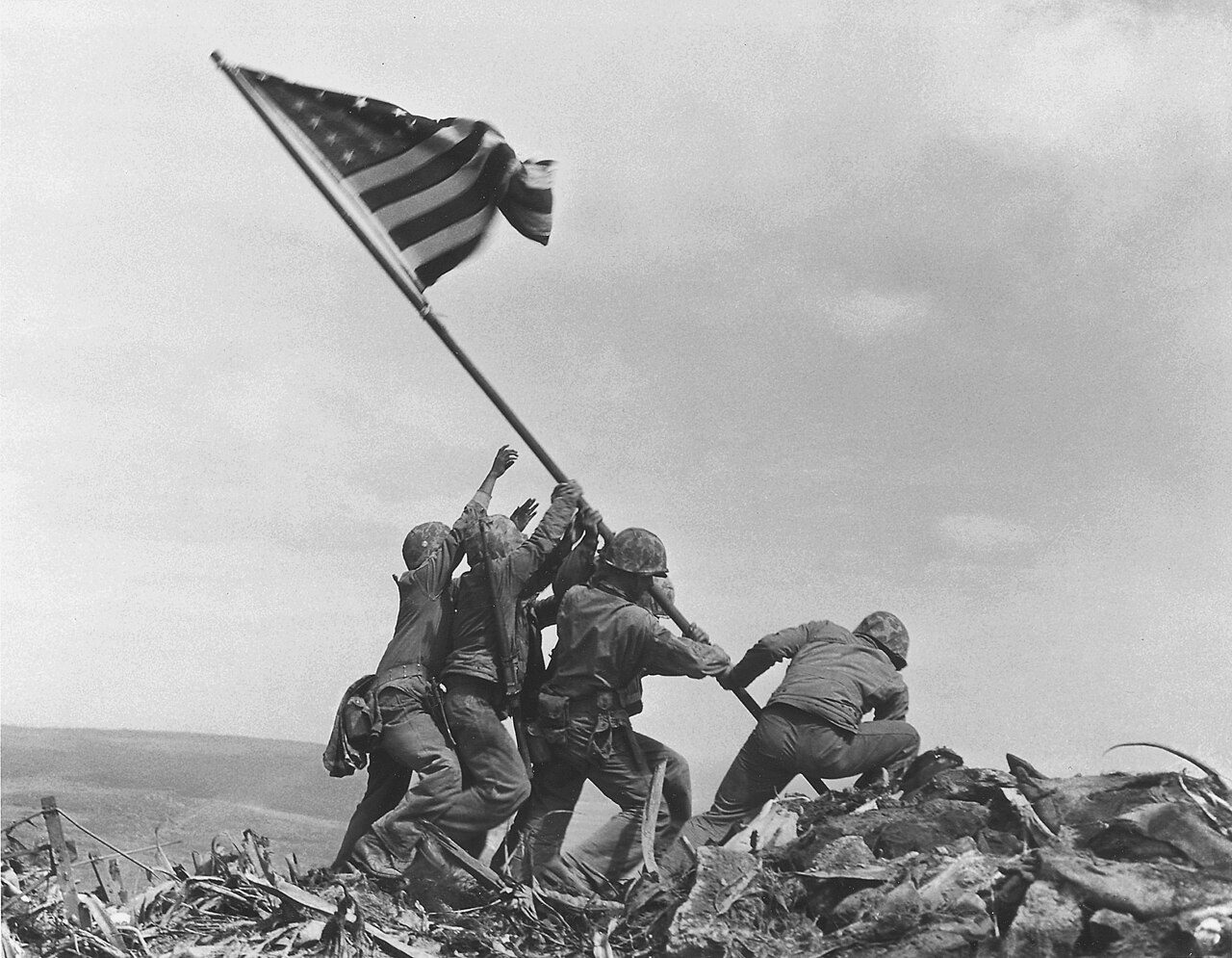
On 23 February 1945, five days into the Battle of Iwo Jima, U.S. Marines raised the American flag on Mount Suribachi — twice in one day, the second raising producing the most famous photograph of the Second World War. February 23 is also the day the siege of the Alamo began, Woody Guthrie wrote This Land Is Your Land, and the first children received the Salk polio vaccine.
Choose another date: open the On This Day calendar to browse events, births and deaths for any day of the year.
At a Glance
- The battle
- U.S. Marines landed on Iwo Jima on 19 February 1945; the island was not declared secure until 26 March
- First flag
- Raised at about 10:20 a.m. on 23 February by Lieutenant Harold Schrier's patrol and photographed by Sergeant Louis Lowery
- Second flag
- A larger battle ensign raised the same day by six Marines, photographed by AP photographer Joe Rosenthal
- The photograph
- Won the 1945 Pulitzer Prize for photography and fronted the Seventh War Bond Drive
- The memorial
- Rosenthal's image became the model for the Marine Corps War Memorial in Arlington, Virginia
- Corrected record
- In 2016 the Marine Corps confirmed Harold Schultz, long unrecognised, as one of the six second-flag raisers
Events on this day
- 1540The expedition of Francisco Vázquez de Coronado sets out from Mexico in search of the fabled Seven Cities of Cíbola.
- 1778Baron Friedrich Wilhelm von Steuben, a Prussian officer, arrives at Valley Forge to drill George Washington's Continental Army.
- 1836The siege of the Alamo begins in San Antonio, as Mexican forces under Santa Anna surround the Texan-held mission.
- 1861President-elect Abraham Lincoln arrives secretly in Washington after slipping through Baltimore, where a plot to assassinate him had been uncovered.
- 1940Woody Guthrie writes This Land Is Your Land in New York City, the song that becomes an alternative American anthem.
- 1945U.S. Marines raise the American flag on Mount Suribachi, Iwo Jima — the featured story above.
- 1954The first children receive Jonas Salk's polio vaccine at Arsenal Elementary School in Pittsburgh, opening the mass vaccination campaign against the disease.
- 1980Speed skater Eric Heiden wins the 10,000 metres in world-record time at Lake Placid, completing a sweep of all five men's speed skating gold medals at one Olympics.
- 2014Jason Collins plays for the Brooklyn Nets, becoming the first openly gay athlete to appear in a game in a major American professional league.
Born on this day
- 1633Samuel Pepys — English naval administrator whose diary is the great eyewitness record of Restoration London.
- 1685George Frideric Handel — German-born composer of Messiah, who made his career in London.
- 1744Mayer Amschel Rothschild — German banker who founded the Rothschild banking dynasty.
- 1868W. E. B. Du Bois — American sociologist, historian and civil rights leader, author of The Souls of Black Folk.
- 1940Peter Fonda — American actor who embodied the counterculture in Easy Rider.
Died on this day
- 1821John Keats — English Romantic poet, dead of tuberculosis in Rome at the age of 25.
- 1848John Quincy Adams — sixth president of the United States, who collapsed in the House of Representatives, where he served as a congressman, and died two days later.
- 1965Stan Laurel — English comedian, the thin half of Laurel and Hardy.
The featured story: the flag raised on Iwo Jima, 23 February 1945
In February 1945 the Second World War in the Pacific had reached Japan's doorstep. Iwo Jima, a small volcanic island administered as part of Tokyo itself, held airfields from which Japanese fighters intercepted American bombers on their way to the home islands — and from which the United States wanted to operate its own fighters in support of those bombers. On 19 February 1945, after days of naval bombardment, U.S. Marines stormed ashore against defenders dug into tunnels, caves and concrete. At the island's southern tip stood Mount Suribachi, a dormant volcano whose guns commanded the landing beaches. Taking it was the first great task of the battle, and it fell to the Marines in the island's south while the main fight for the airfields raged to the north.
On the morning of 23 February, four days after the landing, a combat patrol led by First Lieutenant Harold Schrier climbed Suribachi carrying a flag given to him by his battalion adjutant, with orders to raise it if they reached the summit. The patrol fought its way up and, at about 10:20 in the morning, hoisted the Stars and Stripes on a length of Japanese water pipe. Staff Sergeant Louis Lowery, a Marine photographer, captured the moment, and Marines below cheered as the flag appeared over the island. The flag was small, though, and hard to see from the beaches where thousands of men were still fighting. Later the same day a second patrol carried up a larger battle ensign, and six Marines raised it on the same summit — this time in front of Associated Press photographer Joe Rosenthal, whose camera caught the men straining together against the pole.
Rosenthal's photograph was on its way to the United States within hours, and it became the defining image of the Pacific war. Published in newspapers across the country, it won the Pulitzer Prize for photography in 1945, was used as the centrepiece of the Seventh War Bond Drive that raised billions for the war effort, and later served as the model for the Marine Corps War Memorial in Arlington, Virginia. Yet the photograph's fame has always sat oddly beside the battle it symbolised: the flag went up on the fifth day of a fight that had more than a month still to run. Iwo Jima was not declared secure until 26 March 1945, and most of the Marines who died on the island — and nearly all of its Japanese defenders — were killed after the flags were flying over Suribachi.
The image also carried a quieter lesson about how history gets recorded. The first raising, photographed by Lowery, was the one that announced to the men on the beaches that Suribachi had fallen; the second, photographed by Rosenthal, was the one the world remembered. Even the identities of the six men in the famous frame were not finally settled for seventy years: in 2016 the Marine Corps confirmed, after a historian's investigation, that one of the raisers was Private First Class Harold Schultz, who had never sought the fame and had kept his part in the photograph largely to himself for the rest of his life.
Why this date matters
February 23 is a day of arrivals and ascents. Steuben arrives at Valley Forge in 1778 to turn colonists into an army; Lincoln arrives secretly in his own capital in 1861, fleeing an assassin; Coronado sets out in 1540 after cities of gold that did not exist. Its most famous moment is also an ascent — a flag going up a volcano in 1945, photographed so perfectly that the picture outgrew the battle. The day keeps pairing hope with cost: the same date that gives children the first polio vaccine in 1954 gave the world the beginning of the Alamo siege in 1836. February 23 remembers both halves of that bargain.
Sources
- Encyclopaedia Britannica — On This Day: February 23
- HISTORY — This Day in History: February 23
- National Museum of the Pacific War — The Battle of Iwo Jima
- Associated Press — This Day in History: February 23 (via Jamaica Observer)
The facts on this page were checked against these sources on 19 November 2026. The History Trail's permanent pages are researched and written for this site; the live profiles elsewhere on The History Trail are assembled automatically from Wikipedia and Wikidata.
About the Author
Researched and written by the The History Trail Editorial Team — the accountable editorial function behind this site's permanent story pages. The team works from the published sources cited on each page; it does not invent historians, reviewers or credentials, and it corrects errors openly.
Fact Check
Every load-bearing fact on this page traces to one of the sources listed above, and significant claims link to their source in the text. Our checking method is described on the methodology page; errors can be reported via the corrections page.
Sources & Citations
Cite this page as: The History Trail Editorial Team, The History Trail — this article's title, publication and update dates are shown beneath its headline. The full source list appears under Sources above; the site's source standards are on the sources page.