
On This Day
November 23 in History
On 23 November 1942, four days after the Red Army launched Operation Uranus, Soviet spearheads met south of Kalach on the Don and closed a steel ring around the German Sixth Army at Stalingrad — an estimated quarter of a million Axis soldiers trapped in a pocket from which almost none would escape. It was the turning point of the Second World War in Europe. November 23 is also the day Life magazine first appeared in 1936, Doctor Who began in 1963, and Boris Karloff was born in 1887.
Choose another date: open the On This Day calendar to browse events, births and deaths for any day of the year.
At a Glance
- The operation
- Uranus, launched 19 November 1942 against the weaker Romanian armies guarding the German flanks
- The meeting
- Soviet tank forces linked up near Sovetsky, south of Kalach, on 23 November, completing the encirclement
- The trapped force
- The German Sixth Army under General Friedrich Paulus, with elements of the Fourth Panzer Army and Romanian units — an estimated 250,000 to 300,000 men
- The fatal order
- Hitler refused permission to break out and promised supply by air; the Luftwaffe could deliver only a fraction of the minimum needed
- The end
- Paulus surrendered the southern pocket on 31 January 1943 and the northern pocket on 2 February; some 91,000 survivors marched into captivity
- The significance
- With Stalingrad, the initiative on the Eastern Front passed permanently to the Soviet Union
Events on this day
- 1499Perkin Warbeck, who had claimed to be one of the lost Princes in the Tower and invaded England in 1497, is hanged at Tyburn in London.
- 1855Mexico's Ley Juárez is passed, abolishing the special courts and privileges of the clergy and the military — a landmark of the Liberal reform era known as La Reforma.
- 1863The Battles for Chattanooga begin in Tennessee, as Union forces move to break the Confederate siege of the city; the fighting culminates two days later on Missionary Ridge.
- 1876William 'Boss' Tweed, the corrupt leader of New York's Tammany Hall machine, is handed over to authorities in New York after being captured in Spain.
- 1889The first jukebox goes into service at the Palais Royale Saloon in San Francisco, playing music through listening tubes for a nickel.
- 1936The first issue of Life magazine is published in the United States, with Margaret Bourke-White's photograph of Fort Peck Dam on the cover.
- 1940Romania signs the Tripartite Pact, formally joining the Axis alliance of Germany, Italy and Japan.
- 1942Soviet forces complete the encirclement of the German Sixth Army at Stalingrad — the featured story above.
- 1946French warships bombard the Vietnamese port of Haiphong, killing thousands of civilians by most estimates and precipitating the First Indochina War.
- 1963The first episode of Doctor Who, An Unearthly Child, is broadcast by the BBC, overshadowed by the news from Dallas the day before.
- 1990Roald Dahl, the author of Charlie and the Chocolate Factory and Matilda, dies — he is listed among this day's deaths below.
Born on this day
- 1804Franklin Pierce — 14th president of the United States, whose administration deepened the divisions that led to civil war.
- 1859Billy the Kid — American outlaw of the New Mexico frontier, born Henry McCarty, probably on this day in New York City.
- 1883José Clemente Orozco — Mexican muralist whose vast frescoes chronicled revolution and human suffering.
- 1887Boris Karloff — English actor, born William Henry Pratt, immortalised as Frankenstein's monster.
- 1992Miley Cyrus — American singer and actor who grew up on screen as Hannah Montana.
Died on this day
- 1572Il Bronzino — Florentine Mannerist painter Agnolo Bronzino, court portraitist to the Medici dukes of Florence.
- 1990Roald Dahl — British novelist and screenwriter whose children's books sold in the hundreds of millions, dead at 74.
- 1991Klaus Kinski — German actor of ferocious intensity, star of Aguirre, the Wrath of God and Fitzcarraldo, dead at 65.
- 2012Larry Hagman — American actor known worldwide as J. R. Ewing in Dallas, dead at 81.
The featured story: the trap closes at Stalingrad, 23 November 1942
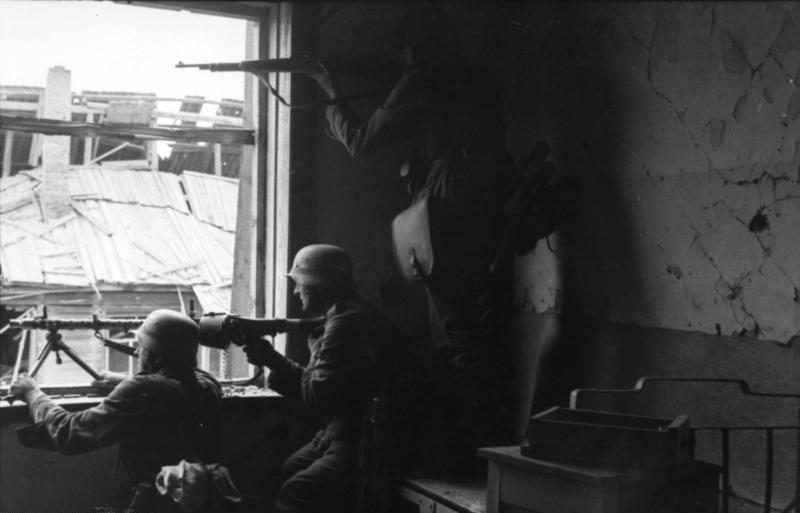
By the autumn of 1942 the German summer offensive had carried the Sixth Army into Stalingrad, where it was consumed, street by street and factory by factory, in some of the closest fighting of the war. While General Friedrich Paulus's men battered at the Soviet 62nd Army's shrinking strip along the Volga, the flanks of the German advance were held by Romanian, Italian and Hungarian armies — thinly spread, short of anti-tank guns and armour. Soviet planners, under Generals Zhukov and Vasilevsky, saw the opportunity exactly: a double envelopment through those weak flanks, aimed not at the city but at the steppe behind it.
Operation Uranus opened on 19 November in fog and snow. The northern pincer smashed through the Romanian Third Army; the southern pincer, launched a day later, broke the Romanian Fourth Army. Tank columns raced for the Don crossing at Kalach, the hinge of the whole design. On 23 November, near the village of Sovetsky south of Kalach, the spearheads met. The ring was closed. Inside it, by the usual estimates, sat some 250,000 to 300,000 Axis troops — the entire Sixth Army, part of the Fourth Panzer Army and Romanian remnants — with their horses, guns and wounded, at the end of a supply line that no longer existed.
What followed was a decision, not a battle. Paulus asked permission to break out while the ring was still thin. Hitler, assured by Göring that the Luftwaffe could supply the pocket by air, ordered the army to stand fast and be fed from the sky. The promise was impossible: the pocket needed an estimated 300 tons a day at the barest minimum, and the airlift, in winter weather from distant airfields under Soviet attack, averaged a small fraction of that. Rations shrank to starvation levels; horses were eaten; typhus spread. A relief offensive in December, Operation Winter Storm, fought to within about 30 miles of the pocket and was stopped.
The end came in the new year. Soviet forces split the pocket, took the last airfield, and on 31 January 1943 Paulus — promoted to field marshal the day before, in a pointed hint that no German field marshal had ever surrendered — gave up the southern pocket. The northern pocket followed on 2 February. Some 91,000 starved survivors went into captivity, of whom only a few thousand ever came home. Stalingrad did not end the war, but it ended the question of who would win it in the east: from this date the Wehrmacht never regained the strategic initiative on the Eastern Front.
Why this date matters
November 23 is a day of enclosures and openings. Its featured event is a ring closing around an army, and the date is full of sieges of one kind or another — of a besieged city in Tennessee in 1863, of colonial privilege in Mexico in 1855, of a pretender's ambitions ending on a London scaffold in 1499. Against them stand two great openings of popular culture: Life magazine teaching America to see the news in photographs in 1936, and a low-budget science-fiction serial about a time traveller beginning, almost unnoticed, in 1963. The day rewards those who look past the headline.
Sources
- Encyclopaedia Britannica — On This Day: November 23
- HISTORY — What Happened on November 23
- Encyclopaedia Britannica — Battle of Stalingrad
- Encyclopaedia Britannica — Ley Juárez
The facts on this page were checked against these sources on 19 November 2026. The History Trail's permanent pages are researched and written for this site; the live profiles elsewhere on The History Trail are assembled automatically from Wikipedia and Wikidata.
About the Author
Researched and written by the The History Trail Editorial Team — the accountable editorial function behind this site's permanent story pages. The team works from the published sources cited on each page; it does not invent historians, reviewers or credentials, and it corrects errors openly.
Fact Check
Every load-bearing fact on this page traces to one of the sources listed above, and significant claims link to their source in the text. Our checking method is described on the methodology page; errors can be reported via the corrections page.
Sources & Citations
Cite this page as: The History Trail Editorial Team, The History Trail — this article's title, publication and update dates are shown beneath its headline. The full source list appears under Sources above; the site's source standards are on the sources page.