
On This Day
November 22 in History
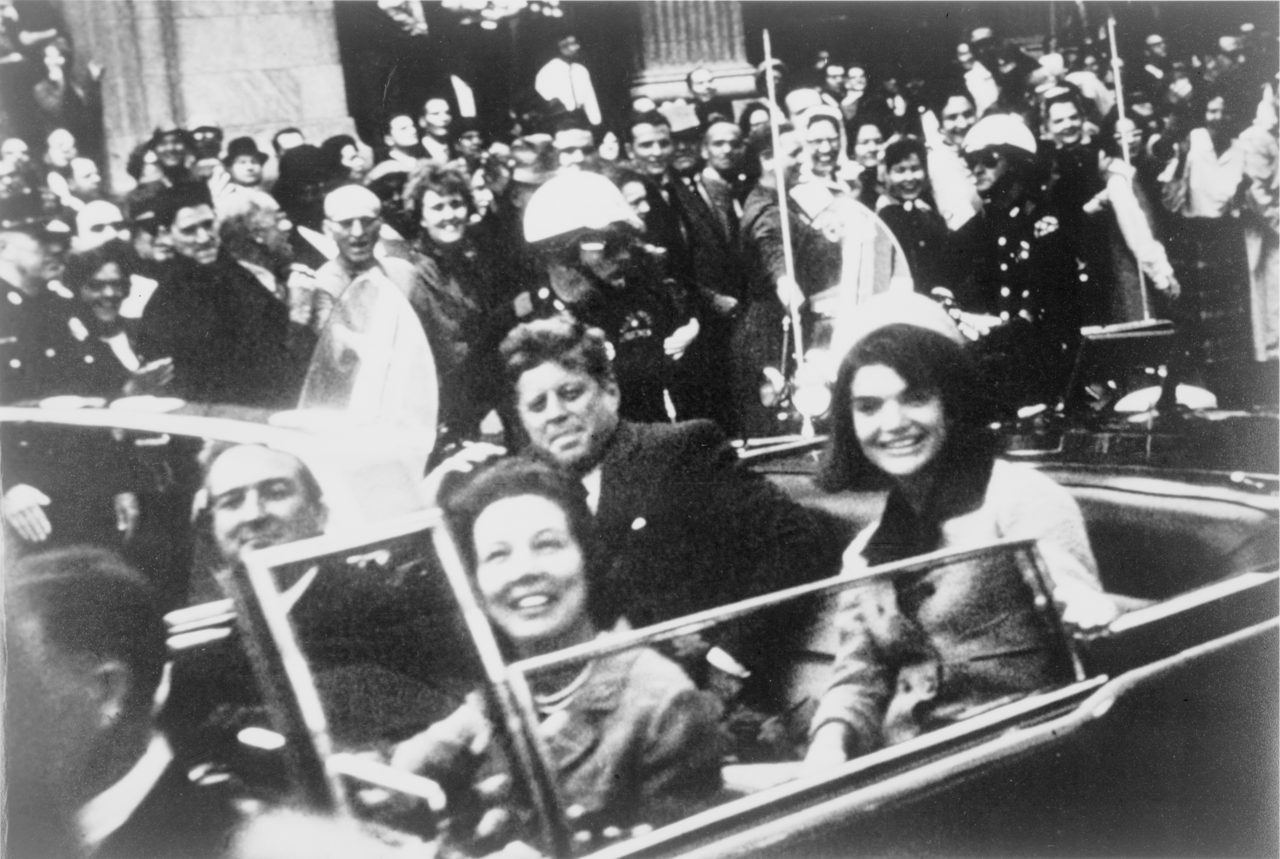
On 22 November 1963, President John F. Kennedy was shot and killed as his motorcade passed through Dealey Plaza in Dallas, Texas — an assassination, carried live into American homes by television, that ended a presidency of a thousand days and fixed this date in the world's memory. November 22 is also the day Blackbeard was killed in 1718, Margaret Thatcher resigned in 1990, Angela Merkel became Germany's first woman chancellor in 2005, and Charles de Gaulle was born in 1890.
Choose another date: open the On This Day calendar to browse events, births and deaths for any day of the year.
At a Glance
- The victim
- John F. Kennedy, 46, the 35th president of the United States, in office since January 1961
- The place
- Dealey Plaza, Dallas, as the open limousine turned past the Texas School Book Depository at 12:30 p.m.
- Also wounded
- Texas governor John Connally, riding in the same car, was seriously wounded but survived
- The accused
- Lee Harvey Oswald, a former Marine working at the depository, was arrested that afternoon and himself shot dead two days later
- The succession
- Vice President Lyndon B. Johnson was sworn in aboard Air Force One less than two hours after the shooting
- The inquiry
- The Warren Commission of 1964 concluded Oswald acted alone; its findings have been disputed ever since
Events on this day
- 1718The pirate Edward Teach, known as Blackbeard, is killed off Ocracoke Island, North Carolina, in a battle with a Royal Navy force sent from Virginia.
- 1869The clipper ship Cutty Sark, among the fastest sailing ships ever built, is launched at Dumbarton in Scotland.
- 1900The first car built under the Mercedes name is taken for its inaugural drive at Cannstatt in Germany, commissioned by entrepreneur Emil Jellinek.
- 1943Lebanon proclaims its independence from the French mandate, though full independence is not achieved until French troops leave in 1946.
- 1963President John F. Kennedy is assassinated in Dallas, Texas — the featured story above.
- 1968Star Trek broadcasts the episode Plato's Stepchildren, in which Captain Kirk and Lieutenant Uhura kiss — a landmark interracial kiss on American network television.
- 1972The United States loses its first B-52 bomber to enemy fire in the Vietnam War, shot down by a surface-to-air missile near Vinh.
- 1986Mike Tyson, aged 20, knocks out Trevor Berbick in the second round to become the youngest heavyweight boxing champion in history.
- 1988The Northrop B-2 stealth bomber is publicly unveiled at Palmdale, California, after nearly a decade of secret development.
- 1990Margaret Thatcher announces her resignation as British prime minister after eleven years, having failed to win her party's leadership ballot outright.
- 1995Toy Story, the first fully computer-animated feature film, is released by Pixar and Disney.
- 2005Angela Merkel is sworn in as chancellor of Germany, the first woman to hold the office.
Born on this day
- 1819George Eliot — English novelist, born Mary Ann Evans, whose Middlemarch is often called the greatest novel in English.
- 1869André Gide — French writer and Nobel laureate whose journals and novels probed morality and desire.
- 1890Charles de Gaulle — French general who led the Free French in the Second World War and founded the Fifth Republic.
- 1899Hoagy Carmichael — American composer of Stardust and Georgia on My Mind.
- 1943Billie Jean King — American tennis champion whose victories on and off court transformed women's sport.
Died on this day
- 1718Blackbeard — English pirate Edward Teach, killed in battle at Ocracoke; his severed head was hung from the bowsprit of the ship that defeated him.
- 1963John F. Kennedy — 35th president of the United States, assassinated in Dallas at 46 — the featured story above.
- 1963C. S. Lewis — Belfast-born writer of the Narnia books and Mere Christianity, dead at home in Oxford at 64, his death almost unnoticed in the news from Dallas.
- 1963Aldous Huxley — English novelist of Brave New World, dead in Los Angeles at 69 on the same day as Kennedy and Lewis.
- 1980Mae West — American stage and screen star whose double-edged wit made her a star of the 1930s, dead at 87.
The featured story: President John F. Kennedy is assassinated, 22 November 1963
Kennedy came to Texas to mend a divided Democratic Party and to begin, in effect, his 1964 re-election campaign. After a morning rally in Fort Worth, Air Force One made the short flight to Dallas, where crowds lined the motorcade route through the city in warm sunshine. The president rode in an open limousine with his wife Jacqueline, Governor John Connally and Nellie Connally, waving to spectators who in places stood ten deep. At 12:30 p.m., as the car turned into Dealey Plaza and passed the Texas School Book Depository, shots rang out. Kennedy was struck in the neck and head; Connally was gravely wounded. The limousine raced to Parkland Memorial Hospital, where Kennedy was pronounced dead at 1:00 p.m.
Within the hour, Dallas police officer J. D. Tippit was shot dead in a suburb, and in a nearby cinema police arrested Lee Harvey Oswald, a 24-year-old former Marine who had defected to the Soviet Union in 1959 and returned, and who worked in the depository building. Oswald was charged with both murders. He never stood trial: two days later, in the basement of police headquarters and in front of television cameras, nightclub owner Jack Ruby shot him dead — the accused assassin silenced on live television, a sequence of events that guaranteed the case would never feel closed.
Aboard Air Force One at Love Field, with Jacqueline Kennedy standing beside him in her bloodstained suit, Lyndon B. Johnson took the presidential oath at 2:38 p.m. The plane carried Kennedy's coffin back to Washington, where three days of state mourning culminated in a funeral modelled on Lincoln's, watched around the world. Johnson appointed a commission under Chief Justice Earl Warren to establish the facts; reporting in September 1964, it concluded that Oswald, firing from the depository's sixth floor, had acted alone, and that Ruby had acted alone in killing him.
That conclusion has never commanded universal assent. A later congressional committee in 1979 judged a conspiracy probable on acoustic evidence that was itself then discredited, and millions of pages of records have since been released without settling the argument. What is not disputed is the assassination's weight: it ended the brief Kennedy era, elevated a president who would pass the great civil rights laws and deepen the Vietnam War, and — because it unfolded on film and live television — became the template for how modern nations experience public catastrophe. Two other notable deaths the same day, of the writers C. S. Lewis and Aldous Huxley, passed almost unremarked in its shadow.
Why this date matters
November 22 is dominated, as few dates are, by a single afternoon. The assassination in Dallas is so large that it swallowed even the deaths of two major writers on the same day, and it bends the rest of the date around it: two days of the Kennedy story's aftershocks belong to neighbouring dates, while this one also holds a pirate's death, a prime minister's fall and a chancellor's rise. It is a date about power changing hands suddenly — by bullet, by ballot and, in Berlin in 2005, by a first that had been centuries coming.
Sources
- Encyclopaedia Britannica — On This Day: November 22
- HISTORY — What Happened on November 22
- National Archives — John F. Kennedy Assassination Records
- Encyclopaedia Britannica — Assassination of John F. Kennedy
The facts on this page were checked against these sources on 19 November 2026. The History Trail's permanent pages are researched and written for this site; the live profiles elsewhere on The History Trail are assembled automatically from Wikipedia and Wikidata.
About the Author
Researched and written by the The History Trail Editorial Team — the accountable editorial function behind this site's permanent story pages. The team works from the published sources cited on each page; it does not invent historians, reviewers or credentials, and it corrects errors openly.
Fact Check
Every load-bearing fact on this page traces to one of the sources listed above, and significant claims link to their source in the text. Our checking method is described on the methodology page; errors can be reported via the corrections page.
Sources & Citations
Cite this page as: The History Trail Editorial Team, The History Trail — this article's title, publication and update dates are shown beneath its headline. The full source list appears under Sources above; the site's source standards are on the sources page.