
On This Day
November 21 in History
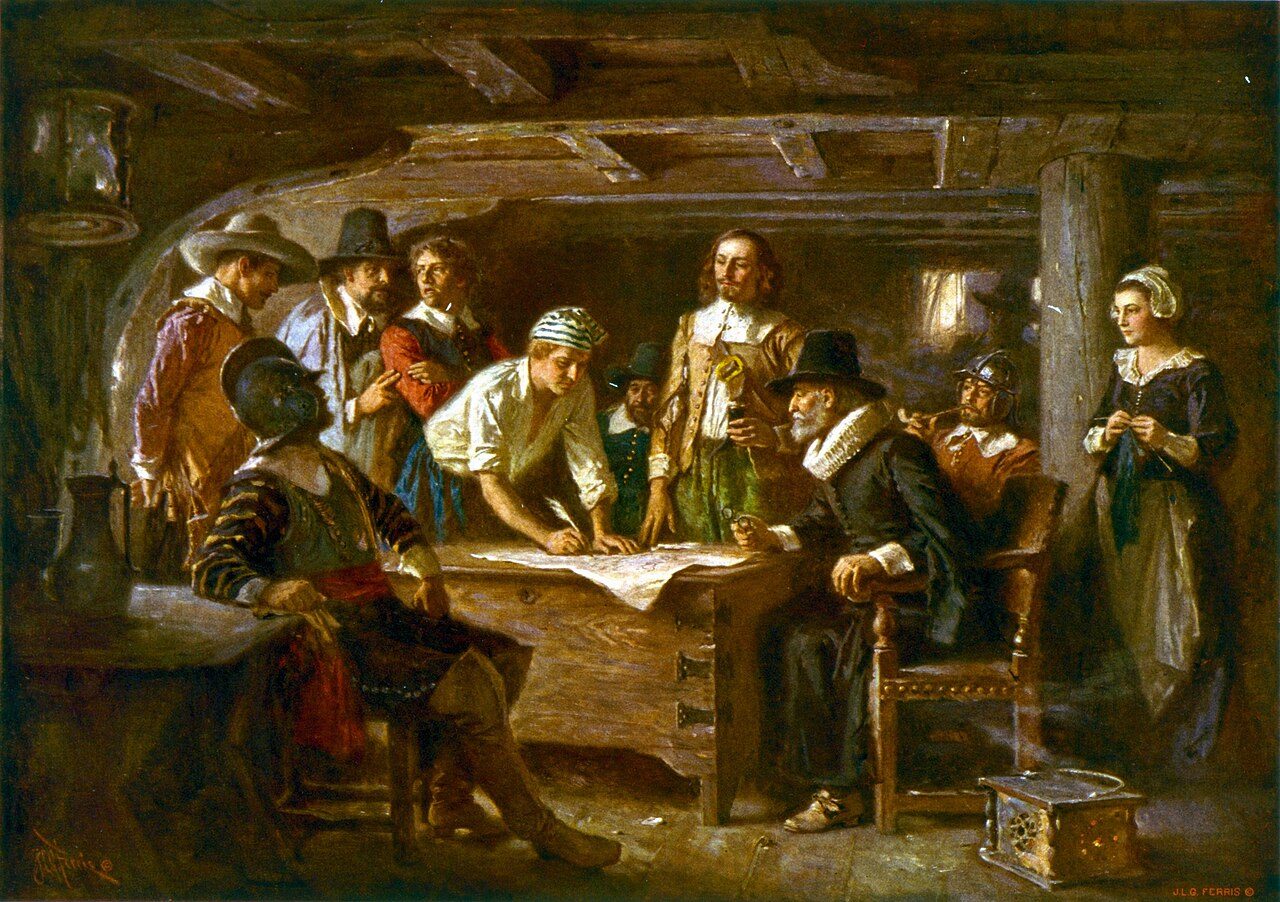
On 21 November 1620, forty-one men aboard the storm-battered Mayflower, anchored off Cape Cod far north of where their patent allowed them to settle, signed a short agreement to combine themselves into a civil body politic and to obey the laws it made. The Mayflower Compact became a founding text of American self-government. November 21 is also the day of Dublin's Bloody Sunday in 1920, the first untethered balloon flight in 1783, and the birth of Voltaire in 1694.
Choose another date: open the On This Day calendar to browse events, births and deaths for any day of the year.
At a Glance
- The signers
- 41 male passengers of the Mayflower; women, servants and crew outside the agreement did not sign
- The problem
- The ship had landed outside the Virginia Company's patent, so the settlers had no legal government
- The promise
- To form a civil body politic and enact just and equal laws, obeyed by consent
- The date puzzle
- The compact is dated 11 November 1620 Old Style — 21 November in the modern Gregorian calendar
- The first governor
- John Carver, elected under the compact, died the first winter; William Bradford succeeded him
- The legacy
- The compact governed Plymouth Colony until its absorption into Massachusetts in 1691 and was later celebrated as a seed of American democracy
Events on this day
- 1620The Mayflower Compact is signed aboard the Mayflower off Cape Cod by 41 male passengers, who agree to form a civil body politic and obey its laws — the featured story above.
- 1783Jean-François Pilâtre de Rozier and the Marquis d'Arlandes make the first untethered human flight, travelling about five and a half miles over Paris in a Montgolfier hot-air balloon.
- 1806Napoleon issues the Berlin Decree, launching the Continental System, a blockade meant to close all of continental Europe to British trade.
- 1864Abraham Lincoln writes his celebrated letter of condolence to Lydia Bixby, a Boston widow reported to have lost five sons in the Civil War; tradition dates the letter to this day.
- 1877Thomas Edison's phonograph, the first machine to record and reproduce sound, is announced to the public, with Scientific American calling it a wonderful invention.
- 1916HMHS Britannic, sister ship of the Titanic and serving as a hospital ship, strikes a mine and sinks in the Aegean Sea; 30 people die and more than 1,000 are rescued.
- 1920Bloody Sunday in Dublin: the Irish Republican Army kills 14 British intelligence officers and alleged spies in the morning, and British forces open fire at a Gaelic football match at Croke Park in the afternoon, killing 14 civilians.
- 1922Rebecca Latimer Felton of Georgia is sworn in as the first woman to serve in the United States Senate, holding the seat for a single day.
- 1931James Whale's film Frankenstein, starring Boris Karloff as the monster, is released in the United States and defines the horror film for a generation.
- 1934A teenage Ella Fitzgerald, entered as a dancer, sings instead and wins Amateur Night at Harlem's Apollo Theater, launching one of the great careers in jazz.
- 1964The Verrazzano-Narrows Bridge opens in New York City, at the time the longest suspension bridge in the world.
- 1976Rocky, written by and starring Sylvester Stallone as the underdog boxer Rocky Balboa, premieres in New York City.
- 1995The Dayton Accords are initialled in Ohio, ending the Bosnian War after three and a half years of fighting in the former Yugoslavia.
- 2017Robert Mugabe resigns as president of Zimbabwe after 37 years in power, as parliament moves to impeach him and the army holds him under house arrest.
Born on this day
- 1694Voltaire — French writer and philosopher, born François-Marie Arouet, the sharpest wit of the Enlightenment.
- 1834Hetty Green — American financier whose frugality and shrewd investing made her one of the richest women of her age.
- 1898René Magritte — Belgian surrealist painter of bowler hats, green apples and pipes that are not pipes.
- 1904Coleman Hawkins — American tenor saxophonist who made his instrument central to jazz.
- 1920Stan Musial — American baseball star of the St Louis Cardinals, one of the game's greatest hitters.
- 1945Goldie Hawn — American actor and producer who rose to fame on Rowan and Martin's Laugh-In.
- 1965Björk — Icelandic singer-songwriter whose experimental pop reshaped the sound of the 1990s and beyond.
Died on this day
- 1695Henry Purcell — English composer of Dido and Aeneas, dead at about 36, the outstanding English composer of the Baroque age.
- 1811Heinrich von Kleist — German dramatist and story writer, dead by his own hand beside Lake Wannsee at 34.
- 1916Franz Joseph I — emperor of Austria and king of Hungary for 68 years, whose death in wartime closed an era of the Habsburg monarchy.
- 1970C. V. Raman — Indian physicist who won the Nobel Prize for his work on the scattering of light, the Raman effect.
- 1996Abdus Salam — Pakistani theoretical physicist and Nobel laureate who helped found Pakistan's atomic and space programmes.
The featured story: the Mayflower Compact is signed, 21 November 1620
The Mayflower left Plymouth, England, in September 1620 carrying 102 passengers — Separatist families seeking freedom to worship, alongside other travellers, servants and a crew — bound for the mouth of the Hudson River, where the Virginia Company's patent entitled them to settle. After sixty-six days of storms the ship sighted Cape Cod instead, hundreds of miles to the north, and attempts to sail south met dangerous shoals and contrary winds. The company anchored in what is now Provincetown Harbor, in legal limbo: outside the patent, some of the non-Separatist passengers argued that when they came ashore they would owe obedience to no one.
It was to answer that argument that the compact was drawn up and signed on 11 November 1620 by the old calendar — 21 November by the new. In fewer than two hundred words the signers, describing themselves as loyal subjects of King James, covenanted to combine into a civil body politic, to frame just and equal laws, ordinances, acts and constitutions for the general good of the colony, and to promise all due submission and obedience to them. Forty-one men signed, including servants as well as gentlemen — a breadth unusual for the time — though women, who could not vote or hold office, did not.
The document was less a constitution than an emergency act of consent, closer to the church covenants the Separatists already knew than to later American charters. Yet it worked. Under it the settlers chose John Carver as governor, landed to found Plymouth, and governed themselves for seventy years until the colony was absorbed into Massachusetts in 1691. The first winter killed about half the company, Carver among them; William Bradford, who succeeded him and chronicled the settlement, preserved the compact's text in his history Of Plymouth Plantation, from which all later knowledge of it comes — the original signed sheet is lost.
Later Americans made the compact carry more than its drafters intended. Celebrated in the young republic and canonised in the nineteenth century, it was read backwards as a founding act of democracy: government by agreement of the governed, made before there was a state to grant it. Historians are careful to note what it was not — it created no rights, no representation and no separation of powers — but its core move, authority built upward from consent rather than downward from a patent, genuinely anticipates the logic of 1776. Few documents of two hundred words have been asked to bear so much, or borne it so long.
Why this date matters
November 21 is a day on which people improvised governments and defied gravity. Its featured act is a two-hundred-word agreement written to stop a ship's company dissolving into anarchy, and the date keeps returning to improvised authority: an emperor's death dissolving an old order in 1916, gunmen and soldiers contesting who ruled Ireland in 1920, negotiators ending a war at Dayton in 1995, and an aging strongman finally resigning in 2017. Between those poles it also holds the first free balloon flight, Edison's talking machine and Ella Fitzgerald's accidental singing debut — a day for beginnings made up on the spot.
Sources
- Encyclopaedia Britannica — On This Day: November 21
- HISTORY — What Happened on November 21
- Encyclopaedia Britannica — Mayflower Compact
- Encyclopaedia Britannica — Bloody Sunday (Dublin, 1920)
The facts on this page were checked against these sources on 19 November 2026. The History Trail's permanent pages are researched and written for this site; the live profiles elsewhere on The History Trail are assembled automatically from Wikipedia and Wikidata.
About the Author
Researched and written by the The History Trail Editorial Team — the accountable editorial function behind this site's permanent story pages. The team works from the published sources cited on each page; it does not invent historians, reviewers or credentials, and it corrects errors openly.
Fact Check
Every load-bearing fact on this page traces to one of the sources listed above, and significant claims link to their source in the text. Our checking method is described on the methodology page; errors can be reported via the corrections page.
Sources & Citations
Cite this page as: The History Trail Editorial Team, The History Trail — this article's title, publication and update dates are shown beneath its headline. The full source list appears under Sources above; the site's source standards are on the sources page.