
On This Day
November 20 in History
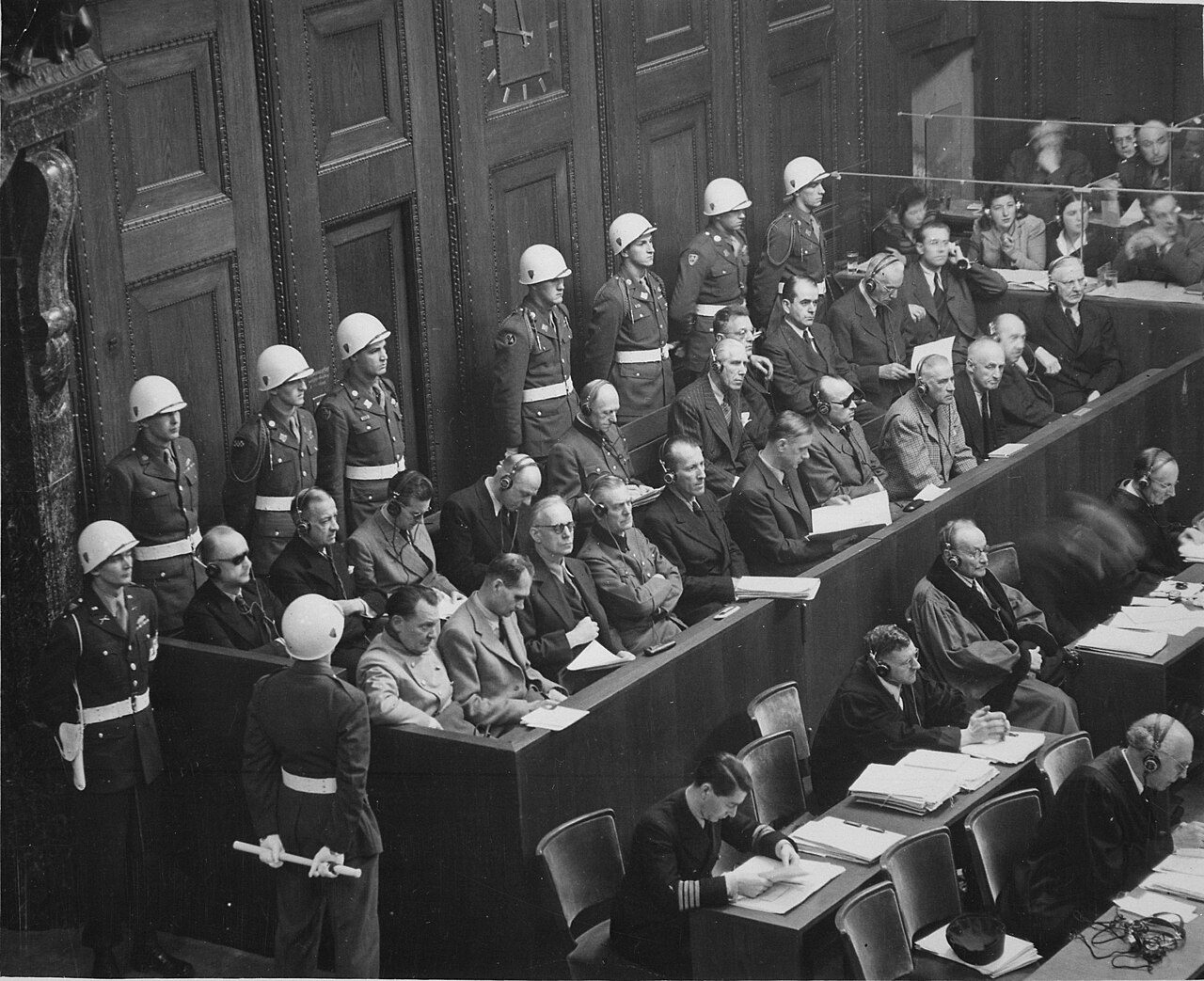
On 20 November 1945, in a courtroom in Nuremberg's Palace of Justice, judges from the United States, Britain, France and the Soviet Union opened the trial of the surviving leaders of Nazi Germany — the first international war-crimes trial in history. Twenty-one defendants sat in the dock to answer charges that included crimes against humanity. November 20 is also the day the whaler Essex was sunk by a whale and Franco's death ended an era in Spain.
Choose another date: open the On This Day calendar to browse events, births and deaths for any day of the year.
At a Glance
- Opened
- 20 November 1945, in Courtroom 600 of the Palace of Justice, Nuremberg
- The court
- The International Military Tribunal — judges and prosecutors from the four Allied powers, created by the London Charter of August 1945
- Defendants
- 24 men indicted; 21 appeared in court on the opening day (National WWII Museum). Hitler, Himmler and Goebbels were already dead by suicide
- Charges
- Conspiracy, crimes against peace, war crimes and crimes against humanity
- Duration
- Nearly a year — verdicts on 1 October 1946: 12 death sentences, prison terms for seven, three acquittals
- Legacy
- The Nuremberg principles became foundations of international criminal law, leading eventually to the International Criminal Court
Events on this day
- 1820The Nantucket whaler Essex is rammed and sunk by a sperm whale in the Pacific — the disaster that inspired Moby-Dick.
- 1866Pierre Lallement receives a U.S. patent for the pedal bicycle.
- 1910Francisco Madero calls for revolt against Porfirio Díaz, launching the Mexican Revolution.
- 1917The Battle of Cambrai opens with a massed tank attack that breaks the Hindenburg Line before stalling.
- 1923Garrett Morgan patents the three-position traffic signal.
- 1945The Nuremberg trials open before the International Military Tribunal — the featured story above.
- 1947Princess Elizabeth marries Philip Mountbatten at Westminster Abbey.
- 1969Native American activists begin a 19-month occupation of Alcatraz Island, claiming it under treaty rights.
- 1985Microsoft releases Windows 1.0, its first graphical operating environment for personal computers.
- 1992Fire breaks out at Windsor Castle, gutting more than a hundred rooms in the Queen's 'annus horribilis'.
- 1998American tobacco companies sign the Master Settlement Agreement with 46 states, worth $206 billion.
Born on this day
- 1858Selma Lagerlöf — Swedish novelist, the first woman to win the Nobel Prize for Literature.
- 1889Edwin Hubble — American astronomer who proved the universe is expanding.
- 1908Alistair Cooke — British-American broadcaster of Letter from America for 58 years.
- 1923Nadine Gordimer — South African novelist and Nobel laureate who wrote against apartheid.
- 1925Robert F. Kennedy — U.S. attorney general and senator, assassinated in 1968.
- 1942Joe Biden — 46th president of the United States.
Died on this day
- 1910Leo Tolstoy — Russian novelist of War and Peace, dead at a railway station at 82.
- 1925Alexandra of Denmark — queen consort of Edward VII of the United Kingdom.
- 1952Benedetto Croce — Italian philosopher and historian.
- 1972Ennio Flaiano — Italian screenwriter who worked with Fellini on La Strada and La Dolce Vita.
- 1975Francisco Franco — dictator of Spain for 36 years; his death opens Spain's transition to democracy.
- 2006Robert Altman — American director of M*A*S*H and Nashville.
The featured story: the Nuremberg trials begin, 20 November 1945
The victors of 1945 faced a problem no previous war had posed in quite this form. Earlier ages had shot defeated leaders, exiled them, or let victors' justice pass as vengeance; the Allied governments, prodded by jurists who had watched the Holocaust's evidence accumulate, chose something harder and newer: a trial. The London Charter of August 1945 created an International Military Tribunal, with judges from the four Allied powers, and defined charges that had never before been crimes in international law — above all 'crimes against humanity'. Nuremberg was chosen partly because its Palace of Justice had survived the bombing comparatively intact, and partly, as the National WWII Museum notes, because the city had been the ceremonial heart of Nazism, the stage of the great party rallies. The law would sit in judgement where the rallies had been held.
On the morning of 20 November 1945 the indictment was read in Courtroom 600. Twenty-one defendants took their seats in the two-tiered dock — Hermann Göring in the front corner, Rudolf Hess beside him, then Ribbentrop, Keitel, Rosenberg, Speer and the rest of the regime's surviving summit; of the 24 indicted, Robert Ley had hanged himself in his cell, Gustav Krupp was unfit, and Martin Bormann was tried in absentia. The chief American prosecutor, Justice Robert H. Jackson, opened the next day with a statement that set the trial's moral terms: that civilization itself was the plaintiff, and that the record on which the defendants were judged would be the record on which history judged the tribunal. Jackson insisted on proving the case from the Nazis' own documents, orders and films rather than relying on witness horror alone — a decision that made the trial's archive unanswerable.
The trial ran for nearly eleven months: 216 court sessions, simultaneous translation into four languages — a technical innovation, delivered through headphones, that changed courtrooms forever — and mountains of captured German paperwork. The defendants mostly denied knowledge, claimed obedience to orders, or, in Göring's case, performed defiance until cross-examination dismantled him. On 1 October 1946 the tribunal delivered its verdicts: twelve men, including Göring, Ribbentrop and Keitel, were sentenced to hang; three received life sentences; four drew long prison terms; three were acquitted — a distribution that mattered, because acquittals from a court the defendants had denounced as victors' justice demonstrated that evidence, not only power, had decided individual fates. Göring cheated the gallows with a smuggled cyanide capsule the night before his execution; the other ten were hanged on 16 October 1946.
Nuremberg's deepest product was not the verdicts but the precedent. Its principles — that aggressive war is a crime, that orders are no defence, that individuals and not only states bear responsibility — were affirmed by the new United Nations in 1946 and carried into the Geneva Conventions, the Genocide Convention and, half a century later, the statute of the International Criminal Court. The trial has been criticised, fairly, for trying only the defeated; Jackson himself warned that the standard set at Nuremberg must one day apply to the victors too, or it would be mere revenge in robes. That tension is the trial's living legacy, argued in every war-crimes courtroom since. It began, deliberately and on the record, on 20 November 1945.
Why this date matters
November 20 is the day judgement and endurance share a page. A tribunal opens that invents modern international law; a dictator dies in his bed and a country walks, carefully, toward democracy; a whaleship meets the one creature it cannot master, in the disaster that gave American literature its white whale. Its births run from a Nobel-winning storyteller to the astronomer who enlarged the universe. It is a date about reckonings — legal, literary and cosmic — and about how long their consequences take to unfold.
Sources
- Encyclopaedia Britannica — On This Day: November 20
- HISTORY — What Happened on November 20
- United States Holocaust Memorial Museum — The Nuremberg Trials
- National WWII Museum — The Nuremberg Trials
- Wikimedia — On This Day feed: November 20
The facts on this page were checked against these sources on 19 November 2026. The History Trail's permanent pages are researched and written for this site; the live profiles elsewhere on The History Trail are assembled automatically from Wikipedia and Wikidata.
About the Author
Researched and written by the The History Trail Editorial Team — the accountable editorial function behind this site's permanent story pages. The team works from the published sources cited on each page; it does not invent historians, reviewers or credentials, and it corrects errors openly.
Fact Check
Every load-bearing fact on this page traces to one of the sources listed above, and significant claims link to their source in the text. Our checking method is described on the methodology page; errors can be reported via the corrections page.
Sources & Citations
Cite this page as: The History Trail Editorial Team, The History Trail — this article's title, publication and update dates are shown beneath its headline. The full source list appears under Sources above; the site's source standards are on the sources page.