
On This Day
November 11 in History
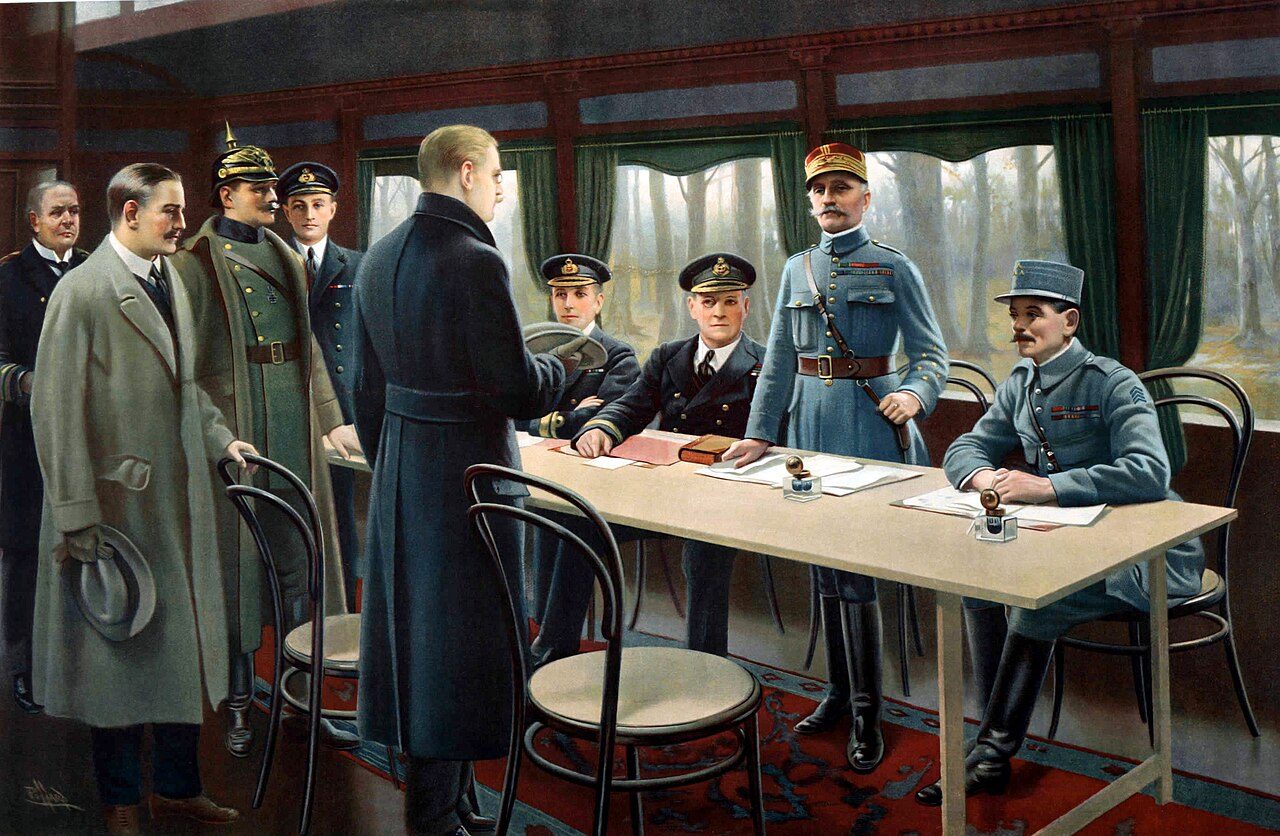
At the 11th hour of the 11th day of the 11th month of 1918, the fighting of the First World War stopped. An armistice signed that morning in a railway carriage in the Forest of Compiègne silenced the Western Front after more than four years of war, and 11 November has been a day of remembrance ever since. It is also the day Nat Turner was executed, Route 66 was created and Ned Kelly was hanged.
Choose another date: open the On This Day calendar to browse events, births and deaths for any day of the year.
At a Glance
- Signed
- In the early hours of 11 November 1918, in Marshal Foch's railway carriage in the Forest of Compiègne, France
- In force
- 11 a.m. the same day — the 11th hour of the 11th day of the 11th month
- Signatories
- Matthias Erzberger led the German delegation; Ferdinand Foch and Admiral Rosslyn Wemyss signed for the Allies
- Terms
- Germany to evacuate occupied territory and the west bank of the Rhine, surrender heavy weapons, submarines and the High Seas Fleet, and renounce the treaties of Brest-Litovsk and Bucharest
- Nature
- A ceasefire, not a peace treaty — it was renewed three times until the Treaty of Versailles took effect in 1920
- Remembered as
- Armistice Day, Remembrance Day in Commonwealth countries, and Veterans Day in the United States
Events on this day
- 1778British and Iroquois forces attack Cherry Valley, New York, killing soldiers and civilians in one of the Revolutionary War's most notorious raids.
- 1831Nat Turner, leader of the largest revolt of enslaved people in United States history, is hanged at Jerusalem, Virginia.
- 1864Union troops begin the systematic destruction of Atlanta's railroads, factories and warehouses on General Sherman's orders.
- 1880Australian bushranger Ned Kelly is hanged at Melbourne Gaol despite a huge petition for his reprieve.
- 1918The armistice between Germany and the Allies is signed in a railway carriage at Compiègne, and the guns fall silent at 11 a.m. — the featured story above.
- 1920The Cenotaph is unveiled in London and the Unknown Warrior is buried in Westminster Abbey.
- 1921The Tomb of the Unknown Soldier is dedicated at Arlington National Cemetery, exactly three years after the armistice.
- 1926The United States Numbered Highway System is approved, creating the famed Route 66 among its designated highways.
- 1940At Taranto, British carrier aircraft carry out the first all-aircraft ship-to-ship naval attack in history against the Italian fleet.
- 1965Rhodesia, under Ian Smith, unilaterally declares independence from Britain rather than accept majority rule.
- 1975Australia's governor-general, Sir John Kerr, dismisses Prime Minister Gough Whitlam's government, triggering a constitutional crisis.
- 1999The House of Lords Act receives royal assent, removing most hereditary peers from Britain's upper house.
Born on this day
- 1821Fyodor Dostoevsky — Russian novelist of Crime and Punishment and The Brothers Karamazov.
- 1885George S. Patton — American general famed for his armoured campaigns of the Second World War.
- 1922Kurt Vonnegut — American author of Slaughterhouse-Five, himself a prisoner of war at Dresden.
- 1928Carlos Fuentes — Mexican novelist and essayist, a central figure of the Latin American Boom.
- 1962Demi Moore — American actress who rose to fame in Ghost and A Few Good Men.
- 1974Leonardo DiCaprio — American actor, star of Titanic and The Revenant, and environmental campaigner.
Died on this day
- 1855Søren Kierkegaard — Danish philosopher regarded as the first existentialist thinker.
- 1917Liliʻuokalani — the last monarch of the Kingdom of Hawaii, deposed in 1893.
- 1945Jerome Kern — American composer of Show Boat and a founder of the modern musical.
- 1976Alexander Calder — American sculptor who invented the mobile.
- 2004Yasser Arafat — Palestinian leader who headed the PLO for 35 years and shared the Nobel Peace Prize.
- 2005Peter Drucker — Austrian-born writer who founded modern management theory.
The featured story: the armistice ends the First World War, 11 November 1918
By the autumn of 1918 Germany was beaten in everything but name. Its spring offensives had failed, the Allied Hundred Days offensive was driving its armies back, its allies Bulgaria, the Ottoman Empire and Austria-Hungary had each signed armistices, the High Seas Fleet had mutinied at Kiel, and revolution was spreading through German cities. On 9 November the Kaiser abdicated. The new German government, desperate to end the fighting before invasion reached German soil, sent a delegation under the politician Matthias Erzberger across the lines to the headquarters train of Marshal Ferdinand Foch, the Allied supreme commander, in the Forest of Compiègne.
Foch received them coldly on 8 November and presented terms designed to make it impossible for Germany to resume the war: evacuation of all occupied territory and of the left bank of the Rhine, Allied occupation of Rhine bridgeheads, the surrender of thousands of guns, machine guns and aircraft, the internment of the High Seas Fleet and all submarines, and the annulment of Germany's imposed treaties in the east. The Germans were given 72 hours. Erzberger protested at the harshness but had no leverage; Berlin, facing collapse at home, authorised signature. In the early hours of 11 November, at about 5 a.m., the document was signed in Foch's carriage, with the ceasefire set for 11 a.m. — six hours in which, on parts of the front, men continued to fight and die for ground that would be worthless by lunch.
At 11 a.m. the guns stopped, from the North Sea to Switzerland. Soldiers climbed out of trenches into an unnatural quiet; in London, Paris and New York crowds poured into the streets, church bells rang, and the day was celebrated as the end of the 'war to end all wars'. The human cost behind the silence was staggering: the war had killed some nine million soldiers — the figure HISTORY gives — and wounded more than twenty million, and it had destroyed four empires. Yet the armistice was only a ceasefire. It was renewed three times while the peace conference sat, and the formal settlement, the Treaty of Versailles, was signed the following June and took effect in January 1920.
The resentments that settlement left behind shaped the next twenty years, and the carriage at Compiègne became a symbol potent enough for Hitler to weaponise: in June 1940 he forced France to sign its own armistice in the same carriage, on the same spot, before having it hauled to Berlin. But 11 November kept its older meaning. Britain and the Commonwealth mark it as Remembrance Day, with two minutes' silence at 11 a.m.; the United States, which had made it Armistice Day, broadened it into Veterans Day in 1954. The eleventh hour remains the most precisely remembered moment of the twentieth century.
Why this date matters
November 11 is a date built around an ending. Its featured event stopped the largest war yet fought, and the date has stayed in uniform ever since: the Cenotaph unveiled and the Unknown Warrior buried on it in 1920, America's Tomb of the Unknown Soldier dedicated on it in 1921, a draft age lowered on it in 1942. Around that solemn core the day gathers other closings and reckonings — Nat Turner hanged, Ned Kelly hanged, a prime minister dismissed in Canberra, hereditary peers voted out of the Lords. Even its lighter entries, Route 66 and the Taranto raid, are about journeys ending and eras turning. It is the calendar's day for laying things down.
Sources
- Encyclopaedia Britannica — On This Day: November 11
- HISTORY — What Happened on November 11
- Anzac Portal (Australian Department of Veterans' Affairs) — Signing of the armistices in 1918
- Wikimedia — On This Day feed: November 11
The facts on this page were checked against these sources on 19 November 2026. The History Trail's permanent pages are researched and written for this site; the live profiles elsewhere on The History Trail are assembled automatically from Wikipedia and Wikidata.
About the Author
Researched and written by the The History Trail Editorial Team — the accountable editorial function behind this site's permanent story pages. The team works from the published sources cited on each page; it does not invent historians, reviewers or credentials, and it corrects errors openly.
Fact Check
Every load-bearing fact on this page traces to one of the sources listed above, and significant claims link to their source in the text. Our checking method is described on the methodology page; errors can be reported via the corrections page.
Sources & Citations
Cite this page as: The History Trail Editorial Team, The History Trail — this article's title, publication and update dates are shown beneath its headline. The full source list appears under Sources above; the site's source standards are on the sources page.