
On This Day
November 15 in History
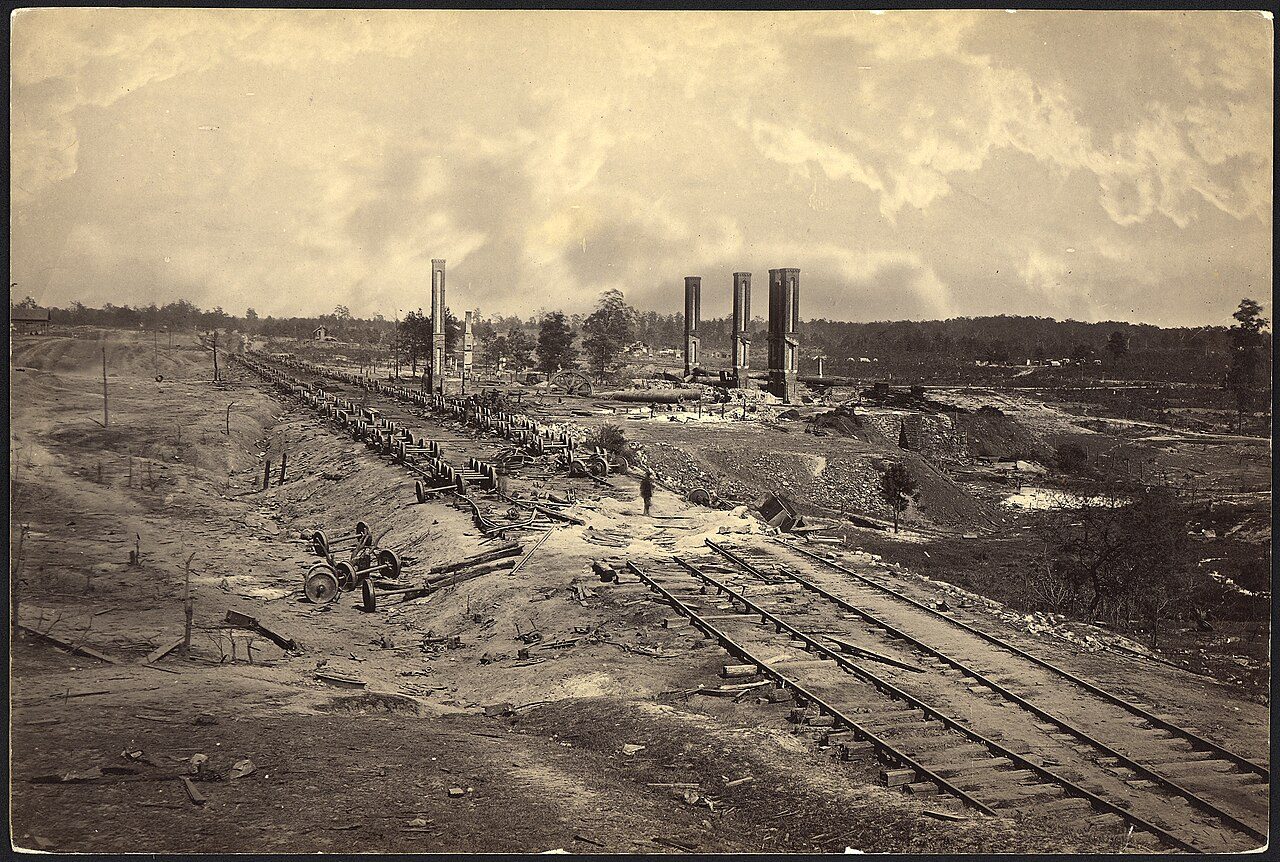
On 15 November 1864 Major General William Tecumseh Sherman marched some 62,000 Union soldiers out of the ruins of Atlanta and turned toward Savannah, 285 miles away, intending to make Georgia pay for the war and to prove the Confederacy could not protect its own heartland. Britannica calls the March to the Sea the modern era's first example of total war. November 15 is also the day Brazil became a republic and the Articles of Confederation were adopted.
Choose another date: open the On This Day calendar to browse events, births and deaths for any day of the year.
At a Glance
- Commander
- Maj. Gen. William Tecumseh Sherman, with two wings totalling some 62,000 men (Britannica)
- Route
- From Atlanta to the port of Savannah, Georgia — roughly 285 miles, covered in about five weeks
- Method
- The army cut loose from its supply lines and lived off the land, destroying railroads, mills, warehouses and cotton in a swath dozens of miles wide
- Aim
- Psychological as much as military: to break the Confederacy's capacity and will to make war
- Arrival
- Sherman reached Savannah in December and presented the city to President Lincoln 'as a Christmas gift'
- Judgement
- A landmark in the coming of 'total war' — and still argued over in Georgia memory
Events on this day
- 655Oswiu of Northumbria defeats Penda of Mercia at the Battle of the Winwaed, reshaping the kingdoms of early England.
- 1777The Continental Congress adopts the Articles of Confederation, the United States' first constitution.
- 1806Lieutenant Zebulon Pike sights the Colorado peak that will bear his name, Pikes Peak.
- 1864General Sherman leaves burning Atlanta and begins his March to the Sea — the featured story above.
- 1889Emperor Pedro II is deposed in a coup and Brazil is proclaimed a republic.
- 1908After international outrage at Leopold II's atrocities, the Congo Free State is annexed to Belgium as the Belgian Congo.
- 1943Heinrich Himmler orders that Romani people be put 'on the same level as Jews' and sent to concentration camps.
- 1988In Algiers, Yasser Arafat proclaims the establishment of a Palestinian state.
- 1988The Soviet space shuttle Buran makes its first and only flight, uncrewed, orbiting the Earth twice.
- 2001Microsoft releases the Xbox, entering the home games-console market.
- 2012Xi Jinping succeeds Hu Jintao as general secretary of the Chinese Communist Party, becoming China's paramount leader.
Born on this day
- 1708William Pitt the Elder — British statesman who led Britain through the Seven Years' War.
- 1738William Herschel — German-born astronomer who discovered the planet Uranus.
- 1887Georgia O'Keeffe — American modernist painter of flowers, skulls and desert landscapes.
- 1887Marianne Moore — American modernist poet and editor.
- 1891Erwin Rommel — German field marshal of the Afrika Korps in the Second World War.
- 1929Ed Asner — American actor, Lou Grant of The Mary Tyler Moore Show.
- 1942Daniel Barenboim — Argentine-Israeli pianist and conductor.
Died on this day
- 1630Johannes Kepler — German astronomer who discovered the laws of planetary motion.
- 1908Empress Dowager Cixi — the dominant figure in Qing-dynasty China for nearly half a century.
- 1917Émile Durkheim — French founder of modern sociology.
- 1954Lionel Barrymore — American actor of It's a Wonderful Life and the Barrymore dynasty.
- 1958Tyrone Power — American film star of The Mark of Zorro, dead of a heart attack at 44.
- 1978Margaret Mead — American anthropologist whose Coming of Age in Samoa made her world-famous.
The featured story: Sherman begins his March to the Sea, 15 November 1864
Atlanta had fallen in September 1864, and Sherman faced a choice: chase the Confederate army of John Bell Hood through Tennessee, or do something colder. He chose the cold thing. Having sent part of his force back to deal with Hood, he obtained Grant's and Lincoln's approval for a plan that broke the rules of the war as it had been fought: he would abandon his supply lines entirely, march his remaining army — some 62,000 men, Britannica records — across the undefended interior of Georgia to the sea, living off the country and wrecking everything that sustained the Confederate war effort. On 11 November his men began destroying Atlanta's depots, mills and rail yards; on the 15th, with the city burning behind them, the columns marched out to the south-east.
The march was organised destruction on an industrial scale. The army moved in two wings across a front that could stretch sixty miles wide, foragers — 'bummers', in the soldiers' slang — sweeping farms of food, livestock and horses, while demolition parties tore up railroads, heating the rails and twisting them around telegraph poles into 'Sherman's neckties' so they could not be relaid. Cotton gins, warehouses and mills were burned; private houses were officially protected, though the line between foraging and plunder was honoured unevenly across five weeks. Sherman's own estimate put the damage in Georgia at a hundred million dollars, and his purpose was avowedly psychological: in his phrase, to make Georgia howl — to show ordinary Southerners that their government could not protect them and that the war's cost would now be collected at home.
Militarily, almost nothing stood in his way. Georgia's forces were scattered militia and cavalry; the great Confederate armies were locked with Grant in Virginia or chasing phantoms in Tennessee. The march therefore became a procession with a soundtrack of destruction, and on 21 December Savannah's mayor rode out to surrender the city rather than see it stormed. Sherman telegraphed Lincoln: 'I beg to present you, as a Christmas gift, the city of Savannah.' Coming weeks after Lincoln's re-election — which the fall of Atlanta had done much to secure — the news settled the war's direction. The March was followed in the new year by an even harsher campaign through the Carolinas, and within four months Lee had surrendered.
The March to the Sea remains the most argued-over campaign in American memory: a masterstroke that shortened the war, in the Union case, or state terror against civilians, in the older Southern one. Modern scholarship sits between — the destruction fell overwhelmingly on property and infrastructure rather than persons, and enslaved Georgians by the thousand freed themselves by following the columns — but Sherman's own doctrine outlived the argument. He had written the template that the twentieth century would call total war: that a nation's will, not only its armies, is a military target.
Why this date matters
November 15 is a date of foundings and unmakings. Congress adopts a first constitution for the United States; Brazil discards an emperor and proclaims a republic; a colonial horror in the Congo is formally ended by annexation; a new leader takes over China. And at its centre stands a general marching out of a burning city to demonstrate that a state which cannot shield its own heartland has already lost. It is the calendar's day for turning points that cannot be turned back.
Sources
- Encyclopaedia Britannica — On This Day: November 15
- HISTORY — What Happened on November 15
- Encyclopaedia Britannica — On This Day: November 15 (Sherman begins the March to the Sea)
- Wikimedia — On This Day feed: November 15
The facts on this page were checked against these sources on 19 November 2026. The History Trail's permanent pages are researched and written for this site; the live profiles elsewhere on The History Trail are assembled automatically from Wikipedia and Wikidata.
About the Author
Researched and written by the The History Trail Editorial Team — the accountable editorial function behind this site's permanent story pages. The team works from the published sources cited on each page; it does not invent historians, reviewers or credentials, and it corrects errors openly.
Fact Check
Every load-bearing fact on this page traces to one of the sources listed above, and significant claims link to their source in the text. Our checking method is described on the methodology page; errors can be reported via the corrections page.
Sources & Citations
Cite this page as: The History Trail Editorial Team, The History Trail — this article's title, publication and update dates are shown beneath its headline. The full source list appears under Sources above; the site's source standards are on the sources page.