
Years
1943 in History
1943 is remembered as the year the Second World War turned. On 2 February the last German troops at Stalingrad surrendered, ending the battle that turned the war in Europe; in May Axis forces in North Africa surrendered, in July the Allies landed in Sicily, in September Italy itself surrendered, and in November Roosevelt, Churchill and Stalin met at Tehran to fix the invasion of France for May 1944.
At a Glance
- Defining event
- Battle of Stalingrad ends, 2 February 1943 — the turning point of the war in the East
- In North Africa
- Axis forces surrender on 13 May, ending the campaign there
- Return to Europe
- Allied forces land in Sicily on 10 July in Operation Husky
- Italy switches
- Italy surrenders in September, then declares war on Germany on 13 October
- Summit
- Tehran Conference opens 28 November; Overlord fixed for May 1944
- Resistance
- Warsaw Ghetto Uprising begins 19 April; the White Rose leaders are executed 22 February
The defining story: the surrender at Stalingrad
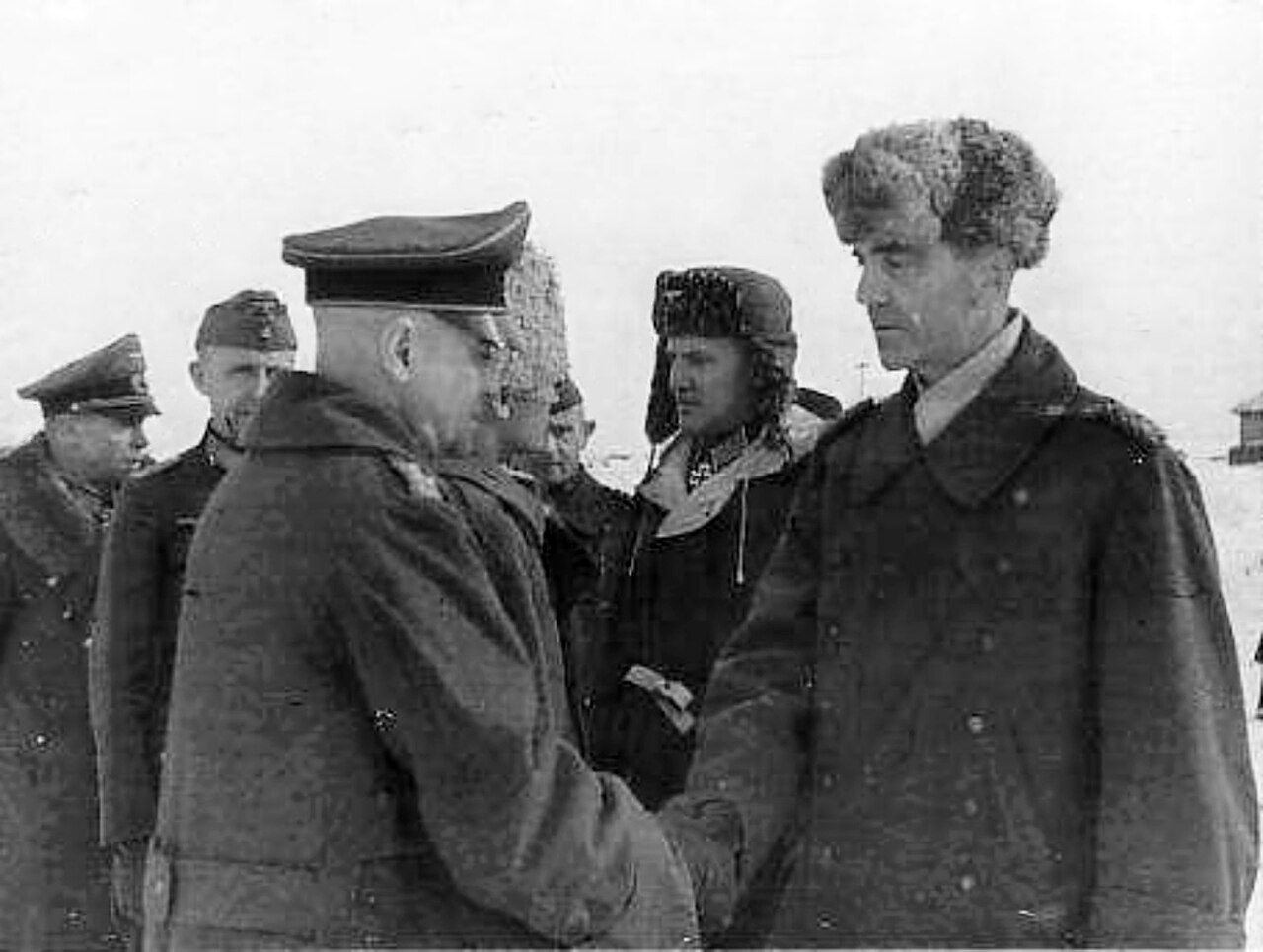
Stalingrad was not supposed to become a byword for catastrophe. When German armies drove east in the summer of 1942, the industrial city on the Volga bearing Stalin's name was one objective among several in a campaign aimed at Soviet oil. But Hitler insisted on taking it, Stalin ordered it held at all costs, and from August 1942 the two armies ground each other down in ruins, fighting room by room. Soviet defenders clung to a narrow strip along the river's west bank, supplied by boats under fire, while the German Sixth Army under Friedrich Paulus bled itself white capturing most of a city that no longer functioned.
The trap closed in November 1942, when the Red Army struck the weaker Romanian armies guarding the German flanks and encircled some 300,000 Axis troops around Stalingrad. Hitler refused to authorise a breakout, trusting Hermann Goering's promise that the Luftwaffe could supply the pocket by air. It could not. Through December and January the encircled men starved and froze. On 24 January 1943 Paulus asked Hitler for permission to surrender and was refused. On 30 January Hitler promoted him to field marshal, pointing out that no German field marshal had ever surrendered, and clearly expecting suicide.
Paulus instead surrendered himself and his southern pocket on 31 January. Isolated groups fought on in the northern pocket for two more days, and on 2 February 1943 they too laid down their arms. Some 91,000 survivors trudged into a captivity from which only a few thousand would return a decade later. Axis casualties in the campaign are estimated at around 800,000, Soviet casualties higher still, with total losses on both sides approaching two million. Germany had lost an entire army group and, with it, the initiative in the east: from Stalingrad onward, the Red Army advanced, with interruptions, all the way to Berlin.
The rest of 1943 ran in the same direction. Japan completed its evacuation of Guadalcanal in February, ending the first great Allied offensive of the Pacific War in American victory. Axis forces in North Africa surrendered on 13 May. On 10 July Allied forces landed in Sicily, and on 3 September the British Eighth Army crossed to Calabria as Italy's secret armistice was agreed; Eisenhower announced Italy's surrender on 8 September, and on 13 October Italy's new government declared war on Germany. In November the Big Three met at Tehran and fixed Overlord, the cross-Channel invasion, for May 1944.
Timeline of 1943
- 12 January
Soviet forces breach the German siege of Leningrad, opening a narrow land corridor into the starving city.
- 31 January
Paulus surrenders the southern pocket of the Sixth Army at Stalingrad.
- 2 February
The last German troops at Stalingrad surrender, ending the battle.
- 9 February
The United States declares the Guadalcanal campaign ended in victory.
- 22 February
Hans and Sophie Scholl and Christoph Probst of the White Rose are executed in Munich.
- 19 April
The Warsaw Ghetto Uprising begins, as Jewish fighters resist the final Nazi deportations.
- 13 May
Axis forces in North Africa surrender, ending the campaign there.
- 10 July
Allied forces land in Sicily in Operation Husky.
- 2 August
A Japanese destroyer sinks PT-109; Lieutenant John F. Kennedy leads the survivors to safety.
- 8 September
Eisenhower publicly announces Italy's surrender to the Allies.
- 13 October
Italy declares war on its former ally, Nazi Germany.
- 14 October
Prisoners at Sobibor rise in revolt; some 300 escape, and the camp is closed.
- 28 November
The Tehran Conference opens, bringing Roosevelt, Churchill and Stalin together for the first time.
- 26 December
The German battleship Scharnhorst is sunk in the Battle of the North Cape off Norway.
Why 1943 still matters
Stalingrad remains the benchmark of a turning point: not a single day's victory but the destruction of an entire army and of the myth of German invincibility that sustained the regime at home. Goebbels answered with his total war speech, an admission in itself. After February 1943 Germany fought a war it could delay but no longer win in the east, while the Western Allies returned to Europe through Sicily and Italy and planned the far larger landing Tehran confirmed. The alliance coordinated at Tehran genuinely won the war — and, in the same conversations about Poland's borders, began to divide the peace.
The year also holds the war's moral counterpoints. The White Rose students Hans and Sophie Scholl were arrested on 18 February after scattering leaflets at Munich University and executed four days later. The Warsaw Ghetto Uprising, begun on 19 April, held out for nearly four weeks against impossible odds before German forces crushed it on 16 May. At Sobibor on 14 October, prisoners rose in revolt, some 300 escaped, and the Germans closed and demolished the camp. Resistance rarely changed the war's course; it changed what the record shows people chose to do inside it.
Away from the fronts, Albert Hofmann deliberately took LSD and rode his bicycle home on 19 April, Albert Schatz isolated streptomycin, the first antibiotic effective against tuberculosis, at Rutgers on 19 October, and the All-American Girls Professional Baseball League played its first games on 30 May to keep baseball alive during the war. George Harrison, Mick Jagger, Robert De Niro, Joni Mitchell and Billie Jean King were all born in 1943 — the generation that would inherit the world the war remade.
1943 on The History Trail
Stalingrad and Tehran anchor 1943 on The History Trail.
- February 2 in History — The Battle of Stalingrad ends, told in full.
- November 28 in History — The Tehran Conference opens.
- April 19 in History — The Warsaw Ghetto Uprising begins.
- July 10 in History — Allied forces land in Sicily.
- September 8 in History — Italy's surrender is announced.
- Penicillin: The Mould That Opened the Antibiotic Age — The antibiotic age whose next breakthrough, streptomycin, came in 1943.
Sources
- Encyclopaedia Britannica — Battle of Stalingrad
- Encyclopaedia Britannica — On This Day: February 2
- Encyclopaedia Britannica — Tehran Conference
- Encyclopaedia Britannica — On This Day: November 28
- Encyclopaedia Britannica — On This Day: April 19
- Encyclopaedia Britannica — On This Day: July 10
- Encyclopaedia Britannica — On This Day: September 8
The facts on this page were checked against these sources on 19 November 2026. The History Trail's permanent pages are researched and written for this site; the live profiles elsewhere on The History Trail are assembled automatically from Wikipedia and Wikidata.
About the Author
Researched and written by the The History Trail Editorial Team — the accountable editorial function behind this site's permanent story pages. The team works from the published sources cited on each page; it does not invent historians, reviewers or credentials, and it corrects errors openly.
Fact Check
Every load-bearing fact on this page traces to one of the sources listed above, and significant claims link to their source in the text. Our checking method is described on the methodology page; errors can be reported via the corrections page.
Sources & Citations
Cite this page as: The History Trail Editorial Team, The History Trail — this article's title, publication and update dates are shown beneath its headline. The full source list appears under Sources above; the site's source standards are on the sources page.