
On This Day
November 28 in History
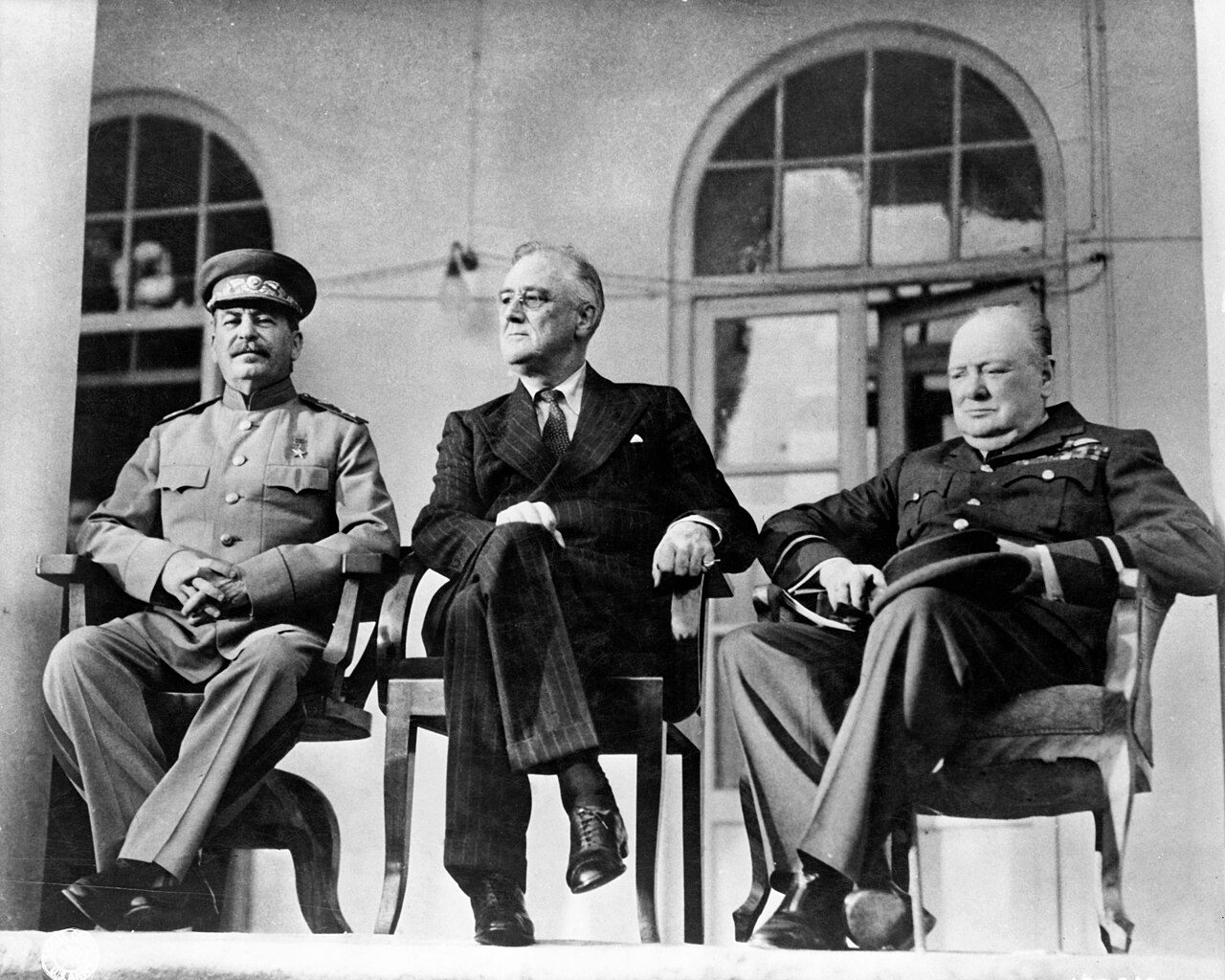
On 28 November 1943, in the Soviet embassy in Tehran, Franklin D. Roosevelt, Winston Churchill and Joseph Stalin sat down together for the first time — the Big Three meeting that fixed the strategy for defeating Germany, agreed the cross-Channel invasion of France, and began, in the same conversations, to draw the map of postwar Europe. November 28 is also the day Magellan entered the Pacific in 1520, the Royal Society was founded in 1660, and William Blake and Friedrich Engels were born.
Choose another date: open the On This Day calendar to browse events, births and deaths for any day of the year.
At a Glance
- The meeting
- Tehran Conference, codenamed Eureka, 28 November to 1 December 1943, in Allied-occupied Iran
- The principals
- Roosevelt (United States), Churchill (Britain) and Stalin (Soviet Union) — their first three-way meeting
- Stalin's price
- A firm commitment to open the second front in France; Operation Overlord was confirmed for May 1944
- Roosevelt's lodging
- The president stayed inside the Soviet embassy compound, officially for security — giving Soviet hosts easy access to his rooms
- The promises
- Stalin pledged to enter the war against Japan after Germany's defeat and to join the planned United Nations
- The shadows
- Poland's borders and future were discussed in terms that foreshadowed the Cold War settlement of Europe
Events on this day
- 1520Ferdinand Magellan's expedition emerges from the strait at South America's tip and enters the ocean he names the Pacific — the first European entry into that ocean from the Atlantic.
- 1582William Shakespeare marries Anne Hathaway at Stratford-upon-Avon; the marriage licence had been issued the day before.
- 1660At Gresham College in London, twelve men including Christopher Wren and Robert Boyle hold the meeting that founds what becomes the Royal Society.
- 1814The Times of London is printed for the first time by steam-powered presses, a landmark in the mass production of newspapers.
- 1905Arthur Griffith founds Sinn Féin in Dublin, the party that will lead Ireland's independence movement.
- 1919Nancy Astor wins the Plymouth Sutton by-election, becoming the first woman elected to take her seat in the British House of Commons.
- 1925The Grand Ole Opry is broadcast for the first time from radio station WSM in Nashville, Tennessee, beginning the longest-running radio show in American history.
- 1942Fire sweeps the Cocoanut Grove nightclub in Boston, killing 492 people in the deadliest nightclub fire in American history; the disaster transforms fire-safety law.
- 1943The Tehran Conference opens — the featured story above.
- 1960Mauritania declares its independence from France.
- 1964NASA launches Mariner 4, which the following July makes the first successful flyby of Mars and returns the first close-up photographs of another planet.
- 2012Peter Jackson's The Hobbit: An Unexpected Journey has its world premiere in Wellington, New Zealand.
Born on this day
- 1628John Bunyan — English preacher and writer whose Pilgrim's Progress became one of the most printed books in English.
- 1757William Blake — English poet, painter and printmaker, visionary creator of Songs of Innocence and of Experience.
- 1820Friedrich Engels — German philosopher and industrialist who co-authored The Communist Manifesto with Karl Marx.
- 1881Stefan Zweig — Austrian novelist and biographer, among the most translated writers of the interwar world.
- 1929Berry Gordy Jr. — American record producer who founded Motown and built its roster of stars.
- 1962Jon Stewart — American comedian who hosted The Daily Show and reshaped political satire on television.
Died on this day
- 1680Gian Lorenzo Bernini — Italian sculptor and architect who shaped Baroque Rome, from St Peter's colonnade to the Ecstasy of Saint Teresa.
- 1859Washington Irving — American author of The Legend of Sleepy Hollow and Rip Van Winkle, dead at 76.
- 1968Enid Blyton — English children's writer of the Famous Five and Noddy books, dead at 71.
- 2010Leslie Nielsen — Canadian-American comic actor of Airplane! and The Naked Gun, dead at 84.
The featured story: the Tehran Conference opens, 28 November 1943
The meeting had taken a year of evasions to arrange. Stalin, whose country was bearing the overwhelming weight of the land war against Germany, had pressed since 1942 for a second front in France and for a meeting of the three leaders; Churchill preferred Mediterranean operations and delay; Roosevelt manoeuvred between them. They settled at last on Tehran — a capital under joint Anglo-Soviet occupation since 1941, reachable by Stalin, who would not fly further from the Soviet Union. Churchill and Roosevelt conferred first with Chiang Kai-shek's China at Cairo, then flew on to Iran, where on the afternoon of 28 November 1943 the three men met in plenary session at the Soviet embassy.
Roosevelt, citing a reported assassination plot, accepted Stalin's invitation to lodge inside the Soviet embassy compound rather than at the distant American legation — a decision that put the president's conversations within reach of Soviet listening devices and placed him, physically, in Stalin's house. The symbolism matched the bargaining. Stalin demanded a date for the invasion of France and got it: Overlord, the cross-Channel assault, would be launched in May 1944, commanded by an American, with a supporting landing in the south of France; in return the Red Army would time its own great summer offensive to match. Churchill's cherished schemes for Italy and the Balkans were politely set aside.
The conference's other business reached beyond the war. Stalin confirmed that the Soviet Union would declare war on Japan once Germany was beaten, and agreed in principle to join Roosevelt's projected United Nations. Poland was discussed in the language of maps — its eastern border moved to the Curzon Line, its western border to the Oder at Germany's expense — a settlement imposed in embryo on a country not represented in the room. Ceremonial warmth covered the transactions: at a banquet, Stalin toasted the American war production that was supplying his armies, and Churchill presented him with the Sword of Stalingrad, a gift from King George VI to the defenders of that city.
Tehran is remembered as the high point of the Grand Alliance, and it was: the coalition that won the war was genuinely coordinated there, and Overlord kept its date. But historians also read it as the conference at which the postwar world began to be divided by the men dividing the wartime one. Roosevelt left believing personal diplomacy had won Stalin's trust; Churchill left privately uneasy. Both readings were available in the same four days — which is why the photographs of the three men smiling on the embassy portico remain the defining, and most ambiguous, image of the alliance.
Why this date matters
November 28 is a day of first meetings with enormous rooms. Magellan meets an ocean and names it for its calm; twelve Londoners meet in a college and found the institution that will organise science; three heads of government meet in an embassy and organise a world war's end — and, in passing, its sequel. The date's smaller entries share the pattern of gatherings: a congregation for a radio barn dance in 1925, a nightclub crowd in Boston in 1942 whose meeting ended in catastrophe. It is a date that believes history is made when the right — or the wrong — people finally get into the same room.
Sources
- Encyclopaedia Britannica — On This Day: November 28
- HISTORY — What Happened on November 28
- Encyclopaedia Britannica — Tehran Conference
- Franklin D. Roosevelt Presidential Library — Tehran Conference (topic coverage)
The facts on this page were checked against these sources on 19 November 2026. The History Trail's permanent pages are researched and written for this site; the live profiles elsewhere on The History Trail are assembled automatically from Wikipedia and Wikidata.
About the Author
Researched and written by the The History Trail Editorial Team — the accountable editorial function behind this site's permanent story pages. The team works from the published sources cited on each page; it does not invent historians, reviewers or credentials, and it corrects errors openly.
Fact Check
Every load-bearing fact on this page traces to one of the sources listed above, and significant claims link to their source in the text. Our checking method is described on the methodology page; errors can be reported via the corrections page.
Sources & Citations
Cite this page as: The History Trail Editorial Team, The History Trail — this article's title, publication and update dates are shown beneath its headline. The full source list appears under Sources above; the site's source standards are on the sources page.