
On This Day
November 29 in History
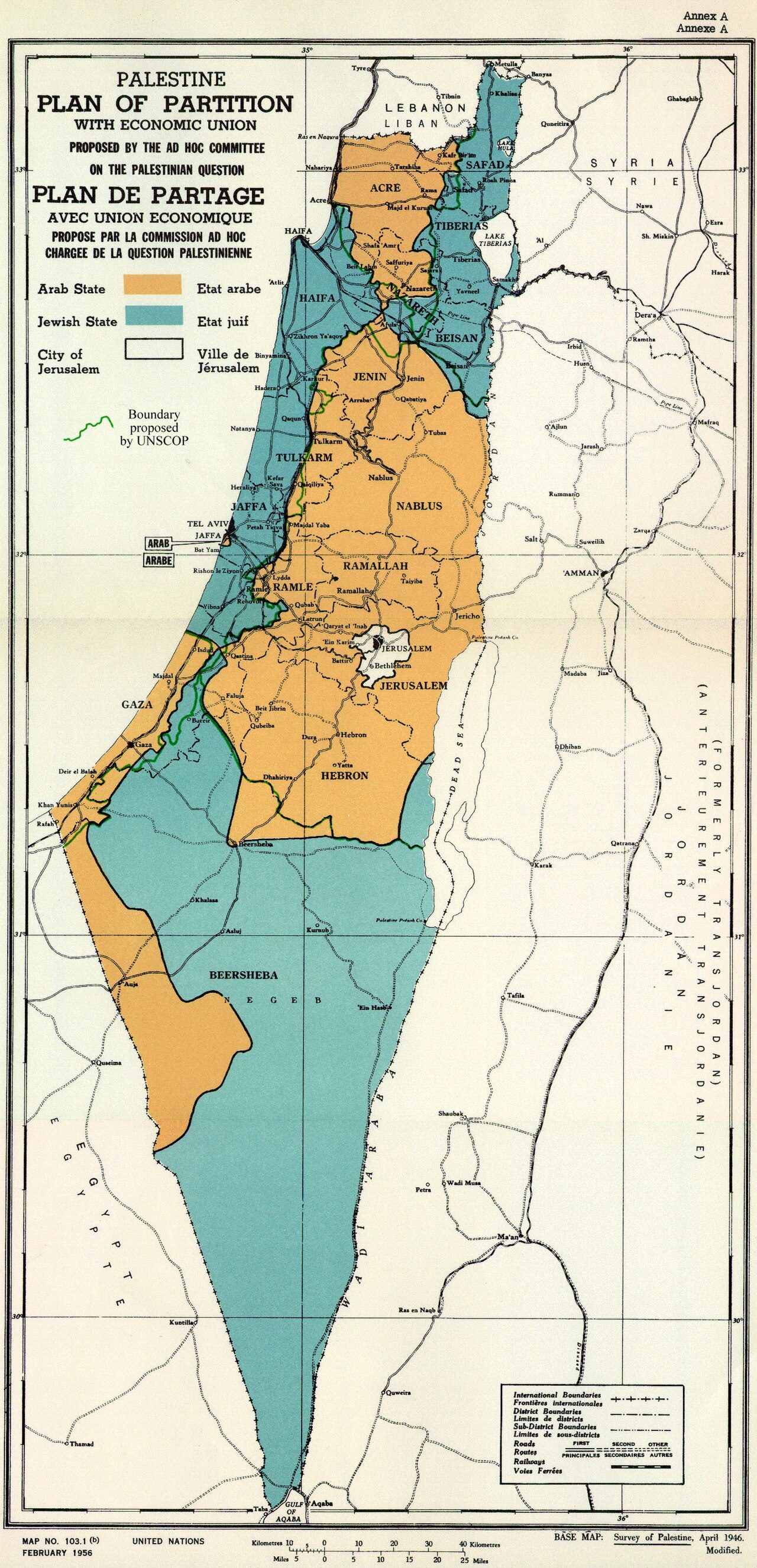
On 29 November 1947, the United Nations General Assembly, meeting at Flushing Meadows in New York, adopted Resolution 181 by 33 votes to 13, recommending the partition of British Mandate Palestine into independent Arab and Jewish states, with Jerusalem placed under international administration. It was the UN's first great attempt to settle a people's future by vote, and its consequences are still unfolding. November 29 is also the day of the Sand Creek massacre in 1864, Byrd's flight over the South Pole in 1929, and the births of Louisa May Alcott and C. S. Lewis.
Choose another date: open the On This Day calendar to browse events, births and deaths for any day of the year.
At a Glance
- The vote
- 33 in favour, 13 against, 10 abstentions — the required two-thirds majority was reached on 29 November 1947
- The plan
- Two states, an economic union between them, and Jerusalem as a corpus separatum under UN administration
- The shares
- The Jewish state was allotted roughly 55 percent of the Mandate's territory; the Arab state about 45 percent, with Jaffa as an Arab enclave
- The background
- Britain, holder of the Mandate since 1920, had handed the problem to the UN in 1947; the UNSCOP committee proposed partition
- The responses
- Jewish Agency leaders accepted the plan; Arab leaders and neighbouring states rejected it as illegitimate
- The aftermath
- Civil war in Palestine followed at once; the Mandate ended in May 1948 with Israel's declaration of independence and the first Arab-Israeli war
Events on this day
- 1777San José de Guadalupe is founded in California, the first civilian town — the first pueblo — in Spanish Alta California.
- 1781The crew of the British slave ship Zong begins throwing enslaved Africans overboard to claim their value as insured cargo; more than 130 people are murdered over the following days in the Zong massacre.
- 1830The November Uprising begins in Warsaw, as Polish cadets attack the Belweder Palace and open Poland's revolt against Russian rule.
- 1864At Sand Creek in Colorado Territory, Colonel John Chivington's volunteers attack a peaceful Cheyenne and Arapaho encampment, killing an estimated 150 or more people, most of them women, children and the elderly.
- 1877Thomas Edison demonstrates his phonograph publicly for the first time, reciting 'Mary Had a Little Lamb' into the tinfoil machine.
- 1899FC Barcelona is founded by a group of Catalan, Spanish and Swiss footballers led by Joan Gamper.
- 1929Richard E. Byrd and three companions make the first flight over the South Pole, an eighteen-hour round trip from the Ross Ice Shelf.
- 1942Coffee joins the list of goods rationed in the wartime United States, limited to about a pound per person every five weeks.
- 1947The United Nations votes to partition Palestine — the featured story above.
- 1963President Lyndon B. Johnson establishes the Warren Commission to investigate the assassination of President Kennedy, one week after the shooting.
- 1972Atari releases Pong, the arcade video game whose success launches the video game industry.
Born on this day
- 1803Christian Doppler — Austrian physicist who described the Doppler effect, the shift in a wave's frequency from a moving source.
- 1832Louisa May Alcott — American novelist whose Little Women drew on her own family's life in New England.
- 1898C. S. Lewis — Belfast-born scholar and writer of the Narnia chronicles and The Screwtape Letters.
- 1918Madeleine L'Engle — American writer whose A Wrinkle in Time reshaped children's science fiction.
- 1932Jacques Chirac — French politician, twice prime minister and twice president of France.
- 1976Chadwick Boseman — American actor who played Jackie Robinson, James Brown and Marvel's Black Panther.
Died on this day
- 1924Giacomo Puccini — Italian composer of La bohème, Tosca and Madama Butterfly, dead in Brussels at 65 with Turandot unfinished.
- 1981Natalie Wood — American film star of West Side Story and Rebel Without a Cause, drowned at 43 off Santa Catalina Island.
- 1986Cary Grant — English-born Hollywood leading man of North by Northwest and Bringing Up Baby, dead at 82.
- 2001George Harrison — guitarist of the Beatles and solo artist of All Things Must Pass, dead of cancer at 58.
- 2023Henry Kissinger — German-born American diplomat, national security adviser and secretary of state, dead at 100.
The featured story: the United Nations votes to partition Palestine, 29 November 1947
Palestine came to the United Nations as an inheritance no one wanted. Britain had ruled it under a League of Nations Mandate since the early 1920s, committed by the Balfour Declaration to a Jewish national home and by other promises to Arab independence, and by 1947 — facing armed revolt, illegal immigration of Holocaust survivors, and its own exhaustion — London announced it would hand the problem to the new world organisation and withdraw. The UN's special committee, UNSCOP, visited Palestine and, in its majority report, recommended what Britain had never dared: partition into two states, joined in economic union, with Jerusalem internationalised.
The lobbying that autumn was among the most intense in the young UN's history, conducted against a deadline as the General Assembly's session ran out. The vote was postponed from 26 November to allow both sides to work on undecided delegations — the United States and the Soviet Union, for once, both supported partition, for different reasons. On 29 November the roll was called in the converted ice rink at Flushing Meadows: 33 in favour, 13 against, 10 abstentions, Britain among the abstainers. The two-thirds majority had been reached. In Jerusalem and Tel Aviv, crowds listened to the count on radios in the street; the Jewish Agency accepted the resolution as the legal basis for a state, while the Arab Higher Committee and the Arab states rejected it outright as a violation of the majority population's rights.
The plan on paper allotted the Jewish state — whose community owned a small fraction of the land but comprised about a third of the population, swollen by immigration — roughly 55 percent of the Mandate's territory, much of it the Negev desert; the Arab state received about 45 percent, and Jerusalem was to be a separate international enclave. Almost nobody on the ground believed the map could be implemented peacefully, and it was not: communal fighting began within hours of the vote, escalated into civil war through the winter, and, when Britain withdrew and Israel declared independence on 14 May 1948, became the first Arab-Israeli war — producing the State of Israel and the displacement of more than 700,000 Palestinian Arabs, remembered as the Nakba.
Resolution 181 remains the legal and symbolic hinge of the conflict. It is cited in Israel's declaration of independence, commemorated by Palestinians as the original act of dispossession, and marked by the UN itself, which in 1977 chose 29 November as the International Day of Solidarity with the Palestinian People — the same organisation observing the anniversary of its own most contested decision. The two-state idea the resolution embodied is still the framework to which diplomacy formally returns, three-quarters of a century after a single evening's voting in a New York suburb.
Why this date matters
November 29 is a day on which the powerful drew lines and the powerless paid for them: a slave ship's crew murdering its human cargo for insurance in 1781, militia falling on a sleeping village at Sand Creek in 1864, and diplomats in New York in 1947 drawing a map for a country most had never seen. Yet the date also holds the counter-current — a flight over the South Pole that was pure exploration, a two-paddle arcade game in 1972 that began an industry, and the births of Alcott and Lewis, two writers who taught generations of children to imagine other worlds. Lines drawn and worlds imagined: the day contains both impulses entire.
Sources
- Encyclopaedia Britannica — On This Day: November 29
- HISTORY — What Happened on November 29
- Encyclopaedia Britannica — Arab-Israeli wars (Resolution 181)
- United Nations — Resolution 181 (II), Future government of Palestine
The facts on this page were checked against these sources on 19 November 2026. The History Trail's permanent pages are researched and written for this site; the live profiles elsewhere on The History Trail are assembled automatically from Wikipedia and Wikidata.
About the Author
Researched and written by the The History Trail Editorial Team — the accountable editorial function behind this site's permanent story pages. The team works from the published sources cited on each page; it does not invent historians, reviewers or credentials, and it corrects errors openly.
Fact Check
Every load-bearing fact on this page traces to one of the sources listed above, and significant claims link to their source in the text. Our checking method is described on the methodology page; errors can be reported via the corrections page.
Sources & Citations
Cite this page as: The History Trail Editorial Team, The History Trail — this article's title, publication and update dates are shown beneath its headline. The full source list appears under Sources above; the site's source standards are on the sources page.