
On This Day
August 7 in History
On 7 August 1942, the US 1st Marine Division landed on Guadalcanal in the Solomon Islands — the first American offensive of the Second World War, launched barely eight months after Pearl Harbor. The airfield the Marines seized became the hinge on which the Pacific war turned. August 7 is also the day Washington created the badge that became the Purple Heart, and the day Philippe Petit walked between the Twin Towers.
Choose another date: open the On This Day calendar to browse events, births and deaths for any day of the year.
At a Glance
- The operation
- Operation Watchtower — American landings on Guadalcanal and Tulagi in the Solomon Islands, 7 August 1942
- The force
- The US 1st Marine Division, commanded by Major General Alexander A. Vandegrift
- The objective
- An airfield the Japanese were building on Guadalcanal, from which their aircraft could threaten the sea lanes between the United States and Australia
- The significance
- The first American ground offensive of the Second World War, launched eight months after Pearl Harbor
- The campaign
- Six months of fighting on land, at sea and in the air follow, before Japan evacuates the island in February 1943
Events on this day
- 1782George Washington creates the Badge of Military Merit, awarded for 'singularly meritorious action' — the ancestor of the Purple Heart.
- 1819Simón Bolívar defeats Spanish royalist forces at the Battle of Boyacá, securing the independence of New Granada, modern Colombia.
- 1912Theodore Roosevelt is nominated for a third-party presidential run by the Progressive Party — the 'Bull Moose' Party — splitting the Republicans and handing the election to Woodrow Wilson.
- 1942US Marines land on Guadalcanal, opening the first American offensive of the Second World War — the featured story above.
- 1947Thor Heyerdahl's balsa-wood raft Kon-Tiki strikes a reef in Polynesia, completing a 101-day, 4,300-mile voyage from Peru intended to prove that ancient South Americans could have reached the Pacific islands.
- 1959The American satellite Explorer 6 is launched; it will return the first photograph of the Earth taken from orbit.
- 1964Congress passes the Gulf of Tonkin Resolution, granting President Lyndon Johnson sweeping authority to conduct the war in Vietnam.
- 1974French high-wire artist Philippe Petit walks a cable strung between the twin towers of New York's World Trade Center, some 1,350 feet above the street.
- 1987American swimmer Lynne Cox swims across the Bering Strait from Alaska to the Soviet Union, through water barely above freezing, in a gesture of Cold War goodwill.
- 1990President George H. W. Bush orders American forces to Saudi Arabia in Operation Desert Shield, five days after Iraq's invasion of Kuwait.
- 2007Barry Bonds hits his 756th career home run, passing Hank Aaron's record — a milestone shadowed by allegations of steroid use.
- 2008War breaks out between Russia and Georgia over the breakaway region of South Ossetia, on the eve of the Beijing Olympics.
Born on this day
- 1867Emil Nolde — German-Danish expressionist painter, born Hans Emil Hansen.
- 1876Mata Hari — Dutch dancer, born Margaretha Zelle, executed by France as a spy during the First World War.
- 1904Ralph Bunche — American diplomat who won the Nobel Peace Prize for his mediation of the 1948 Arab-Israeli war.
- 1925M. S. Swaminathan — Indian geneticist remembered as the father of India's Green Revolution.
- 1932Abebe Bikila — Ethiopian runner who won the 1960 Olympic marathon in Rome running barefoot.
- 1960David Duchovny — American actor, star of The X-Files.
- 1975Charlize Theron — South African-American actress, Oscar winner for Monster.
- 1987Sidney Crosby — Canadian ice hockey player, among the defining stars of his generation.
Died on this day
- 1938Constantin Stanislavski — Russian theatre director whose 'system' of acting reshaped the modern stage and screen.
- 1941Rabindranath Tagore — Bengali poet and philosopher, the first non-European to receive the Nobel Prize in Literature.
- 1957Oliver Hardy — American comedian, the larger half of Laurel and Hardy.
- 2005Peter Jennings — Canadian-American journalist, long-time anchor of ABC's World News Tonight.
- 2011Mark Hatfield — American politician, governor of Oregon and a United States senator for thirty years.
The featured story: US Marines land on Guadalcanal, 7 August 1942
Eight months after Pearl Harbor, the United States was still, everywhere, on the defensive. Japan's forces had swept across the Pacific and Southeast Asia, and in the summer of 1942 Japanese engineers began building an airfield on a humid island in the Solomons called Guadalcanal. From that airfield, Japanese aircraft could threaten the shipping lanes between the United States and Australia — the lifeline on which any Allied counter-offensive would depend. The American response was to strike first, with forces scraped together in haste, in the first amphibious offensive of the war. Its codename was Operation Watchtower; the men who would carry it out called it, for the shoestring nature of its supply, 'Operation Shoestring'.
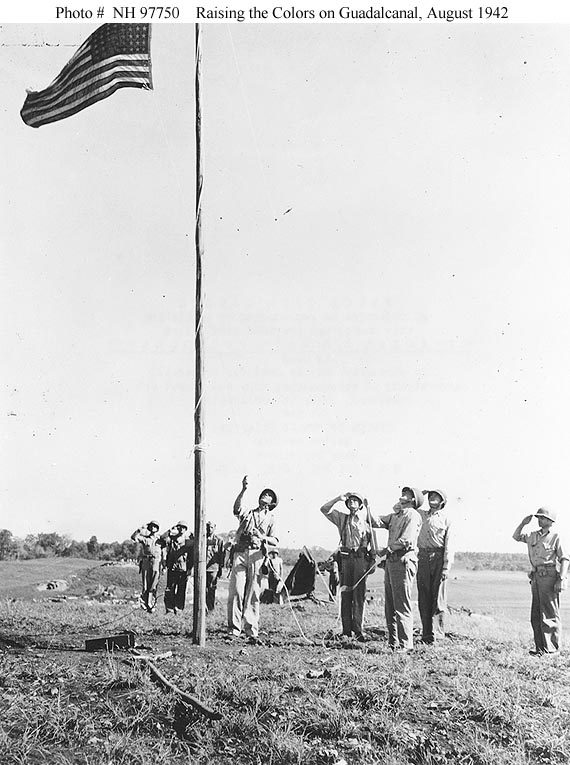
Before dawn on 7 August 1942, the US 1st Marine Division, commanded by Major General Alexander A. Vandegrift, went ashore on Guadalcanal and on the smaller islands of Tulagi, Gavutu and Tanambogo across the strait. The landings on Guadalcanal itself were almost unopposed — the Japanese construction units fled into the jungle — and within two days the Marines had captured the nearly finished airfield, which they completed and named Henderson Field. On Tulagi the fighting was savage from the first hour. The photograph on this page was taken on Guadalcanal on the day of the landing: Marines raising the colours over their beachhead, with their divisional commander standing in the group.
What looked like a walkover became a six-month campaign of attrition unmatched in the Pacific war. Japan, refusing to yield the island, poured in reinforcements and attacked the airfield again and again — by land in night assaults against the Marine perimeter, from the air almost daily, and at sea in a series of night battles in the strait the Americans came to call Ironbottom Sound for the ships sunk there. The Marines, and later the Army divisions that joined them, endured hunger, malaria and bombardment, and held the airfield. In December the exhausted 1st Marine Division was withdrawn; in February 1943 Japan evacuated its surviving troops, conceding the island.
Guadalcanal was the first major land defeat suffered by Japan in the war, and with the naval victory at Midway two months earlier it marks the point at which the Pacific war turned. Japan never regained the initiative; the airfield its engineers had begun for their own bombers became the base from which the Allies advanced up the Solomon chain toward Rabaul and, eventually, toward Japan itself. The campaign also fixed a pattern for the war to come: an island airfield, a perimeter, and a battle of supply and endurance as much as of arms. It began, almost quietly, with an unopposed landing on an August morning.
Why this date matters
August 7 is a day of first steps taken at great risk. Washington's badge of 1782 honoured ordinary soldiers for the first time; Bolívar's victory at Boyacá founded a nation; the Marines who waded ashore in 1942 began the long road back across the Pacific. Its later entries share the same character of ventures launched on a shoestring — a balsa raft, a satellite's first photograph of home, a man on a wire between two towers, a swimmer in a freezing strait. Few dates so consistently reward the people who went first and improvised.
Sources
- Encyclopaedia Britannica — On This Day: August 7
- HISTORY — What Happened on August 7
- Naval History and Heritage Command — Photo NH 97750 Picture Data
- Wikimedia — On This Day feed: August 7
The facts on this page were checked against these sources on 19 November 2026. The History Trail's permanent pages are researched and written for this site; the live profiles elsewhere on The History Trail are assembled automatically from Wikipedia and Wikidata.
About the Author
Researched and written by the The History Trail Editorial Team — the accountable editorial function behind this site's permanent story pages. The team works from the published sources cited on each page; it does not invent historians, reviewers or credentials, and it corrects errors openly.
Fact Check
Every load-bearing fact on this page traces to one of the sources listed above, and significant claims link to their source in the text. Our checking method is described on the methodology page; errors can be reported via the corrections page.
Sources & Citations
Cite this page as: The History Trail Editorial Team, The History Trail — this article's title, publication and update dates are shown beneath its headline. The full source list appears under Sources above; the site's source standards are on the sources page.