
On This Day
August 8 in History
On the evening of 8 August 1974, Richard Nixon went on television from the Oval Office and announced that he would resign the presidency at noon the next day — the first, and still the only, American president to give up the office. Watergate had closed every other exit. August 8 is also the day the Quit India resolution was passed and the 8888 Uprising began in Burma.
Choose another date: open the On This Day calendar to browse events, births and deaths for any day of the year.
At a Glance
- The announcement
- 8 August 1974 — Nixon addresses the nation from the Oval Office at 9:01 p.m. Eastern Time and announces his resignation
- The resignation
- Effective at noon on 9 August 1974 — the first, and still the only, resignation of a president of the United States
- The cause
- The Watergate scandal: the 'smoking gun' tape, released on 5 August, proves Nixon approved obstructing the FBI's investigation
- The arithmetic
- Republican elders tell Nixon he can count on perhaps fourteen Senate votes against conviction — far fewer than he needs to survive
- The speech
- Prepared with speechwriter Raymond K. Price; Nixon insists 'I have never been a quitter', but puts the nation's interest first
- The succession
- Gerald Ford is sworn in at noon on 9 August; on 8 September he grants Nixon a full pardon
Events on this day
- 1908Wilbur Wright makes the Wright brothers' first public flight, at a racecourse at Le Mans in France, astonishing European spectators who had doubted the Americans' claims.
- 1942In Bombay, the Indian National Congress adopts the Quit India resolution, demanding an immediate end to British rule; Gandhi and the Congress leadership are arrested the next morning.
- 1942Six German saboteurs who had been landed by U-boat on the American coast are executed in Washington, D.C., after trial by a military commission.
- 1945President Harry Truman signs the United Nations Charter, making the United States the first nation to complete the ratification of the new world organisation.
- 1945The Soviet Union declares war on Japan; the next day more than a million Soviet troops invade Japanese-occupied Manchuria.
- 1967The Association of Southeast Asian Nations (ASEAN) is founded in Bangkok by five Southeast Asian states.
- 1969Photographer Iain Macmillan shoots the Beatles crossing Abbey Road in London — ten minutes of pictures that produce one of the most imitated album covers in history.
- 1974President Richard Nixon announces on live television that he will resign — the featured story above.
- 1988The 8888 Uprising reaches its height in Burma, as a general strike against military rule brings huge crowds into the streets; in the suppression that follows, more than 3,000 people are killed, by the British government's account.
- 1988N.W.A release their album Straight Outta Compton, the record that carries gangsta rap from Los Angeles into the American mainstream.
- 1990Iraq declares the conquered Kuwait to be its 19th province, formally abolishing the country it had invaded six days earlier.
- 2014The United States begins air strikes against Islamic State forces advancing in northern Iraq.
Born on this day
- 1902Paul Dirac — English physicist who predicted the existence of antimatter and shared the Nobel Prize in Physics.
- 1921Esther Williams — American competitive swimmer who became the star of Hollywood's lavish aquatic musicals.
- 1937Dustin Hoffman — American actor of The Graduate, Midnight Cowboy and Rain Man.
- 1981Roger Federer — Swiss tennis player who won twenty Grand Slam singles titles and redefined the sport's elegance.
- 1998Shawn Mendes — Canadian singer-songwriter who rose from online covers to stadium tours.
Died on this day
- 1827George Canning — British prime minister, dead in office only a few months after taking it, having also been foreign secretary and a leading opponent of the slave trade.
- 1909Mary MacKillop — Australian nun and educator, the first Australian to be canonised as a saint by the Catholic Church.
- 1965Shirley Jackson — American writer of the story 'The Lottery' and the novel The Haunting of Hill House.
- 1985Louise Brooks — American silent-film actress whose bobbed hair and performance in Pandora's Box defined an era.
- 2010Patricia Neal — American actress, Oscar winner for Hud, who rebuilt her career after a series of strokes.
- 2017Glen Campbell — American singer and guitarist of 'Wichita Lineman' and 'Rhinestone Cowboy'.
- 2022Olivia Newton-John — Australian singer and actress, star of Grease and one of the best-selling recording artists of her era.
The featured story: Nixon announces his resignation, 8 August 1974
The scandal that ended Richard Nixon's presidency began with a burglary: in June 1972, five men working for the president's re-election campaign were caught inside the Democratic Party's headquarters in the Watergate building in Washington. For two years the affair unspooled — through Senate hearings, the revelation that Nixon had secretly recorded his Oval Office conversations, a constitutional battle over the tapes, the resignation of his vice president on unrelated corruption charges, and the dismissal of the special prosecutor investigating him. Nixon survived each stage by narrowing margins, insisting he was not a crook and that the tapes, once heard, would clear him.
On 5 August 1974 the Supreme Court's order forced the release of the tape that ended it: a recording from 23 June 1972, days after the break-in, in which Nixon approved using the CIA to block the FBI's investigation. The 'smoking gun' destroyed what remained of his support. His own party's elders came to the White House to tell him the arithmetic: impeachment in the House was certain, and in the Senate he could count on perhaps fourteen votes against conviction — far short of the third he needed to survive. Resignation, unthinkable for two years, became the only door left open.
On the evening of 8 August 1974, at 9:01 p.m. Eastern Time, Nixon addressed the nation on television from the Oval Office, in a speech prepared with his speechwriter Raymond K. Price. 'I have never been a quitter,' he said, but the interests of the nation had to come first: he would resign the presidency at noon the following day. It was the first resignation of an American president in the republic's history — the only one there has ever been. For the fifteen hours between the announcement and noon on 9 August, the country had a president who had already told it he was leaving.
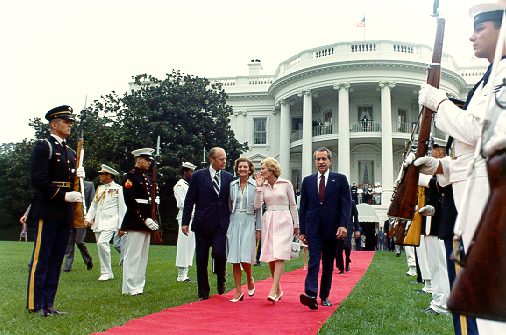
At noon on 9 August, Gerald Ford — the man Nixon had appointed vice president less than a year before — was sworn in as the 38th president, declaring that 'our long national nightmare is over'. The Nixons were escorted to a helicopter on the White House lawn and flew out of Washington. A month later, on 8 September, Ford granted Nixon a full pardon for any crimes he might have committed in office, a decision that closed the legal story of Watergate while opening an argument about it that has never entirely ended. The presidency Nixon left behind was permanently changed: in its relationship with Congress, with the press, and with the public that had watched a president fall on live television.
Why this date matters
August 8 is a day on which power changes hands, or tries to. Gandhi's Congress voted to end an empire on it; Southeast Asia founded its enduring bloc on it; Burma's crowds filled the streets on it in 1988 and were answered with bullets; Iraq erased a country on it in 1990. And on it in 1974, the most powerful elected office in the world was surrendered — not to an army or a mob, but to a tape recording, a vote count, and a television camera. The date is a small history of how authority ends: by resolution, by force, and once, uniquely, by announcement.
Sources
- Encyclopaedia Britannica — On This Day: August 8
- HISTORY — What Happened on August 8
- Office of the Historian — Foreign Relations of the United States: Editorial Note on the Nixon Resignation
- timeanddate — On This Day: August 8
The facts on this page were checked against these sources on 19 November 2026. The History Trail's permanent pages are researched and written for this site; the live profiles elsewhere on The History Trail are assembled automatically from Wikipedia and Wikidata.
About the Author
Researched and written by the The History Trail Editorial Team — the accountable editorial function behind this site's permanent story pages. The team works from the published sources cited on each page; it does not invent historians, reviewers or credentials, and it corrects errors openly.
Fact Check
Every load-bearing fact on this page traces to one of the sources listed above, and significant claims link to their source in the text. Our checking method is described on the methodology page; errors can be reported via the corrections page.
Sources & Citations
Cite this page as: The History Trail Editorial Team, The History Trail — this article's title, publication and update dates are shown beneath its headline. The full source list appears under Sources above; the site's source standards are on the sources page.