
Years
1945 in History
1945 is the year the Second World War ended. Germany surrendered in May after Hitler's suicide in his Berlin bunker, atomic bombs destroyed Hiroshima and Nagasaki in August, and Japan signed its formal surrender aboard USS Missouri in September. Between the endings, fifty nations signed the Charter that created the United Nations.
At a Glance
- Defining event
- The end of the Second World War: Germany's surrender in May and Japan's in August-September
- VE Day
- 8 May 1945: Germany's unconditional surrender takes effect in Europe
- Hiroshima
- 6 August: an estimated 70,000 killed outright; the toll passes 100,000 by the end of 1945
- Nagasaki
- 9 August: an estimated 35,000-40,000 killed immediately, by the featured record's accounting
- United Nations
- Charter signed by fifty nations at San Francisco, 26 June; in force 24 October
- Closed the year
- The Nuremberg trials of the major Nazi war criminals open, 20 November
The defining story: the end of the Second World War
The war's last year opened with its crimes coming into the light. On 27 January soldiers of the Red Army's 60th Army reached Auschwitz in occupied Poland and freed some 7,000 surviving prisoners; the date is now International Holocaust Remembrance Day. In February Roosevelt, Churchill and Stalin met at Yalta in Crimea to plan Germany's occupation, the United Nations and the postwar order, and Allied raids of 13 to 15 February destroyed the centre of Dresden in a firestorm, killing an estimated 25,000 people. In the Pacific, US Marines raised the flag on Mount Suribachi, Iwo Jima, on 23 February, twice in one day, the second raising producing Joe Rosenthal's Pulitzer Prize-winning photograph. On 12 April President Roosevelt died of a cerebral haemorrhage at Warm Springs, Georgia, at 63, weeks before the victory he had led toward, and Harry Truman succeeded him.
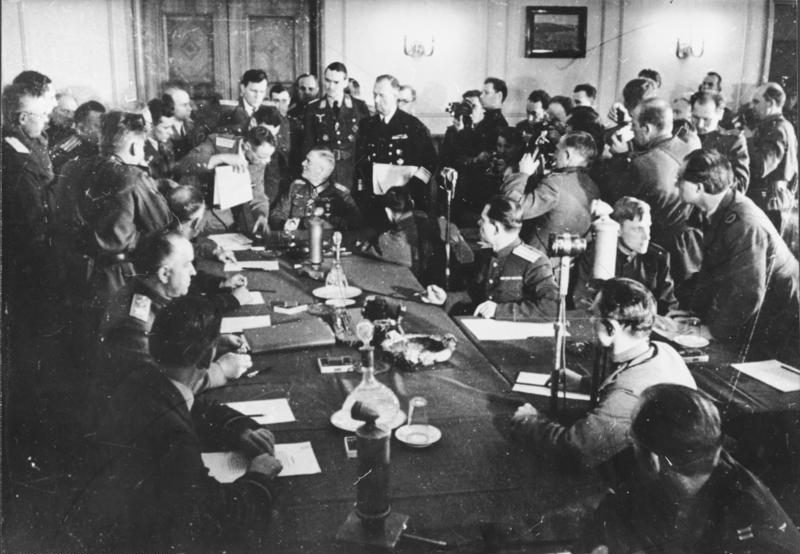
Berlin fell in a fortnight of suicides and signatures. Soviet forces opened the Battle of Berlin on 16 April; American troops liberated Dachau, the first Nazi concentration camp, on 29 April; that night, in his bunker, Hitler married Eva Braun, and the following afternoon both were dead by suicide, with Soviet troops streets away. Mussolini had been shot by Italian partisans at Lake Como two days earlier. Germany signed its unconditional surrender at Reims on 7 May, to take effect on 8 May, and Field Marshal Wilhelm Keitel signed the definitive instrument at Berlin-Karlshorst on the night of 8 May, the scene in this page's photograph. Victory in Europe Day ended the war on the continent, though the Soviet Union celebrated its Victory Day on 9 May.
The Pacific war ended in fire of a new kind. On 16 July the Trinity test detonated the first atomic bomb in New Mexico. At 8:15 on the morning of 6 August, the B-29 Enola Gay dropped the uranium bomb Little Boy over Hiroshima: an estimated 70,000 people were killed outright, the toll passed 100,000 by the end of 1945, and some two-thirds of the city was destroyed. Three days later the B-29 Bockscar, diverted from the cloud-hidden primary target Kokura, dropped the plutonium bomb Fat Man over Nagasaki: an estimated 35,000 to 40,000 people were killed immediately, and total deaths reached an estimated 60,000 to 80,000 by the end of the year. The Soviet Union declared war on Japan on 8 August and invaded Manchuria the next day. On 14 August Japan accepted the Potsdam Declaration and Truman announced the surrender; the emperor's recorded message was broadcast in Japan on 15 August, the first time his subjects had heard his voice; and on 2 September Japanese envoys signed the Instrument of Surrender aboard USS Missouri in Tokyo Bay, formally ending the war six years and a day after it began.
Between those endings the postwar world was founded on paper. Delegates of fifty nations signed the United Nations Charter in San Francisco on 26 June, creating the UN with a binding Security Council and a ban on wars of aggression, and the Charter entered into force on 24 October. Indonesia proclaimed its independence on 17 August and Vietnam on 2 September, the first cracks in the colonial order the war had shattered. And on 20 November the trial of the major Nazi war criminals opened at Nuremberg before the International Military Tribunal of the four Allied powers, with 21 defendants in the dock on the opening day.
Timeline of 1945
- 27 January
Soviet troops liberate the Auschwitz camp complex in Poland, finding about 7,000 surviving prisoners.
- 4 February
The Yalta Conference opens in Crimea, where Roosevelt, Churchill and Stalin plan the postwar world.
- 23 February
US Marines raise the American flag on Mount Suribachi, Iwo Jima, five days into a battle that runs until 26 March.
- 12 April
Franklin D. Roosevelt dies of a cerebral haemorrhage at Warm Springs, Georgia, at 63.
- 30 April
Adolf Hitler kills himself in his Berlin bunker, as does Eva Braun, his wife of one day.
- 8 May
Victory in Europe Day: Germany's unconditional surrender takes effect.
- 26 June
Delegates of fifty nations sign the United Nations Charter in San Francisco.
- 16 July
The Trinity test detonates the first atomic bomb in New Mexico.
- 6 August
The United States drops the first atomic bomb used in warfare on Hiroshima.
- 9 August
The United States drops a second atomic bomb, on Nagasaki; Soviet forces invade Manchuria.
- 14 August
Japan accepts the Potsdam Declaration, and President Truman announces the surrender.
- 2 September
Japan signs the Instrument of Surrender aboard USS Missouri, formally ending the Second World War.
- 24 October
The United Nations Charter enters into force, bringing the UN into legal existence.
- 20 November
The Nuremberg trials open before the International Military Tribunal.
Why 1945 still matters
Every institution of the modern international order is dated 1945. The United Nations, founded that June and in force that October, remains the world's parliament and the framework of international law; the Nuremberg trials created the precedent that heads of state and their ministers can be tried for aggression and crimes against humanity, the root of every war-crimes court since. The International Monetary Fund came into formal existence in December, and the summits at Yalta and Potsdam drew the lines across Europe and Asia along which the Cold War would be fought for the next forty-five years.
The atomic bombs fixed the other half of the modern condition. Hiroshima and Nagasaki remain the only uses of nuclear weapons in warfare, and the shadow of the weapons tested at Trinity has governed great-power politics ever since: no two nuclear-armed states have fought a full war. The liberations of Auschwitz and Dachau, and the evidence assembled for Nuremberg, also fixed the documentary record of the Holocaust in public memory, which is why 27 January is kept as International Holocaust Remembrance Day. Even the year's quieter publications endured: George Orwell's Animal Farm, issued in London in August, became the century's defining fable of a revolution betrayed.
1945 on The History Trail
Sixteen of 1945's days carry featured stories on The History Trail; these are the six that ended and remade the world.
- January 27 in History — Soviet troops liberate Auschwitz and free some 7,000 surviving prisoners.
- May 8 in History — Victory in Europe Day: Germany's surrender takes effect.
- June 26 in History — Fifty nations sign the United Nations Charter in San Francisco.
- August 6 in History — The atomic bombing of Hiroshima, the first use of a nuclear weapon in warfare.
- September 2 in History — Japan signs its surrender aboard USS Missouri, formally ending the war.
- November 20 in History — The Nuremberg trials of the major Nazi war criminals begin.
- United Nations — The organisation founded in 1945, told as a permanent story on The History Trail.
- Penicillin: The Mould That Opened the Antibiotic Age — The antibiotic age that wartime production opened, told as a permanent story.
Sources
- Encyclopaedia Britannica — On This Day: January 27
- Encyclopaedia Britannica — On This Day: February 4
- Encyclopaedia Britannica — Yalta Conference
- Encyclopaedia Britannica — Bombing of Dresden
- Encyclopaedia Britannica — On This Day: February 23
- National Museum of the Pacific War — The Battle of Iwo Jima
The facts on this page were checked against these sources on 19 November 2026. The History Trail's permanent pages are researched and written for this site; the live profiles elsewhere on The History Trail are assembled automatically from Wikipedia and Wikidata.
About the Author
Researched and written by the The History Trail Editorial Team — the accountable editorial function behind this site's permanent story pages. The team works from the published sources cited on each page; it does not invent historians, reviewers or credentials, and it corrects errors openly.
Fact Check
Every load-bearing fact on this page traces to one of the sources listed above, and significant claims link to their source in the text. Our checking method is described on the methodology page; errors can be reported via the corrections page.
Sources & Citations
Cite this page as: The History Trail Editorial Team, The History Trail — this article's title, publication and update dates are shown beneath its headline. The full source list appears under Sources above; the site's source standards are on the sources page.