
Things
United Nations
The United Nations is the world's general international organisation, founded in 1945 as the Second World War ended, when 50 countries signed its Charter in San Francisco and Poland made 51 original members. Built to save succeeding generations from the scourge of war, it now has 193 member states, six principal organs, and a system of agencies that reaches from peacekeeping to health and human rights.
At a Glance
- Founded
- 24 October 1945, when the UN Charter entered into force after ratification by the five permanent Security Council members and a majority of signatories
- The Charter
- Signed at San Francisco on 26 June 1945 by representatives of 50 countries; Poland signed later, making 51 original members
- Membership today
- 193 member states - nearly every sovereign state on Earth
- Principal organs
- General Assembly, Security Council, Economic and Social Council, Trusteeship Council, International Court of Justice, Secretariat
- Headquarters
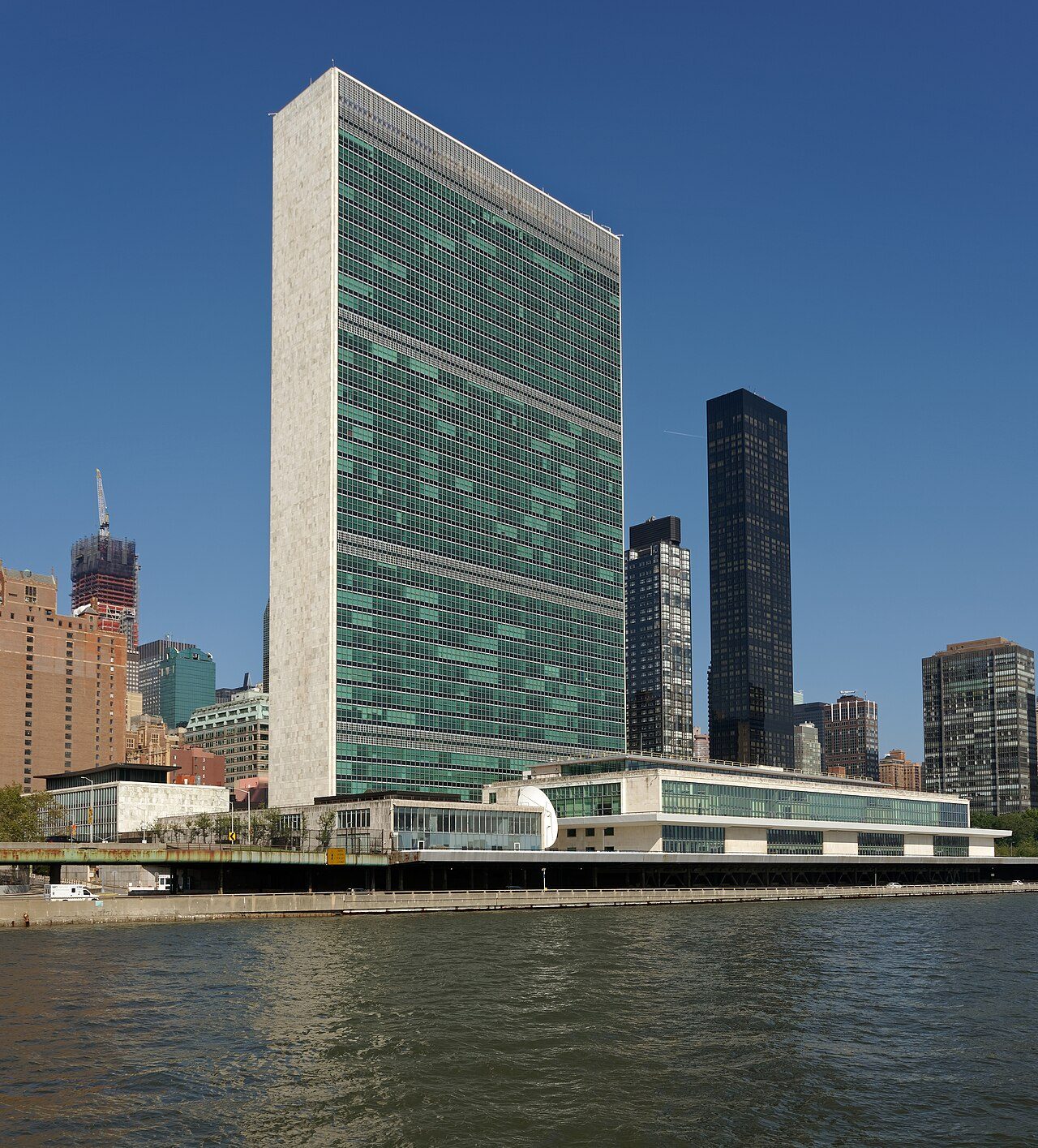
- New York City, with the International Court of Justice seated at The Hague
- The veto
- Each of the five permanent Security Council members - China, France, Russia, the United Kingdom and the United States - can block a substantive resolution
- Predecessor
- The League of Nations, whose failure to prevent the Second World War shaped the UN's stronger design
Introduction
The United Nations was a wartime invention. The name itself began as the Allies' name: on 1 January 1942, twenty-six states at war with the Axis signed the Declaration by United Nations in Washington, pledging to fight on together and make no separate peace. By 1945 that wartime coalition had become something else - a permanent organisation meant to outlast the war, with a Charter, a court, a council with real powers, and eventually a headquarters on the East River in New York.
Its opening words state its purpose. The Charter's preamble begins with the determination to save succeeding generations from the scourge of war, which twice in our lifetime has brought untold sorrow to mankind. Everything the UN has done since - and everything it has failed to do - is measured against that sentence.
Before the UN: The League and the Wartime Plans
The UN's predecessor was the League of Nations, created after the First World War. The League did useful work in health, labour and refugees, as the UN Chronicle's own history of the Charter acknowledges, but in the 1930s it proved unable to stop aggression, and the Second World War began in September 1939. The lesson the wartime planners drew was not that international organisation was futile, but that the League had been built too weak: the United States never joined it, its decisions required near-unanimity, and it had no enforcement machinery.
Planning began while the war still raged. The Atlantic Charter of August 1941 looked forward to a wider and permanent system of general security. At Moscow in October 1943 the foreign ministers of the United States, the United Kingdom, the Soviet Union and China recognised the necessity of a general international organisation based on the sovereign equality of all peace-loving states. In August to October 1944, experts of those four powers met at Dumbarton Oaks in Washington and produced the proposals that became the Charter's skeleton: a General Assembly, a Security Council, an International Court of Justice and a Secretariat. Two questions were left open - how the Security Council would vote, and the trusteeship of colonies - and were settled at Yalta in February 1945, where the permanent members' veto was agreed.
San Francisco and the Charter
The founding conference opened in San Francisco on 25 April 1945, weeks before the war in Europe ended. Representatives of 50 nations debated the Dumbarton Oaks draft for two months, widening it: smaller states strengthened the General Assembly and the Economic and Social Council, and human rights language entered the text. On 26 June 1945 the Charter was signed. Poland, which had no recognised government represented at the conference, signed later and counts as the fifty-first original member.
The Charter entered into force on 24 October 1945 - now United Nations Day - once China, France, the Soviet Union, the United Kingdom and the United States, the five permanent members of the Security Council, and a majority of the other signatories had ratified it. The first General Assembly met in London in January 1946. The organisation the Charter created had six principal organs, and one deliberate imbalance at its heart: the Assembly, where every member has one vote, can debate and recommend on almost anything but cannot compel; the Security Council, charged with primary responsibility for international peace and security, can issue binding decisions - but any one of its five permanent members can veto them.
Cold War, Decolonisation and Peacekeeping
The Cold War tested that design immediately. Deadlock between the United States and the Soviet Union made the Security Council, in Britannica's assessment, an ineffective institution for much of that period. Yet the UN improvised a tool the Charter never mentions: peacekeeping. In 1948 the Security Council authorised military observers to monitor the armistice between Israel and its Arab neighbours - the UN Truce Supervision Organization, still operating today. In 1956, during the Suez Crisis, the first armed peacekeeping force, the UN Emergency Force, was deployed to supervise the withdrawal of British, French and Israeli forces from Egypt.
Meanwhile decolonisation transformed the membership: from 1955 to 1960 forty new members were admitted, seventeen African nations joining in 1960 alone, and by the end of the 1970s membership stood at about 150. The Assembly's agenda shifted toward development, self-determination and the end of apartheid. It had already given the UN its most quoted text: the Universal Declaration of Human Rights, adopted on 10 December 1948. After the Cold War, the Security Council authorised more peacekeeping operations between 1987 and 2000 than in all its previous history - and the failures of the 1990s, in Rwanda and Bosnia, exposed the limits of missions sent without the means to protect civilians.
Timeline
- 1 January 1942
Twenty-six Allied states sign the Declaration by United Nations in Washington - the first official use of the name.
- August-October 1944
The Dumbarton Oaks conversations draft the organisation's structure: Assembly, Security Council, Court and Secretariat.
- February 1945
At Yalta the great powers settle the Security Council voting formula, including the permanent members' veto.
- 26 June 1945
Representatives of 50 countries sign the UN Charter in San Francisco; Poland signs later as the 51st original member.
- 24 October 1945
The Charter enters into force - the United Nations officially exists.
- 10 December 1948
The General Assembly adopts the Universal Declaration of Human Rights in Paris.
- 1948
The first peacekeeping mission, the UN Truce Supervision Organization, deploys military observers to the Middle East.
- 1956
The first armed peacekeeping force, UNEF, deploys during the Suez Crisis.
- 1960
Seventeen newly independent African nations join in a single year, transforming the General Assembly.
- 1965
A Charter amendment expands the Security Council from 11 to 15 members.
- 2011
South Sudan becomes the 193rd member state, the most recent admission.
Significance
The UN's significance is that it made multilateral diplomacy permanent. Before 1945, world organisation was an experiment; after it, there was a standing table at which every state, however small, holds a seat and a vote in the Assembly, a court for legal disputes, and a specialised system - health, food, refugees, children, labour - that does much of the organisation's least contested work. Its Charter also changed international law itself: it prohibited war except in self-defence or with Security Council authorisation, a legal revolution even where practice falls short of it.
Questions readers ask
Can the UN stop a war? Only through the Security Council, and only when the five permanent members agree - or at least none of them vetoes. That is why the Council acted over Korea in 1950 and Kuwait in 1990, and why it has repeatedly deadlocked over conflicts in which a permanent member is itself involved. The veto is the most criticised feature of the Charter and also the price its founders paid: the great powers of 1945 would not have joined an organisation that could bind them against their will, and the League had shown what happened when a great power simply stayed out.
Is the UN a world government? No. It is an organisation of sovereign states; Assembly resolutions are recommendations, not laws, and the UN has no standing army - peacekeepers are soldiers lent by member states, mission by mission. Defenders answer that this was always the design: a forum and a framework, not a ruler. Reform debates - above all over enlarging the Security Council to reflect 193 members rather than the victors of 1945 - have run for decades without result, because the Charter can only be amended with the permanent members' consent.
Legacy
Eighty years on, the UN's legacy is double-sided. It has not saved succeeding generations from war: wars have continued throughout its existence, some catastrophic. What it built instead is the infrastructure of a connected world - the peacekeeping tradition improvised in 1948 and 1956, the human rights framework of 1948, the decolonisation it midwifed, and the agencies through which states cooperate daily on health, aviation, weather and food. The Charter remains almost unamended, which critics call paralysis and defenders call stability. Both readings agree on one fact: nearly every state on Earth belongs, and none has ever chosen to leave permanently.
Sources
- United Nations - UN Chronicle: The Story of the Charter
- Encyclopaedia Britannica - United Nations: Principal organs
- United Nations Peacekeeping - Our history
- HISTORY - 10 Key Moments in United Nations History
- UN News - From a first mission of 120 unarmed men: UN peacekeeping across the decades
The facts on this page were checked against these sources on 19 November 2026. The History Trail's permanent pages are researched and written for this site; the live profiles elsewhere on The History Trail are assembled automatically from Wikipedia and Wikidata.
About the Author
Researched and written by the The History Trail Editorial Team — the accountable editorial function behind this site's permanent story pages. The team works from the published sources cited on each page; it does not invent historians, reviewers or credentials, and it corrects errors openly.
Fact Check
Every load-bearing fact on this page traces to one of the sources listed above, and significant claims link to their source in the text. Our checking method is described on the methodology page; errors can be reported via the corrections page.
Sources & Citations
Cite this page as: The History Trail Editorial Team, The History Trail — this article's title, publication and update dates are shown beneath its headline. The full source list appears under Sources above; the site's source standards are on the sources page.